Rare for me to drive out to Ann Arbor, that college town of college towns, that sea of blue baseball caps worn backwards. Walking the streets of Ann Arbor, the strange juxtaposition of bohemianism-for-sale (loook, hemp products) and upscale retail (look, $200 shoes) always strikes me. Plus I grow fearful that I'll hear people utter those two grating syllables "A Squared." Sorry, folks, but Detroit boasts more personality, more diversity, and better places to eat. But I digress.
After a delicious reuben at Zingerman's Deli (okay, there are a few places out there where you can get some good grub), my friend Kenny and I caught Yo La Tengo at the Michigan Theatre. Too many hipster bands are too cool to play a show that entertains. Not so, YLT. Last night, the band melted a few faces, cracked a few jokes, worked the crowd, ran through a satisfying set heavy on tracks from their new record, and indulged in two encores. They entertained.
Longer songs from I Am Not Afraid of You and I Will Beat Your Ass (notably "Pass the Hatchet, I Think I'm Goodkind") sounded especially good live, allowing for heavy doses of feedback and highlighting the lyrics-as-afterthought aesthetic of the tracks. The bouncy cheese of Beat Your Ass tracks "Beanbag Chair" and "Mr. Tough," featuring YLT leader/chief face shredder Ira Kaplan on keyboards, brought a 70s pop vibe to the middle of the set. I appreciated the set's inclusion of "Little Eyes," one of my favorite YLT songs, with drummer Georgia Hubley doing her Mo Tucker imitation while crooning esoteric lines like "you can only hurt the ones you love, not the ones you're thinking of."
And, of course, the band did its obligatory, feedback-drenched jam, with Ira doing a couple anomalous, Hendrix-style moves on his guitar--tossing around his ax, rubbing the neck against the amp, untuning several different guitars--all between verses of the Beach Boys' "Little Honda." How many indie rock bands have that much fun? During one of the encores, Ira went into the crowd and cracked wise with fans about the Tigers-Yankees series (expressing support for the Tigers, Ira said: "I'm a lifelong Yankee fan but I'll take pandering over loyalty any day"). The three band members rotated through instruments (everybody played guitar
at some point) and took requests from the crowd ("Center of Gravity"!). In short, they gave fans a show. Gracias, yo la tengo.
10/05/2006

10/04/2006
dying van, foolhardy dealers
At long last my 1985 mini-van finds itself taking its final breaths. Old enough to drink legally, the van doesn't merit the investment of money or resources anymore. Sad.
More than a little happy to do something to support the reeling auto industry here in Detroit, I went to look at new pick-up trucks yesterday, hoping to find something basic, something fuel efficient. "I'm interested in a Ranger," says I to a Ford dealer. He showed me several four-wheel-drive, extended-cab, big-ass-engine, versions of the Ranger, all in excess of $20,000. "How's about something basic, with a fuel-efficient engine?," I query. He rolls his eyes and says they don't even stock such models.
I try another Ford dealer and get basically the same. What? No V-8? You sure I can't show you an F-150? How dare you? And no attempts to contact other dealers, check the system, or locate something closer to what I'm looking for. I had marginally more responsive service at a Chevy dealership, but still the eye-rolls when I articulate a desire for fuel efficiency and absence of bells and whistles.
The auto industry reels. Factories close. The economy, especially here in the motor city, sings the post-globalization blues. I can't help but see these dealer practices as foolhardy. Obviously bigger vehicle equals bigger commission, but, given the state of Ford and its rivals these days, a potential new vehicle sale seems like something they ought to be pursuing a little more aggressively. And, related to all that, do a few weeks of cheap(er) gas prices completely negate the desire for something easy on the wallet?
More than a little happy to do something to support the reeling auto industry here in Detroit, I went to look at new pick-up trucks yesterday, hoping to find something basic, something fuel efficient. "I'm interested in a Ranger," says I to a Ford dealer. He showed me several four-wheel-drive, extended-cab, big-ass-engine, versions of the Ranger, all in excess of $20,000. "How's about something basic, with a fuel-efficient engine?," I query. He rolls his eyes and says they don't even stock such models.
I try another Ford dealer and get basically the same. What? No V-8? You sure I can't show you an F-150? How dare you? And no attempts to contact other dealers, check the system, or locate something closer to what I'm looking for. I had marginally more responsive service at a Chevy dealership, but still the eye-rolls when I articulate a desire for fuel efficiency and absence of bells and whistles.
The auto industry reels. Factories close. The economy, especially here in the motor city, sings the post-globalization blues. I can't help but see these dealer practices as foolhardy. Obviously bigger vehicle equals bigger commission, but, given the state of Ford and its rivals these days, a potential new vehicle sale seems like something they ought to be pursuing a little more aggressively. And, related to all that, do a few weeks of cheap(er) gas prices completely negate the desire for something easy on the wallet?
10/02/2006
Indexing
The joys of indexing. Here's a challenge for which grad school didn't prepare me, a task that's time consuming and tedious, but also an interesting way to interact with a written product. I've spent the last month or so indexing the anthology. This entailed sitting at Caribou Coffee on many of my writing days with the manuscript and a big yellow legal pad, pouring over chapters and deciding what terms and concepts warranted an entry in the book's index, and then carefully tracking the appearances of those terms and concepts.
One complexity is how to handle a fundamental concept like 'working class.' I mean, the whole book revolves around this topic, so do you just toss out the term completely, or come up with sub-categories, or what? And how do you handle references to secondary sources? I mean if someone is using a Burkean lens to look at a phenomenon throughout her chapter, do you reference Burke throughout the chapter, or only when Burke's quoted, or only when Burke's mentioned, or only when Burke is discussed in some detail, and, if so, how much detail?
How did I do? Not sure. I'm happy with the index; indeed, I emailed it to the publisher the other day. It's accurate and, I believe, thorough, but it was a first for me, so, again, I just don't know. Some entries probably have too many references ('class consciousness,' 'gender,' 'ideology,' 'organized labor') and, hence, maybe needed sub-categories. Then again, some entries strike me as odd for a rhetoric book (Extreme Makeover, Notorious B.I.G., Steel Workers Organizing Council, White Trash, and Work Songs) and, as such, just make me excited that the thing's going to see the light of day in a few short months.
One complexity is how to handle a fundamental concept like 'working class.' I mean, the whole book revolves around this topic, so do you just toss out the term completely, or come up with sub-categories, or what? And how do you handle references to secondary sources? I mean if someone is using a Burkean lens to look at a phenomenon throughout her chapter, do you reference Burke throughout the chapter, or only when Burke's quoted, or only when Burke's mentioned, or only when Burke is discussed in some detail, and, if so, how much detail?
How did I do? Not sure. I'm happy with the index; indeed, I emailed it to the publisher the other day. It's accurate and, I believe, thorough, but it was a first for me, so, again, I just don't know. Some entries probably have too many references ('class consciousness,' 'gender,' 'ideology,' 'organized labor') and, hence, maybe needed sub-categories. Then again, some entries strike me as odd for a rhetoric book (Extreme Makeover, Notorious B.I.G., Steel Workers Organizing Council, White Trash, and Work Songs) and, as such, just make me excited that the thing's going to see the light of day in a few short months.
Details on Jim Daniels' Reading
Acclaimed poet and Detroit native Jim Daniels will give a poetry reading on Wednesday, October 11 at 7:30 in CASL 1030, U of M Dearborn. The event is free and open to the public. Spread the word about the reading and attend, dear readers, if you find yourself in Metro Detroit next Wednesday. A reception with food and beverage will follow.
Daniels directs the creative writing program at Carnegie Mellon University but grew up in the working-class suburbs of Detroit. Much of his poetry tackles the complexities of race and class here in the motor city. His early work in particular centers on the frustrations and dehumanization of industrial and post-industrial U.S. as well as the joys of working-class culture and family life. Daniels' narrator "Digger," a young assembly line worker in Detroit, is a vivid and familiar character. Here's a taste:
COSTS
I press my nose to the screen
and wait for the dog.
Dark sky tonight--the moon
getting some time off too.
I think of the numbers.
How many cars America buys
determines whether I work
or not, whether I have money
or not. My dog jangles
as he trots around the corner
and the music of his chain hits
a warm spot. I crouch next to him.
Our breath steams the air.
He licks my face, glad to have me home.
Maybe I buy his friendship
with food. He is trained
to accept the chain, to wait patiently
while I hook and unhook it.
I do not miss the noise and sweat.
I may get called back soon,
or I may not. I let the dog
back into the house.
They have lists.
My bank account dwindles.
I hang the chain on its hook.
I search for more ways to save.
(from Jim Daniels' Punching Out)
Daniels directs the creative writing program at Carnegie Mellon University but grew up in the working-class suburbs of Detroit. Much of his poetry tackles the complexities of race and class here in the motor city. His early work in particular centers on the frustrations and dehumanization of industrial and post-industrial U.S. as well as the joys of working-class culture and family life. Daniels' narrator "Digger," a young assembly line worker in Detroit, is a vivid and familiar character. Here's a taste:
COSTS
I press my nose to the screen
and wait for the dog.
Dark sky tonight--the moon
getting some time off too.
I think of the numbers.
How many cars America buys
determines whether I work
or not, whether I have money
or not. My dog jangles
as he trots around the corner
and the music of his chain hits
a warm spot. I crouch next to him.
Our breath steams the air.
He licks my face, glad to have me home.
Maybe I buy his friendship
with food. He is trained
to accept the chain, to wait patiently
while I hook and unhook it.
I do not miss the noise and sweat.
I may get called back soon,
or I may not. I let the dog
back into the house.
They have lists.
My bank account dwindles.
I hang the chain on its hook.
I search for more ways to save.
(from Jim Daniels' Punching Out)
9/27/2006
yo la tengo
Yo La Tengo has a new record called I Am Not Afraid of You and I Will Beat Your Ass which is a very good title. The music on the record is pretty good in its own right.
The songs are diverse and borrow aesthetic elements from many genres. "Beanbag Chair" and "Mr. Tough," two highlights, both sound like 70s a.m. pop, incorporating horns and bouncy keyboards. "The Room Got Heavy" sounds a lot like its title: psychedelic and proggy. The opener, "Pass the Hatchet, I Think I'm Goodkind," is drenched in feedback and--despite its nearly-eleven-minute running time--resembles garage, with its simple, endless-loop bassline and unadorned drumming.
Not the band's best work; some of the slower tracks, notably "Daphnia," slow things down a bit too much for my taste. But *remarkably good* when you consider the band's been at it for over twenty years.
They're playing in Ann Arbor on October 4th and the band tends to put on a mean live show. Sometimes Fred Armisen from Saturday Night Live joins the band as a fourth member. And they move back and forth during shows between fuzzed-out electric rock and pop numbers, like listening to the Velvet Underground's second and third records on random play. And they made one of the best, or at least funniest, music videos ever. The video bears thematic resemblance to a certain Jack Black film but the video predates the film.
The songs are diverse and borrow aesthetic elements from many genres. "Beanbag Chair" and "Mr. Tough," two highlights, both sound like 70s a.m. pop, incorporating horns and bouncy keyboards. "The Room Got Heavy" sounds a lot like its title: psychedelic and proggy. The opener, "Pass the Hatchet, I Think I'm Goodkind," is drenched in feedback and--despite its nearly-eleven-minute running time--resembles garage, with its simple, endless-loop bassline and unadorned drumming.
Not the band's best work; some of the slower tracks, notably "Daphnia," slow things down a bit too much for my taste. But *remarkably good* when you consider the band's been at it for over twenty years.
They're playing in Ann Arbor on October 4th and the band tends to put on a mean live show. Sometimes Fred Armisen from Saturday Night Live joins the band as a fourth member. And they move back and forth during shows between fuzzed-out electric rock and pop numbers, like listening to the Velvet Underground's second and third records on random play. And they made one of the best, or at least funniest, music videos ever. The video bears thematic resemblance to a certain Jack Black film but the video predates the film.
driving while muslim
This week's Metro Times picked up a story from the Nation about Dearborn's Arab-American and Muslim communities and their growing frustration with the war on terror. According to the article, the past few months have seen fifteen residents of Dearborn indicted on "often flimsy" terror-related charges. None of the charges stuck, according to the article. But the Israel-Lebanon conflict--moreso even than some fairly blatant civil rights violations--has been the primary source of this increased frustration, as many members of the community see U.S. foriegn policy as blindly supportive of Israel.
The piece also quotes several leaders from within the community criticizing U.S. intervention in Iraq and Bush's middle east doctrine regarding the war there. Maha Hussain, who initially supported Bush's invasion, said:
These crack-downs on the Arab-American community in Dearborn have clearly involved some highly unconstitutional practices, made possible by both public policy and a xenophobic national ethos. I see the sources of the frustration this article describes, and, politically, find myself in agreement with most of the sentiments being expressed.
Yet I also find myself wishing that some of the leaders the piece quotes hadn't been so trusting of Bush et al and hadn't stepped onto the proverbial slippery slope by allowing themselves to serve as photo-ops with the likes of Wolfowitz et al three years ago. And I also find myself wishing for a less equivocal, more unified, and louder call for PEACE from members and leaders of the community. One attendant at a Dearborn event calling itself a "peace march" during the first week of the Israel-Lebabon conflict told me that she attended hoping to join others in advocating for an end to the violence but that the event gave voice to many *advocating* more violence.
U.S. foriegn policy--my tax dollars--has hurt the Arab world and many of the people who call the Arab world home. But it becomes difficult at times to make that statement given some (and I stress "some") members of the community lending support to the neo-con machine in 2003 and Hezbollah in 2006 (links, according to the Metro Times piece, between Dearborn Arab-Americans and Hezbollah are only "trivial" so far...huh? "trivial"? that kind of euphemism doesn't help). I hope this is a moment where more and more players in this complex situation will work toward a just peace. Not "peace" as in "victory for my side." Peace. Period.
The piece also quotes several leaders from within the community criticizing U.S. intervention in Iraq and Bush's middle east doctrine regarding the war there. Maha Hussain, who initially supported Bush's invasion, said:
The Iraqi community put its trust in the administration at the intention level and the competence level. Only God knows what their intentions were, but in terms of competence, at every step, they made the wrong choice. Iraq is destroyed.Sentiment not likely to change with two recent intelligence reports confirming--from within the Bush camp--that the U.S. invasion of Iraq was a mistake and has expanded, diffused, and strengthed al-qa'ida by toppling a secular (albeit highly oppressive in its own right) regime and increasing the hatred of all things western there. [Incidentally, in the aftermath of the recent leak, two aspects of Bush's rhetoric are interesting: 1) his insistence that the information will just confuse "the American people," and 2) his sudden acknowledgment that issues are complex and require context. On the latter, I wonder what happened to the notion of 'it's a right and wrong, good-vs-evil issue, pure and simple.']
These crack-downs on the Arab-American community in Dearborn have clearly involved some highly unconstitutional practices, made possible by both public policy and a xenophobic national ethos. I see the sources of the frustration this article describes, and, politically, find myself in agreement with most of the sentiments being expressed.
Yet I also find myself wishing that some of the leaders the piece quotes hadn't been so trusting of Bush et al and hadn't stepped onto the proverbial slippery slope by allowing themselves to serve as photo-ops with the likes of Wolfowitz et al three years ago. And I also find myself wishing for a less equivocal, more unified, and louder call for PEACE from members and leaders of the community. One attendant at a Dearborn event calling itself a "peace march" during the first week of the Israel-Lebabon conflict told me that she attended hoping to join others in advocating for an end to the violence but that the event gave voice to many *advocating* more violence.

U.S. foriegn policy--my tax dollars--has hurt the Arab world and many of the people who call the Arab world home. But it becomes difficult at times to make that statement given some (and I stress "some") members of the community lending support to the neo-con machine in 2003 and Hezbollah in 2006 (links, according to the Metro Times piece, between Dearborn Arab-Americans and Hezbollah are only "trivial" so far...huh? "trivial"? that kind of euphemism doesn't help). I hope this is a moment where more and more players in this complex situation will work toward a just peace. Not "peace" as in "victory for my side." Peace. Period.
9/25/2006
"a tale of class and trash"
The short indie film Dumpster will screen at UM-Dearborn on the afternoon of October 11. Written and produced by poet Jim Daniels, Dumpster revolves around the relationship between Jim, a maintenance worker at an elite university, and Francis, a privileged frat boy who has taken to hanging out in the dumpster behind the frathouse. A kind of Waiting for Godot with an emphasis on class conflict. If you are in the Detroit area, come partake. The film runs about sixty minutes and will screen continuously from Noon until 5:00 (University Center 1227), in anticipation of Jim's 7:30 reading that evening (CASL 1030).
9/24/2006
klosterman on teaching
In his smart and smarmy new book A Decade of Curious People and Dangerous Ideas, Chuck Klosterman describes his meeting with Britney Spears. Klosterman, who writes for Spin, Esquire, and other magazines, attempts to convince Spears to discuss her own iconography, to analyze her own appeal, to reflect on her cultural significance. Spears won't bite. Perhaps she has no interest in such things, maybe she's intellectually incapable of meta...it isn't clear. But the point is, Klosterman wants analysis and Spears wants surface. Even regarding the easiest of Spears' cultural moments, they differ on how to talk. For Spears, "I'm a Slave 4U" is a ditty about how she gets lost in music. Her Catholic schoolgirl costume is an outfit. Klosterman wants to riff on how soft-porn Esquire covers impact careers of young women in the entertainment industry. Spears: "...it's the freaking cover of Esquire magazine! Why not? You get to look beautiful. It's not that deep."
And there it is. The moment of teacher-student conflict. "Analyze. Think critically. Deconstruct. Expand." "Why? It's not that deep."
Chuck Klosterman, one of my favorite writers, is always aware of the absurdity of his own subject matter, the absurdity of his own positioning as commentator. Yet he never hesitates to elevate the absurd--and the popular, the everyday, the cliche--to the highest of heights. He's a skilled rhetorical analyst, always searching for a funny but somehow useful shorthand for, say, outlining why Billy Joel is great but not cool, or coming up with a taxonomy for types of Lakers and Celtics fan, or listing what 20th century icons are "advanced" (Val Kilmer and Raymond Carver, for example). Rhetorical analysis as three-hour drunken dorm conversation.
I must confess that I want students to write like Chuck Klosterman, which is probably a by-product of obsessing over pop culture from the time I could talk, coming up through a graduate and TA-training program foregrounding neo-aristotelian rhetorical analysis, and using for years cultural studies readers in first-year comp courses (talk about cultural myths and you'll become a better writer--which itself has become a cultural myth!). A preferable objective would probably be wanting students to write themselves...only more effectively, with a larger arsenal of writerly choices, blah, blah, blah. But I know I'm not alone in having this kind of model writer in my head as I plan syllabi, comment on student papers, and lead discussion in class. Some teachers want their students to write like Noam Chomsky or Natalie Goldberg or a columnist at Wired or Anna Quindlen; for me, it's Klosterman.
I've heard that Britney Spears response over the years: "It's not that deep." In the Klosterman piece, Spears seems lost in soundbites, lost in her handlers, unaware of what she even thinks, as she subsistutes the p.r. answer for the honest answer. I'm not saying this mentality is the mentality of students. I wouldn't be so cavalier as to position teachers as somehow above this kind of mythic thinking (see again the aforementioned instance of teacher mythology; see also a thousand other examples of said thinking), but I would suggest that one useful thing we can do for students is to help them locate writers whose thinking resonates for them, whose thinking opens up new possibilities for them. Might not be Chomsky or Klosterman or whoever else we valorize, but there's a wonderful and productive process (discovery, reflection, critique, expression) that we've got the opportunity to model. Good way to earn a buck. Meantime, check out Klosterman's book.
And there it is. The moment of teacher-student conflict. "Analyze. Think critically. Deconstruct. Expand." "Why? It's not that deep."
Chuck Klosterman, one of my favorite writers, is always aware of the absurdity of his own subject matter, the absurdity of his own positioning as commentator. Yet he never hesitates to elevate the absurd--and the popular, the everyday, the cliche--to the highest of heights. He's a skilled rhetorical analyst, always searching for a funny but somehow useful shorthand for, say, outlining why Billy Joel is great but not cool, or coming up with a taxonomy for types of Lakers and Celtics fan, or listing what 20th century icons are "advanced" (Val Kilmer and Raymond Carver, for example). Rhetorical analysis as three-hour drunken dorm conversation.
I must confess that I want students to write like Chuck Klosterman, which is probably a by-product of obsessing over pop culture from the time I could talk, coming up through a graduate and TA-training program foregrounding neo-aristotelian rhetorical analysis, and using for years cultural studies readers in first-year comp courses (talk about cultural myths and you'll become a better writer--which itself has become a cultural myth!). A preferable objective would probably be wanting students to write themselves...only more effectively, with a larger arsenal of writerly choices, blah, blah, blah. But I know I'm not alone in having this kind of model writer in my head as I plan syllabi, comment on student papers, and lead discussion in class. Some teachers want their students to write like Noam Chomsky or Natalie Goldberg or a columnist at Wired or Anna Quindlen; for me, it's Klosterman.
I've heard that Britney Spears response over the years: "It's not that deep." In the Klosterman piece, Spears seems lost in soundbites, lost in her handlers, unaware of what she even thinks, as she subsistutes the p.r. answer for the honest answer. I'm not saying this mentality is the mentality of students. I wouldn't be so cavalier as to position teachers as somehow above this kind of mythic thinking (see again the aforementioned instance of teacher mythology; see also a thousand other examples of said thinking), but I would suggest that one useful thing we can do for students is to help them locate writers whose thinking resonates for them, whose thinking opens up new possibilities for them. Might not be Chomsky or Klosterman or whoever else we valorize, but there's a wonderful and productive process (discovery, reflection, critique, expression) that we've got the opportunity to model. Good way to earn a buck. Meantime, check out Klosterman's book.
9/19/2006
studio 60
I eagerly anticipated last night's premier of the new Aaron Sorkin drama Studio 60 on the Sunset Strip. Sorkin writes about ambitious themes with shameless idealism, pretending postmodernism doesn't exist, eschewing cynicism and irony. His dialogue is part Mamet, part Altman, part Shakespeare.
I devoured the early seasons of Sorkin's West Wing. "Porn for liberals," critics cried, referring to the indulgent fantasy world of a progressive president--Martin Sheen essentially playing Martin Sheen but channeling a little JFK too (the show's opening credits even included Sheen posing in imitation of Kennedy, hand on his hip looking out the oval office window). Sheen's President Bartlet saved social security, negotiated peace between Israel and Palestine, put a far-left female feminist and a far-left-formerly-working-class Latino on the supreme court, and told off radio talk show demagogues and representatives of the religious right. True, it was an indulgent show, escapism during Patriot Act/Abu Ghraib/pre-emptive war years.
But it was more. I knew a lot of conservatives back in Ohio who loved the show, who admired the West Wing characters's intense work ethic, their comittment to public service, their civic engagement. Therein was the show's most effective appeal. You wanted to be willing to work twenty hours a day, to sacrifice social life and a six-figure income and even good health and hygiene to change the world. Not porn for liberals, fantasy for anyone willing to pretend the postmodern revolution never happened.
Along comes Studio 60, also a workplace drama (this time a television studio), also populated with a sprawling ensemble cast, also featuring a set of characters from an elite but familiar milieu (this time the universe of Hollywood players), also, at its core, about the tension between compromising with mainstream values and maintaining a righteous agenda. The action centers on a sketch comedy show that's lost its critical edge, a show that used to specialize in risky social satire and now caters "to twelve year boys, and not the smart ones either." A show that's sold out due to corporate pressure, an increasingly conservative FCC, a puritanical shift in the national ethos, and a desire for more and more ad revenue. One of the show's stars, played by DL Hughley, comes out to warm up the studio audience before the show goes live and asks how many have been watching the show since they were schoolkids.
Sound familiar? Of course it does. I remember watching Saturday Night Live when I was in elementary school. I remember my dad howling at skits, and laughing along even when I didn't get the joke. I recall my older brother coming home from Cleveland for the weekend, ordering pizza, and staying up for the show. The program at once felt counter-cultural, dangerous, smart, cool, a representation of youth culture. Even the sketches I didn't get, I loved. When The Clash appeared as musical guest, I was only about nine years old, but it was the confluence of all, in my small world, that was radical and great.
Studio 60 offers the same pacing and tone and ideological outlook as West Wing. It's a show about optimism. The way that West Wing suggested that politicians can change the world, so does Studio 60 suggest that pop culture can do the same. Two writers from the "old days" of the show (Matthew Perry and Bradley Whitford) come back after an on-air meltdown a la Network (a producer played by Judd Hirsch interrupts an inane sketch and delivers, on live tv, a critique of the channel that just nixed a sketch called "Stupid Christians") results in a public relations nightmare for the fictional NBC. That monologue brilliantly de-constructs the profit motives behind the show's increasing mediocrity, setting the stage for what surely will become Studio 60's central conflict: the creative team vs. the network censors and executives. Righteousness vs. compromise.
If you think the state has nothing to offer in terms of progressive social change, you probably didn't like West Wing. Likewise, if you think pop culture has nothing new or critical to offer in terms of advancing the national discourse--no potential to provoke us or slap us around--you probably won't like Studio 60. But if the image of Joe Strummer and Mick Jones suiting up in camoflauge and taking the SNL stage with their guitars blazing means something to you, you might want to give the new program a chance.
Last night's premier is over at nbc.com, free of charge.
I devoured the early seasons of Sorkin's West Wing. "Porn for liberals," critics cried, referring to the indulgent fantasy world of a progressive president--Martin Sheen essentially playing Martin Sheen but channeling a little JFK too (the show's opening credits even included Sheen posing in imitation of Kennedy, hand on his hip looking out the oval office window). Sheen's President Bartlet saved social security, negotiated peace between Israel and Palestine, put a far-left female feminist and a far-left-formerly-working-class Latino on the supreme court, and told off radio talk show demagogues and representatives of the religious right. True, it was an indulgent show, escapism during Patriot Act/Abu Ghraib/pre-emptive war years.
But it was more. I knew a lot of conservatives back in Ohio who loved the show, who admired the West Wing characters's intense work ethic, their comittment to public service, their civic engagement. Therein was the show's most effective appeal. You wanted to be willing to work twenty hours a day, to sacrifice social life and a six-figure income and even good health and hygiene to change the world. Not porn for liberals, fantasy for anyone willing to pretend the postmodern revolution never happened.
Along comes Studio 60, also a workplace drama (this time a television studio), also populated with a sprawling ensemble cast, also featuring a set of characters from an elite but familiar milieu (this time the universe of Hollywood players), also, at its core, about the tension between compromising with mainstream values and maintaining a righteous agenda. The action centers on a sketch comedy show that's lost its critical edge, a show that used to specialize in risky social satire and now caters "to twelve year boys, and not the smart ones either." A show that's sold out due to corporate pressure, an increasingly conservative FCC, a puritanical shift in the national ethos, and a desire for more and more ad revenue. One of the show's stars, played by DL Hughley, comes out to warm up the studio audience before the show goes live and asks how many have been watching the show since they were schoolkids.
Sound familiar? Of course it does. I remember watching Saturday Night Live when I was in elementary school. I remember my dad howling at skits, and laughing along even when I didn't get the joke. I recall my older brother coming home from Cleveland for the weekend, ordering pizza, and staying up for the show. The program at once felt counter-cultural, dangerous, smart, cool, a representation of youth culture. Even the sketches I didn't get, I loved. When The Clash appeared as musical guest, I was only about nine years old, but it was the confluence of all, in my small world, that was radical and great.
Studio 60 offers the same pacing and tone and ideological outlook as West Wing. It's a show about optimism. The way that West Wing suggested that politicians can change the world, so does Studio 60 suggest that pop culture can do the same. Two writers from the "old days" of the show (Matthew Perry and Bradley Whitford) come back after an on-air meltdown a la Network (a producer played by Judd Hirsch interrupts an inane sketch and delivers, on live tv, a critique of the channel that just nixed a sketch called "Stupid Christians") results in a public relations nightmare for the fictional NBC. That monologue brilliantly de-constructs the profit motives behind the show's increasing mediocrity, setting the stage for what surely will become Studio 60's central conflict: the creative team vs. the network censors and executives. Righteousness vs. compromise.
If you think the state has nothing to offer in terms of progressive social change, you probably didn't like West Wing. Likewise, if you think pop culture has nothing new or critical to offer in terms of advancing the national discourse--no potential to provoke us or slap us around--you probably won't like Studio 60. But if the image of Joe Strummer and Mick Jones suiting up in camoflauge and taking the SNL stage with their guitars blazing means something to you, you might want to give the new program a chance.
Last night's premier is over at nbc.com, free of charge.
9/14/2006
thursday misc.
- I'm happy to report that I got my acceptance letter from the 4Cs. NYCity here we come--if only for a week, if the conference is still six months off. Lots and lots of noise in the rhet/comp blogosphere over the past two days, almost exclusively of folks saying they got on the program. Good work, bloggers. In the meantime, e-mails from various friends saying they did NOT get on the program--reminders that it's tough to get accepted at the Cs. Maybe blogging helps to polish the proposal-writing skills? Hmmm, a good study for someone to conduct. Our panel, "Labor of Love: Research as a Lived Process," consists of my UMD colleague Liz Rohan and Gesa Kirsch (a frequent collaborator of Liz's whom I've never met in person but whose work I've admired for a long time) talking about familial and personal-cum-ideological committments to scholarly work. I'll talk a bit about writing on my great-grandfather's poetry as a moment of Burkean identification.
- Steven Climer, right here in the motor city, has started a research and resource portal, Basic Writing.org, which looks to be useful. Good going, Steven.
- See blogroll to your right for links to new blogs maintained by students in my Honors Tutorial, 'Working-Class Cultures, Identities, and Rhetorics.' As term unfolds, those bloggers will reflect on issues of rhetoric and social class, discuss readings, and generally engage in critical discourse. We'll be meeting with some of the writers we study, including Detroit-bred poets Jim Daniels and Lolita Hernandez, heading down to the Detroit Public Library for a presentation by Barbara Ehrenreich, and conducting new action research. So stay tuned to those new sites, if such things interest you.
- Tomorrow, off to Youngstown for the annual Apple Butter festival at my parents' house. In which big crowds gather to eat, drink, play, and, yes, stir a ginormous pot of homemade apple butter as it brews in an outdoor copper kettle. Perhaps some photos of said event next week.
9/11/2006
zweig on widening gap
It's old news. The gap between the capitalist class and the working class is growing wider. Power tends to consolidate, to conserve, and to snowball. Those who posess and control capital--both monetary and human--look for ways (via rhetoric, public policy, etc.) to increase the control and capital they have and exclude others from sharing in significant portions of both. So the gap widens. HMOs take power away from doctors. Drastic cuts in state sponsorship of public education take power away from professors. And so on.
As I re-read Michael Zweig's Working-Class Majority, though, two local strikes, one at Eastern Michigan University (see Stephen Krause's blog for continuing updates) and one at the Detroit Public Schools come to mind. Two "professions" (teaching and professing) whose level of agency once planted their memberships firmly in the managerial/professional class. Zweig points to outside mandates (more vo-tech ed, more efficiency, more accountability--all smokescreens that produce easily marketable soundbites) from corporations and the state that serve to strip agency. Today I'll use these teachable, local examples in the classroom as I teach Zweig's book.
As I re-read Michael Zweig's Working-Class Majority, though, two local strikes, one at Eastern Michigan University (see Stephen Krause's blog for continuing updates) and one at the Detroit Public Schools come to mind. Two "professions" (teaching and professing) whose level of agency once planted their memberships firmly in the managerial/professional class. Zweig points to outside mandates (more vo-tech ed, more efficiency, more accountability--all smokescreens that produce easily marketable soundbites) from corporations and the state that serve to strip agency. Today I'll use these teachable, local examples in the classroom as I teach Zweig's book.
9/07/2006
class dismissed
The new documentary Class Dismissed offers a useful, if brief, overview of how popular television programs have represented working class culture for the past fifty-five years. The film exposes how the shift to product-driven programming ("let's give the Borax soap dancers a round of applause, ladies and gentlemen") in the mid-1950s facilitated the shift to programs about upward mobility. Shows like "I Remember Mama" (about working-class, ethnic--albeit white enthic--families) largely disappeared in favor of "Ozzie and Harriet" et al which took place in suburbs. The latter, of course, put products and gadgets and expensive goods and suburbs at the heart of the narratives. Symbols of class mobility, markers of happiness.
Few revelations in the film, though, as familiar talking heads like Barbara Ehrenreich discuss how television foregrounds individuality, meritocracy, and other mythic, capitalist values. But, again, a useful synthesis of how programs tend to emphasize and idealize life in the professional and managerial classes and either gloss over life in the lower strata ("What's Happening" with its happy depictions of downward mobility) or rehearse bootstraps narratives of moving out of the lower strata (e.g., "The Jeffersons"). Those few television characters who DON'T rise to middle-class life generally display some combination of five overlapping qualities:
But of course the film is held back by the constraints of the genre. The talking heads. The familiar faces, speaking in front of the bookcases in their offices. The expected critique. The neat and tidy taxonomy (see my five bullet points above) of working-class archetypes--which, not coincidentally, make for dandy dvd chapters (just as they make for dandy bullet points in a blog post, I suppose). Interesting that this genre of critique-the-media documentaries (Ethnic Notions, any of the Media Education Foundation's releases, and loads of others) creates films that are exactly the length of most college classes. Hmmm.
Also interesting that this genre wears its "independent film" identity on its sleeve, touting its liberation from the corporate media. What are the virtues of indies? First, free of the constraints that come along with studios pushing predictable narratives and market-tested content. Second, free of the political pressure from said studios. And yet, this genre has become just as predictable (sit public intellectual down in his or her office and let said intellectual summarize the thesis of his/her last book, etc, etc) as a hollywood action film. And in terms of politics, a one-sided critique with no voices that dissent from the dissent.
How will i-movie and you tube challenge this genre? What new activist modes of media critique will emerge in the coming years? What visual rhetorics will these homegrown films put into full effect?
This is not to dismiss the usefulness of Class Dismissed, which offers a stimulating, straight-to-the-point, even compelling analysis of corporate, capitalist class television programs. I plan to screen the film later in the semester for my honors course in working-class culture. But I also plan to encourage the students in that class to create their own documents that challenge (no, resist) both genre constraints and easily packaged political analysis.
Few revelations in the film, though, as familiar talking heads like Barbara Ehrenreich discuss how television foregrounds individuality, meritocracy, and other mythic, capitalist values. But, again, a useful synthesis of how programs tend to emphasize and idealize life in the professional and managerial classes and either gloss over life in the lower strata ("What's Happening" with its happy depictions of downward mobility) or rehearse bootstraps narratives of moving out of the lower strata (e.g., "The Jeffersons"). Those few television characters who DON'T rise to middle-class life generally display some combination of five overlapping qualities:
- bad taste (downward mobility as lifestyle choice/style/subculture a la "Mama's Family")
- lack of intelligence (downward mobility as result of clown-like gullibility a la Ralph Kramden)
- disinterest in political life or adoption of reactionary politics (Archie Bunker's the obvious example of the latter--advocating political ideology opposed to his own interests)
- poor work ethic (two words: Homer Simpson)
- dysfunctional family values (like the folks in "Married with Children")
But of course the film is held back by the constraints of the genre. The talking heads. The familiar faces, speaking in front of the bookcases in their offices. The expected critique. The neat and tidy taxonomy (see my five bullet points above) of working-class archetypes--which, not coincidentally, make for dandy dvd chapters (just as they make for dandy bullet points in a blog post, I suppose). Interesting that this genre of critique-the-media documentaries (Ethnic Notions, any of the Media Education Foundation's releases, and loads of others) creates films that are exactly the length of most college classes. Hmmm.
Also interesting that this genre wears its "independent film" identity on its sleeve, touting its liberation from the corporate media. What are the virtues of indies? First, free of the constraints that come along with studios pushing predictable narratives and market-tested content. Second, free of the political pressure from said studios. And yet, this genre has become just as predictable (sit public intellectual down in his or her office and let said intellectual summarize the thesis of his/her last book, etc, etc) as a hollywood action film. And in terms of politics, a one-sided critique with no voices that dissent from the dissent.
How will i-movie and you tube challenge this genre? What new activist modes of media critique will emerge in the coming years? What visual rhetorics will these homegrown films put into full effect?
This is not to dismiss the usefulness of Class Dismissed, which offers a stimulating, straight-to-the-point, even compelling analysis of corporate, capitalist class television programs. I plan to screen the film later in the semester for my honors course in working-class culture. But I also plan to encourage the students in that class to create their own documents that challenge (no, resist) both genre constraints and easily packaged political analysis.
9/05/2006
stamina
I always forget how tiring that first day can be. No matter how productive the summertime, the start of the term--the bustling about campus, the catching up with colleagues, the meetings--jolts the system a bit. And my classes don't even begin until tomorrow. Today, after working out on campus, a morning in the office finishing up syllabi and planning first day discussions in my two classes. Then, the events begin: 11:30 lunch with first-year students, 12:30 convocation (in full regalia!), 2:00 provost's ice cream social where I chat with media relations folks about promoting Jim Daniels' visit, go to library to put some materials on reserve, check status of texts at bookstore, e-mail a slew of folks regarding Jim's visit, a mid-afternoon of setting up files for various projects of the semester, 5:00 MALS (master's in liberal studies) advisory committee meeting/discussion of MALS student writing/dinner. Twelve hours on campus and I'm dragging. Time to start building up the stamina.
8/30/2006
this is why i got into this line of work
I couldn't be more excited about the honors seminar I'm teaching this Fall, 'Working-Class Cultures, Identities, and Rhetorics,' an interdisciplinary course in which we study literary, scholarly, and pop culture representations of working-class people. Students are interacting with many of the writers we're reading, including two former autoworkers who've used the assembly line as muse, setting, and topoi for their work. Lolita Hernandez, author of Autopsy of an Engine, will pay us a visit, as will poet Jim Daniels.
I've been working on arranging Daniels' visit for the past week or so, securing funds and planning his time on campus. In addition to visiting our class, Daniels will give an open-to-the-public reading, have lunch with the editorial board of our literary magazine, and (hopefully) screen his indie film "Dumpster." When I was an undergrad, I loved events like this, meeting writers, interacting with lovers of language (see Michael Chabon's Wonder Boys for a dramatization of this dynamic), thinking about how what we study impacts life off campus and vice versa. This is why I love working in academe.
If, reader, you live in Metro Detroit, stay tuned for details on Daniels' reading.
I've been working on arranging Daniels' visit for the past week or so, securing funds and planning his time on campus. In addition to visiting our class, Daniels will give an open-to-the-public reading, have lunch with the editorial board of our literary magazine, and (hopefully) screen his indie film "Dumpster." When I was an undergrad, I loved events like this, meeting writers, interacting with lovers of language (see Michael Chabon's Wonder Boys for a dramatization of this dynamic), thinking about how what we study impacts life off campus and vice versa. This is why I love working in academe.
If, reader, you live in Metro Detroit, stay tuned for details on Daniels' reading.
8/29/2006
Katrina
Last year on this day, the morning after I threw a bachelor party in L.A. for my friend Hung, I watched the storm on television with Hung, whose parents and siblings live on the eastside of New Orleans, in the Vietnamese district. Phones were out and we had no idea if his parents got out of the city. Last we had heard, his mother, stubborn, was refusing to flee. On tv, mother nature at her fiercest.
That afternoon, I flew back to Detroit and my sister picked me up at the airport. Exhausted, I fell asleep on her couch, convinced the storm's worst images had already aired. When I woke, the pictures on tv *had* gotten worse: disabled people on rooftops, dead bodies in the street, fights at the convention center.
In the final hours before Katrina hit, Hung's sisters convinced his parents to go stay with relatives in Baton Rouge. Miraculously, they made it out. Thousands did not. And one year later, many still are living in FEMA trailers. Thousands live with the memories of starvation, dehydration, violence and rape. Memories of scenes unfolding in one of the greatest cities in the richest country in the world. Scenes that definitively refute the myth that race and class do not dictate how we experience this society. Court records have been destroyed and many accused felons still sit in cells, twelve months later, awaiting justice. The police force remains grossly understaffed due to many cops being dismissed for malfeasance during Katrina and many more who never returned to the city after the storm.
Randy wrote two beautiful editorials for the Detroit Free Press. Check them out here.
Dateline NBC last night ran an hour-long encomium to Brian Williams, by Brian Williams, about Brian Williams. The special revealed how Williams
**I'm paraphrasing here, but Williams's hard-hitting exchange with el presidente went something like this
Williams: "Some people say relief would have gotten to Kennebunkport more quickly"
Bush: "Call me anything you want but don't call me a racist"
Williams: "Okay"
Murrough would be proud.
That afternoon, I flew back to Detroit and my sister picked me up at the airport. Exhausted, I fell asleep on her couch, convinced the storm's worst images had already aired. When I woke, the pictures on tv *had* gotten worse: disabled people on rooftops, dead bodies in the street, fights at the convention center.
In the final hours before Katrina hit, Hung's sisters convinced his parents to go stay with relatives in Baton Rouge. Miraculously, they made it out. Thousands did not. And one year later, many still are living in FEMA trailers. Thousands live with the memories of starvation, dehydration, violence and rape. Memories of scenes unfolding in one of the greatest cities in the richest country in the world. Scenes that definitively refute the myth that race and class do not dictate how we experience this society. Court records have been destroyed and many accused felons still sit in cells, twelve months later, awaiting justice. The police force remains grossly understaffed due to many cops being dismissed for malfeasance during Katrina and many more who never returned to the city after the storm.
Randy wrote two beautiful editorials for the Detroit Free Press. Check them out here.
Dateline NBC last night ran an hour-long encomium to Brian Williams, by Brian Williams, about Brian Williams. The special revealed how Williams
- arrived in N.O. before first responders
- represented valiantly "the people"
- took FEMA and Bush** and Nagin to task
- was hungry and thirty just like everybody else in the city
**I'm paraphrasing here, but Williams's hard-hitting exchange with el presidente went something like this
Williams: "Some people say relief would have gotten to Kennebunkport more quickly"
Bush: "Call me anything you want but don't call me a racist"
Williams: "Okay"
Murrough would be proud.
8/23/2006
summer reading round-up
Randy invites us to give a run-down of current or recent reading material. I'll bite, especially since I can count on one hand the number of days left in my season of discretionary reading.
- Joanna Kadi, Thinking Class: Sketches from a Cultural Worker. Kadi combines theory, reflection, and polemic, talking through her childhood, Disney films, homophobia in the workplace, and a range of other subects. An intersectional approach to critiquing hegemony, all from the point-of-view of a lesbian, working-class, Arab-American woman.
- Lolita Hernandez, Autopsy of an Engine. Hernandez offers stories based loosely on her experiences working the line at Cadillac assembly plant here in Detroit. Touches of magical realism, particularly in a Rashomon-like story that narrates an engine block falling off the line from multiple points-of-view, i.e., various line workers who all have different songs in their heads. Hernadez is going to visit my honors students this term, who are reading some of her work.
- Laurie Halse Anderson, Fever 1793. I was a little disappointed in this novel, Anderson's follow-up to the great young-adult novel Speak. Fever 1793 is about a sixteen-year-old's harrowing experiences during the titular epidemic in Philadelphia. Lovely plot, compelling protagonist, but comparisons to Speak (an absolute classic) are inevitable and this lacks the intensity.
- Alice Sebold, Lucky. Sebold's memoir of getting raped during her first year of college. Actually, in lage part, this is her memoir of how others react to her and to her trauma. This got huge amounts of press a few years back. The hype was deserved. Honest, filled with real people, filled with moments that make you wince and some that make you nod. The poet Tess Gallagher, Sebold's creative writing teacher at Syracuse, figures into the narrative in interesting ways, becoming Sebold's friend during her attacker's trial. A fascinating representation of the role trauma plays in the classroom. There's a sequence involving Gallagher pressuring Sebold into writing and then workshopping a poem about her rape. Powerful.
- Stephen King, The Colorado Kid. Picked this up at a rummage sale a few weeks ago and fell for the packaging. Hard Case Crime is a new imprint that uses retro, noirish looking covers for new works of pulpy detective fiction. King liked the idea and lent his humongous name, and an indulgent novella, to the venture. King has a blast with over-the-top, much-exaggerated Maine accents, which become distracting after ten or twenty pages, especially given the story-within-a-story plot device King uses (two old newspapermen telling the story of a mysterious dead man to their young intern). A quick, but ulimately less-then-stimulating, read.
- Lots and lots of Kenneth Burke. For article revisions. There are so many ways to look at Burke on identification. I've never had a conversation about Burke that didn't involve somebody saying "That's not how I read Burke." So I'm trying to walk the line between considering the reviewers' perspectives and holding true to my own reading.
8/21/2006
i think it's a conspiracy...
So I've been waiting for Pitt to send proofs so I can start indexing. Boy, I thought, this will be perfect. They'll arrive sometime early August (i.e., the projected arrival time) and I'll have the month to index, index, til daddy takes the page proofs away. That early August thing, not so much. They'll be here at the end of this week, right about the time I'm starting beginning-of-the-schoolyear festivities on campus. And am I going to meet my goal to have poetics article back to Rhetoric Review before classes start? Again, not so much.
8/19/2006
miscelaneous saturday
- Barbara Ehrenreich recently started a blog, which will be required reading in my honors seminar this fall.
- Pitchfork Magazine this past week ran a feature on the Top 200 Songs of the 60s.
- Today the Woodward Dream Cruise turns suburban Detroit into a nostalgic mess. Every August, car enthusiasts spend an entire day driving vintage cars up and down Woodward Avenue and roughly a six-mile stretch of the drag is literally lined with on-lookers in lawn chairs. I've never been a car guy (yet I love Detroit--isn't it ironic?) and the event has no appeal to me. Fair enough. But some things that bug me about the day:
- the event has sprawled into a weeklong affair, clogging traffic and damaging small businesses (bars are the only businesses that benefit from the Cruise)
- did I mention the insane traffic situation?
- the trinket shops--Dream Cruise beer cozys, ball caps, etc.--that have set up, among other places, on the lawn of the cemetery (!) at 12-Mile
- the waste of three-dollar-per-gallon gas involved in the event, as eight- and twelve-cyllinder vehicles spend hours and hours cruising the street
- the pollution
- the bleach people pour in the street to accentuate the spinning tires
- the sound of spinning tires
- the port-o-potties: seems like there must be one per customer...they're everywhere, right there next to people's lawn chairs. yuk. the day involves lots of drinking so I guess this is better than peeing in the cemetery
8/18/2006
SoaP
As a kid I loved low-budget monster movies, which aired incessantly on basic cable. Each Saturday, an indie station out of Lorain, Ohio, Channel 43, ran an out-on-the-cheap show called "Superhost." A stout fellow in a Superman costume hosted the show, yukking it up on a soundstage between segments of Godzilla, The Blob, Attack of the Killer Tomatoes, old Vincent Price flicks, Ben, Willard, Creature from the Black Lagoon, et al. Any cold war paranoia freak-out was typical fare for Superhost. Likewise, 70s exploitation, Christopher Lee, and, somewhat anomalously, the occasional Kung Fu film. And of course, from the vaults, Superhost would break out the first wave of horror. The show would nostalgically re-create an old-school movie-going experience, airing a few cartoons and shorts (Abbot and Costello Meet the Mummy, anyone?) between features.
Because of this weening, I fell for the Snakes on a Plane hype. And, yesterday, on my way home from campus, I won free tickets from the local talk radio station for a free, late-night advanced showing, which Nicole and I attended last night. That's right, free and a day before the movie opens! This was the way to see Snakes: late at night; while enjoying free popcorn and radio station t-shirts; and surrounded by fan-boy types who approached the screening like a drunken, participatory experience, hooting at Samuel Jackson's dialogue, rooting for the snakes; you get the picture. And the showing was at a hoity-toity theatre in the suburbs with big huge seats. Very cool.
The cinematography of the film is such that you can't help but groan and shriek while the snakes kill people in original and sadistic fashion. How many ways can killer snakes dispatch innocent travelers? There are lots and lots of ways, folks. Aesthetically, Snakes shares something in common with Christopher Lee/Vincent Price/Kill Bill/Hong Kong ultra-violence. If it weren't so cartoonish, the film would be disturbing. Snakes biting people on every body part you can think of. Slithering into purses and barf bags. And the movie frontloads any and every over-the-top, lowbrow, flashy, exploitative plot device...Kickboxers! Gratuitous sex! Surfer dudes! Oh what fun, lives up to the hype.
Because of this weening, I fell for the Snakes on a Plane hype. And, yesterday, on my way home from campus, I won free tickets from the local talk radio station for a free, late-night advanced showing, which Nicole and I attended last night. That's right, free and a day before the movie opens! This was the way to see Snakes: late at night; while enjoying free popcorn and radio station t-shirts; and surrounded by fan-boy types who approached the screening like a drunken, participatory experience, hooting at Samuel Jackson's dialogue, rooting for the snakes; you get the picture. And the showing was at a hoity-toity theatre in the suburbs with big huge seats. Very cool.
The cinematography of the film is such that you can't help but groan and shriek while the snakes kill people in original and sadistic fashion. How many ways can killer snakes dispatch innocent travelers? There are lots and lots of ways, folks. Aesthetically, Snakes shares something in common with Christopher Lee/Vincent Price/Kill Bill/Hong Kong ultra-violence. If it weren't so cartoonish, the film would be disturbing. Snakes biting people on every body part you can think of. Slithering into purses and barf bags. And the movie frontloads any and every over-the-top, lowbrow, flashy, exploitative plot device...Kickboxers! Gratuitous sex! Surfer dudes! Oh what fun, lives up to the hype.
8/16/2006
notes on KB, "Revolutionary Symbolism in America"
Working on article revisions today. Specifically, I'm revisiting Burke's "Revolutionary Symbolism in America," his controversial address given at the first American Writers' Congress in 1935. Burke's audience, comprised of radical writers like Langston Hughes and Meridel LeSueuer, reacted with anger and outrage to Burke's thesis that proletariat literature needs to seize a "positive symbol" instead of merely offering representations of abuse. "A poet," Burke wrote, "does not sufficiently golorify his political cause by pictures of suffering and revolt."
Burke argues in the essay that the symbol of The Worker should be replaced with The Person. His reasoning: folks don't strive to be workers. Radical art, in Burke's conception, needs to represent an ideal.
He also suggests that radical art not settle for mere polemic, writing, "Much explicit propaganda must be done, but that is mainly the work of the pamphleteer and political organizer. In the purely imaginitive field, the writer's best contribution to the revolutionary cause is implicit." Burke's implicit representations of the material world have the potential to reach broader, more diverse constituents, as opposed to the polemics which reach only the like-minded: "As a propagandizer, it is not his work to convince the convinced, but to plead with the unconvinced, which requires him to use their vocabular, their values, their symbols, insofar as this is possible." In other words, use the forms and genres and rhetorics of the priveleged, in order to convince the priveleged.
I'm wondering how Burke's ideas--which, again, were greeted with derision at the American Writers' Congress in 1935--speak to, say, Farenheit 911. Is the most effective "imaginitive rhetoric" (what some still call the "poetic") a rhetoric couched in narrative, image, and that which is implicit?
Just a thought.
Burke argues in the essay that the symbol of The Worker should be replaced with The Person. His reasoning: folks don't strive to be workers. Radical art, in Burke's conception, needs to represent an ideal.
He also suggests that radical art not settle for mere polemic, writing, "Much explicit propaganda must be done, but that is mainly the work of the pamphleteer and political organizer. In the purely imaginitive field, the writer's best contribution to the revolutionary cause is implicit." Burke's implicit representations of the material world have the potential to reach broader, more diverse constituents, as opposed to the polemics which reach only the like-minded: "As a propagandizer, it is not his work to convince the convinced, but to plead with the unconvinced, which requires him to use their vocabular, their values, their symbols, insofar as this is possible." In other words, use the forms and genres and rhetorics of the priveleged, in order to convince the priveleged.
I'm wondering how Burke's ideas--which, again, were greeted with derision at the American Writers' Congress in 1935--speak to, say, Farenheit 911. Is the most effective "imaginitive rhetoric" (what some still call the "poetic") a rhetoric couched in narrative, image, and that which is implicit?
Just a thought.
8/11/2006
traffic school
Last night I attended traffic school in Oak Park, Michigan, punishment for speeding. Two hours. Hour one, a high school driver's education teacher gave a lecture, without using any notes whatsoever, bemoaning car accidents in the state of Michigan and praising the amount of revenue generated by speeding tickets. He knew statistics, broken down by city, county, and driver demographics. He had well-rehearsed anecdotes about drunk driving fatalities. Like a walking, talking after-school special. Did you know that in Michigan you can get a ticket for failure to wear a seatbelt in a parked car? Yep, so buckle up *before* turning the ignition, or face a no-point offense potentially.
Hour two, we watched a video (that pervasive classroom activity happens in all kinds of teaching contexts!) from the late 80s on how to respond to difficult driving situations like icy roads, failed brakes, passengers who refuse to buckle up, and so on. Christopher Reeve hosted the video and our teacher found it extremely ironic that Reeve starred in a public service video about car accidents a few years before his own horse accident. A flawed example of irony, I suppose, but, hey, look at that Alanis Morissette song. Perry King (from NBC's awesomely bad Riptide, the action show that aired right after The A Team), Sara Gilbert, Lorenzo Lamas, and Bruce Jenner all had cameos in the video. Viva!
Being married to a lawyer comes in very, very handy. Nicole represented me in court when I appeared for my ticket the other day. Courtroom absolutely full of traffic violators. Dozens of us. Four had lawyers in tow. When the prosecutor arrived in the courtroom, the four lawyers approached him and each lawyer was offered the same deal: avoid the points by going to traffic school. $95. a pop. Not sure if any of the folks who lacked representation got out of the tickets or not; I was gone by then. I tend to doubt it. Most driving infractions run at least $150. Many of the violators were wearing work uniforms: oil change places, fast food, etc., and it was hard not to see the process as the systematic transfer of capital from the service sector to the bureaucratic public sector. And those with attorneys caught a break of about 33% of the funds they had to turn over. I know, I know, don't speed then and you don't get into that kind of trouble. That's a fair point, but, still, let's acknowledge the various dynamics of the economics of this enterprise.
Hour two, we watched a video (that pervasive classroom activity happens in all kinds of teaching contexts!) from the late 80s on how to respond to difficult driving situations like icy roads, failed brakes, passengers who refuse to buckle up, and so on. Christopher Reeve hosted the video and our teacher found it extremely ironic that Reeve starred in a public service video about car accidents a few years before his own horse accident. A flawed example of irony, I suppose, but, hey, look at that Alanis Morissette song. Perry King (from NBC's awesomely bad Riptide, the action show that aired right after The A Team), Sara Gilbert, Lorenzo Lamas, and Bruce Jenner all had cameos in the video. Viva!
Being married to a lawyer comes in very, very handy. Nicole represented me in court when I appeared for my ticket the other day. Courtroom absolutely full of traffic violators. Dozens of us. Four had lawyers in tow. When the prosecutor arrived in the courtroom, the four lawyers approached him and each lawyer was offered the same deal: avoid the points by going to traffic school. $95. a pop. Not sure if any of the folks who lacked representation got out of the tickets or not; I was gone by then. I tend to doubt it. Most driving infractions run at least $150. Many of the violators were wearing work uniforms: oil change places, fast food, etc., and it was hard not to see the process as the systematic transfer of capital from the service sector to the bureaucratic public sector. And those with attorneys caught a break of about 33% of the funds they had to turn over. I know, I know, don't speed then and you don't get into that kind of trouble. That's a fair point, but, still, let's acknowledge the various dynamics of the economics of this enterprise.
8/08/2006
revision
It was easy to feel good about the prospect of revision before actually starting the work. Now, a few days into that labor, revision feels like a drag. As I read and re-read reviewer comments and go back to the article, I get grumpy: "I explained that on page fifteen!" "But that's not what I'm writing about, you want me to write a different article."
Then I wonder, how many of my students feel this frustration when I mark up first drafts? How often do they feel like I'm too heavy-handed in my feedback? How often are they right?
This is not to say that the reviewer comments are anything less than helpful. This is just an admission that those comments make me grumpy.
And the work of revision doesn't always gratify the way that composing does. "Today I wrote three pretty good pages." That gives you a sense of satisfaction. "Today I re-read that section of Burke, then re-wrote those two paragraphs where I was talking about catharsis and tried to explain what class has to do with the critique of Aristotle's Poetics but I'm still not sure if I've addressed what the reviewer critiqued in those paragraphs." That doesn't feel quite so satisfying.
Then I wonder, how many of my students feel this frustration when I mark up first drafts? How often do they feel like I'm too heavy-handed in my feedback? How often are they right?
This is not to say that the reviewer comments are anything less than helpful. This is just an admission that those comments make me grumpy.
And the work of revision doesn't always gratify the way that composing does. "Today I wrote three pretty good pages." That gives you a sense of satisfaction. "Today I re-read that section of Burke, then re-wrote those two paragraphs where I was talking about catharsis and tried to explain what class has to do with the critique of Aristotle's Poetics but I'm still not sure if I've addressed what the reviewer critiqued in those paragraphs." That doesn't feel quite so satisfying.
8/02/2006
hot in here
Detroit, hotter than the Tigers' season. So muggy, I miss the dry-as-Tequila summers of Tucson. Yesterday I drove home from Dearborn in my A.C.-less van, trying to miss the red lights on Greenfield and then 8-Mile and the two minutes without toasty breeze that those stops represented. Greenfield from Michigan Avenue to 96--a stretch where most everybody's got a relative or friend in Lebanon--dozens of cars with Lebanese flags flying out their windows, as sadness and grief mingle with 98-degree afternoons to create anger. As we hope for a little relief from the heat, let's hope against hope for a little bit of peace, too.
8/01/2006
shifting priorities
One of the great things about working in academe is the fact that one can always (err, except when a deadline is looming) set aside one project and focus on another. I had planned to get back from my monthlong sojourn in Ohio and get back to my research in the Reuther archives. However, a "revise and resubmit" letter awaited me and priorities had to shift. So back to the article on working-class poetics.
As is often the case (for me, at least), one review of the article was extremely positive, suggesting only minor changes, and one was more critical, outlining broader revisisions. Good cop, bad cop, I guess? Both reviews, though, offer smart readings of the article-in-progress--readings that, I have to admit, are going to make the piece stronger.
So priorities have shifted for the next few weeks, as I revise, revise, revise.
As is often the case (for me, at least), one review of the article was extremely positive, suggesting only minor changes, and one was more critical, outlining broader revisisions. Good cop, bad cop, I guess? Both reviews, though, offer smart readings of the article-in-progress--readings that, I have to admit, are going to make the piece stronger.
So priorities have shifted for the next few weeks, as I revise, revise, revise.
7/28/2006
seen / heard
Oddities I saw on power walk through Royal Oak this morning:
- House with manicured front lawn including flower beds with brightly colored bowling balls forming a border around the beds.
- The bulldozer of a garbage truck scooping trash. A single, hardcover book fell out of the dozer and almost nailed me in the head. The book: Treasure Island.
- A sign posted on a telephone pole advertising an Insect Zoo. Price of admission: 50 cents.
- Man with a cigar who appeared to be 95 wearing a white tank top and no shoes giving me the evil eye.
- "Another World" Richard Hell
- "Damaged Goods" Gang of Four
- "She Sells" Roxy Music
- "Raw Power" Rocket from the Tombs
- "$1,000 Wedding" Gram Parsons
- "All Apologies (Unplugged)" Nirvana
- "Zealots" The Fugees
- "Standing in the Way of Control" The Gossip
- "Retreat" Minutemen
- "Lakini's Juice" Live
- "Joe's Garage" Frank Zappa
- "The Boy Looked at Johnny" Libertines
- "One PM Again" Yo La Tengo
- "All World Cowboy Romance" Mission of Burma
- "Political Song for Michael Jackson to Sing" Minutemen
- "Tenth Avenue Freeze Out" Springsteen
7/26/2006
Clerks II
In his profane, often hilarious View Askew films, writer-director Kevin Smith plays Silent Bob. It’s telling that Smith opts to play the role of the guy who doesn’t speak, suggesting perhaps a philosophy that art shouldn’t preach, that art should just shut up and give audiences images, stories, and characters. No need to clean things up. No need to put on a shiny bow. Just the grimy, mundane, boring, funny, and perverted. Then again, it’s also telling that Silent Bob always ends up saying something philosophical and abstract.
Clerks II revels in this paradox. On one hand, the film doesn’t do much cleaning up. Smith tosses plenty of dirt at viewers. A spectacle involving a donkey that’s usually reserved for Tijuana. Fast food workers doing gross things to the food of the customers. Silent Bob’s partner-in-crime Jay (Jason Mewes) doing a spot-on imitation of Buffalo Bill’s creepy “Silence of the Lambs” dance. On the other hand, the film gets quite poignant, placing everyman hero/Clerks protagonist Dante (Brian O’Halloran) at the corner of a love triangle and, more importantly, allowing the slackers of the View Askew-niverse to confront their own difficulties with adulthood and responsibility.
Smith manages to walk this line between profane and profound. The story involves a day-in-the-life of Dante and Randal (Jeff Anderson), presently fast food workers, formerly (in the oringial Clerks, that is) employees of convenience and video stores, respectively. Dante’s engaged to the overbearing Emma (Jennifer Schwalbach) but pines for his cute and funny burger-joint-manager Becky (Rosario Dawson, who turns in a great performance). This admittedly thin and not-very-original plot gives Clerks II a framework in which to be laugh-out loud funny, especially scenes in which Randal berates and debates a goody two-shoes co-worker (Trevor Fehrman) about the co-worker’s devotion to Transformers, his mother, and the Lord of the Rings trilogy. And Jay’s Buffalo Bill dance is something you need to see in order to believe.
But Smith also pulls off the poignancy. Dante and Becky are believable as two people who love each other’s company and appreciate each other’s eccentricities. In a nod to real-life, Silent Bob supports Jay’s sobriety (Smith stood by Mewes through the latter’s years of addiction). And of course the best chemistry of all is between Dante and Randal, the slacker Tom Sawyer and Huck Finn.
One misfire was the film’s soundtrack. The original Clerks featured grungy tunes (Bad Religion, Alice in Chains, Love Among Freaks) that sounded like they were being played by dudes Dante and Randall went to high school with. The sequel has glossy tunes from Alanis Morissette and the Talking Heads that seem too serious and self-important for the proceedings.
But overall, a funny piece of work. Kevin Smith junkies and pop culture obsessives will love it. Casual fans of Smith’s work will appreciate the simultaneous maturity and immaturity. And, apparently, Joel Siegel will hate it.
Clerks II revels in this paradox. On one hand, the film doesn’t do much cleaning up. Smith tosses plenty of dirt at viewers. A spectacle involving a donkey that’s usually reserved for Tijuana. Fast food workers doing gross things to the food of the customers. Silent Bob’s partner-in-crime Jay (Jason Mewes) doing a spot-on imitation of Buffalo Bill’s creepy “Silence of the Lambs” dance. On the other hand, the film gets quite poignant, placing everyman hero/Clerks protagonist Dante (Brian O’Halloran) at the corner of a love triangle and, more importantly, allowing the slackers of the View Askew-niverse to confront their own difficulties with adulthood and responsibility.
Smith manages to walk this line between profane and profound. The story involves a day-in-the-life of Dante and Randal (Jeff Anderson), presently fast food workers, formerly (in the oringial Clerks, that is) employees of convenience and video stores, respectively. Dante’s engaged to the overbearing Emma (Jennifer Schwalbach) but pines for his cute and funny burger-joint-manager Becky (Rosario Dawson, who turns in a great performance). This admittedly thin and not-very-original plot gives Clerks II a framework in which to be laugh-out loud funny, especially scenes in which Randal berates and debates a goody two-shoes co-worker (Trevor Fehrman) about the co-worker’s devotion to Transformers, his mother, and the Lord of the Rings trilogy. And Jay’s Buffalo Bill dance is something you need to see in order to believe.
But Smith also pulls off the poignancy. Dante and Becky are believable as two people who love each other’s company and appreciate each other’s eccentricities. In a nod to real-life, Silent Bob supports Jay’s sobriety (Smith stood by Mewes through the latter’s years of addiction). And of course the best chemistry of all is between Dante and Randal, the slacker Tom Sawyer and Huck Finn.
One misfire was the film’s soundtrack. The original Clerks featured grungy tunes (Bad Religion, Alice in Chains, Love Among Freaks) that sounded like they were being played by dudes Dante and Randall went to high school with. The sequel has glossy tunes from Alanis Morissette and the Talking Heads that seem too serious and self-important for the proceedings.
But overall, a funny piece of work. Kevin Smith junkies and pop culture obsessives will love it. Casual fans of Smith’s work will appreciate the simultaneous maturity and immaturity. And, apparently, Joel Siegel will hate it.
7/19/2006
cooking indian
Indian restaurants in Metro Detroit leave something to be desired, ranging from bad (Passage to India Berkley Ferndale Troy
 Peppery chickpeas, one of my all-time favorites. Onion, lemon, cayenne, coriander, turmeric, and lots of black pepper. In the pan until the peas start to pop. Usually I garnish this dish with cilantro, but the parsley outside's going wild, so I made a substitute. Not bad.

The chicken marinates in a masala of cumin, coriander, turmeric, garlic, and ginger. Later, sauteed with coconut milk, lemon, and a couple chiles. Garnished with cashews.

Cumin seeds, mustard seeds, and a couple dried chiles hang out in some olive oil until the smell of the seeds fills the kitchen. This is the base for the veggies (today I added carrots, cabbage, and potatoes), pictured below...


You could substitute most any kinds of veggies in this dish.
Spices at the ready in the handy masala dabba. L-R, starting at top: turmeric, coriander, cayenne, mustard seeds, cumin seeds, and ground cumin. Ground ginger in the middle. All available on the cheap down inDearborn

Dosas on the griddle. This is the first time I've made these. Nicole loves them. Basically a pancake made of several kinds of flour and ground up cumin and sesame seeds.
Here's everything on the table:


 Peppery chickpeas, one of my all-time favorites. Onion, lemon, cayenne, coriander, turmeric, and lots of black pepper. In the pan until the peas start to pop. Usually I garnish this dish with cilantro, but the parsley outside's going wild, so I made a substitute. Not bad.
The chicken marinates in a masala of cumin, coriander, turmeric, garlic, and ginger. Later, sauteed with coconut milk, lemon, and a couple chiles. Garnished with cashews.

Cumin seeds, mustard seeds, and a couple dried chiles hang out in some olive oil until the smell of the seeds fills the kitchen. This is the base for the veggies (today I added carrots, cabbage, and potatoes), pictured below...


You could substitute most any kinds of veggies in this dish.
Spices at the ready in the handy masala dabba. L-R, starting at top: turmeric, coriander, cayenne, mustard seeds, cumin seeds, and ground cumin. Ground ginger in the middle. All available on the cheap down in

Dosas on the griddle. This is the first time I've made these. Nicole loves them. Basically a pancake made of several kinds of flour and ground up cumin and sesame seeds.
Here's everything on the table:



new Belle&Sebastian video
Thank goodness for YouTube and other sites featuring home-spun videos juxtaposed with found, stolen, and forgotten 'professional' clips. The weaving together of do-it-yourself aesthetics, fandom, and reverence for the weird. Among other by-products of YouTube, a rennaisance in my own appreciation for the artform of the music video. I haven't really kept up with the form since junior high. Of course in the early and mid-1980s MTV created (much like YouTube is doing right now) another artistic moment characterized by bizarre juxtaposition: epic storytelling (Duran Duran), avant garde iconography (Devo), on-the-cheap found clips (Donnie Iris), kitsch (Toni Basil or ZZ Top), and the triumph of image for its own sake (Talking Heads).
Who knows what the by-products of YouTube will be? Who knows what musical movements, fads, fashions, logics, poetics, and rhetorics will come about as kids grow up with YouTube? Already my nieces and nephews have filmed their own series of horror films (Insanity Man--sorry, no link, not yet available online). In some ways, the descendents of backyard plays for the neighborhood, but more than that too.
Anyway, that's all set-up for a link to a great new video from one of my favorite bands, the great and eclectic Scottish twee-pop collective, Belle&Sebastian. The song is White Collar Boy. The music takes what Pulp did in the 90s with working-class narrative (a la Common People) and applies the formula to middle-class professionalism. Part Sex Lies and Videotape, part Bridget Jones, part The Office. A follow-up to the white-collar sequence begun on their last album (with songs like "Step Into My Office Baby"). The video itself incorporates slapstick, sexual politics, and, of course, the bizarre. Enjoy.
Who knows what the by-products of YouTube will be? Who knows what musical movements, fads, fashions, logics, poetics, and rhetorics will come about as kids grow up with YouTube? Already my nieces and nephews have filmed their own series of horror films (Insanity Man--sorry, no link, not yet available online). In some ways, the descendents of backyard plays for the neighborhood, but more than that too.
Anyway, that's all set-up for a link to a great new video from one of my favorite bands, the great and eclectic Scottish twee-pop collective, Belle&Sebastian. The song is White Collar Boy. The music takes what Pulp did in the 90s with working-class narrative (a la Common People) and applies the formula to middle-class professionalism. Part Sex Lies and Videotape, part Bridget Jones, part The Office. A follow-up to the white-collar sequence begun on their last album (with songs like "Step Into My Office Baby"). The video itself incorporates slapstick, sexual politics, and, of course, the bizarre. Enjoy.
7/18/2006
missing may
No, the title of this post does not refer to the desire for it still to be the beginning of summer.
Instead, Missing May is the title of a moving short novel by young adult writer Cynthia Rylant, which I read on the recommendation of one of my Writing Project students this summer (each year participants in the program turn me on to at least a few books that I end up loving--all of which tend to be books I'd never pick up without their suggestion).
Missing May tells the story of young Summer--perpetually bounced from relative to relative--and her Uncle Ob who are grieving the death of Aunt May, a person responsible for much of what is good in both Summer and Ob. A sad but redemptive story. But two other characters make the book resonate. First, Summer's quirky and good-hearted chum, Cletus, who has a passion for found art. Second, the West Virginia landscape, which becomes a living, breathing person in Rylant's world.
Instead, Missing May is the title of a moving short novel by young adult writer Cynthia Rylant, which I read on the recommendation of one of my Writing Project students this summer (each year participants in the program turn me on to at least a few books that I end up loving--all of which tend to be books I'd never pick up without their suggestion).
Missing May tells the story of young Summer--perpetually bounced from relative to relative--and her Uncle Ob who are grieving the death of Aunt May, a person responsible for much of what is good in both Summer and Ob. A sad but redemptive story. But two other characters make the book resonate. First, Summer's quirky and good-hearted chum, Cletus, who has a passion for found art. Second, the West Virginia landscape, which becomes a living, breathing person in Rylant's world.
7/17/2006
other publishing news
Waiting for me back in Detroit when I got home from Ohio yesterday, the new issue of Community College Journal of Research and Practice, featuring my article "Community Colleges, the Media, and the Rhetoric of Inevitability." Rejection letters and harsh peer reviews still sting, but successfully placing a piece still feels very, very good.
Open Words
The inaugural issue of Open Words is now available online and in print. Hat tip to the new journal's editors, John Tassoni and Bill Thelin, for the vision and also the tenacity to get the publication up and running. Open Words will focus on issues of literacy, social class, and educational access, attending to the teaching of writing in open-access environments. Kind of a Journal of Basic Writing or TETYC with closer attention to critical theories. This looks to be an interesting venue for scholarship. Information on submissions available on the website above, as is contact info. for John and Bill. While you're checking out the site, take a look at the last article, by yours truly, "Why Basic Writing Professionals on Regional Campuses Need to Know Their Histories."
7/13/2006
southern (Ohio) cooking
Tomorrow the Writing Project four-week comes to a close. Participants have the afternoon off to work on their final portfolios, due bright and early tomorrow. I hosted the class this afternoon in dorm, where I cooked some good old-fashioned southen eats. Macaroni and cheese from scratch, with four different cheeses. Real simple collard greens, prepared with garlic, a dash of vinegar, salt, and cayenne pepper. Crusty bread. Alright, I wimped out on the latter and went with store-bought, whaddaya gonna do? Good teachers. I'll miss 'em.
7/10/2006
freedom summer

My temporary home this summer is just a few steps away from Miami University's Freedom Summer memorial, pictured above. The memorial takes the form of an outdoor ampitheatre, an open-air performance space. Upwards of 1,000 volunteers--including large numbers of college students--took part in non-violence training here at what was then called Western College (a small women's liberal arts college that eventually merged with adjacent Miami U).

Then, they headed down south where they registered close to 2,000 African-Americans to vote. Two of the volunteers became martyrs when the KKK murdered them in attempt to dissuade voter registration. Here's to the memory of those martyrs. May our teaching honor the justice work they begun.
7/07/2006
those American Express ads
So my co-teacher this summer has this great writing prompt she uses with her junior high students and she brought the idea to our classroom yesterday. She uses those cloying American Express ads wherein celebrity endorsers fill in data about themselves. You've seen the ads in popular mags--Ken Watanabe, Ellen DeGeneris, etc. letting you know little tidbits about their personalities. Anyhoo, we used this writing prompt first thing in the a.m. and got some good stuff. I've had a character bouncing around in my head and used the prompt to get me working on a story, which I've been working at like crazy over the past two days. Here's the prompt that got me going:
Name: Myrna
Ambition: Become the next Shirley Jackson
Fondest Memory: Drive-in with her dad for monster movies
Soundtrack: Zeppelin records
Retreat: Toolshed with a book and a flashlight
Wildest Dream: Open a wax museum
Proudest Moment: Getting an adult library card
Biggest Challenge: Making conversation
Alarm Clock: None--wakes up on her own
Perfect Day: Snow day, stay in pajamas and read
First Job: None yet (she's 14), but in two summers she'll wash dishes at HoJo's
Indulgence: Pork rinds
Latest Purchase: Digital camera to start a photoblog
Favorite Movie: Anything Ed Wood
Inspiration: Dorothy Allison
My Life: Social Anxiety Disorder, undiagnosed
My Card: Library
I rarely write in bursts but quickly spun four pages of Myrna's story. Cool prompt. Thanks to awesome co-teacher.
Name: Myrna
Ambition: Become the next Shirley Jackson
Fondest Memory: Drive-in with her dad for monster movies
Soundtrack: Zeppelin records
Retreat: Toolshed with a book and a flashlight
Wildest Dream: Open a wax museum
Proudest Moment: Getting an adult library card
Biggest Challenge: Making conversation
Alarm Clock: None--wakes up on her own
Perfect Day: Snow day, stay in pajamas and read
First Job: None yet (she's 14), but in two summers she'll wash dishes at HoJo's
Indulgence: Pork rinds
Latest Purchase: Digital camera to start a photoblog
Favorite Movie: Anything Ed Wood
Inspiration: Dorothy Allison
My Life: Social Anxiety Disorder, undiagnosed
My Card: Library
I rarely write in bursts but quickly spun four pages of Myrna's story. Cool prompt. Thanks to awesome co-teacher.
7/06/2006
images first
Yesterday we hosted a visit from Jane and Will Hillenbrand, children's author and illustrator respectively. The Hillenbrands collaborated on a beautiful story of friendship, What a Treasure, inspired by their son's love of moles and shovels.
Will showed us his journal, his "playground," which he carries around constantly, making thumbnail sketches of animals, objects, and people who strike his fancy. He quoted C.S. Lewis: "Images always come first," and encouraged writers in the audience to keep this insight in mind at all times. Lewis started with an image: a snowy landscape with a lamppost by a glen. The beginning of the Narnia books. The seed.
I was reminded of a story my advisor when I was an undergrad. told constantly about William Faulkner. He started The Sound and the Fury--one of my favorite novels--with an image of a little girl with muddy underwear climbing a tree. The beginning of the Compson books. Another seed.
What thumbnail sketches are bouncing around our heads? Which end up in our journals or on our blogs? Which images and seeds disappear like nighttime dreams that are gone forever by the time we step out of the shower?
Will showed us his journal, his "playground," which he carries around constantly, making thumbnail sketches of animals, objects, and people who strike his fancy. He quoted C.S. Lewis: "Images always come first," and encouraged writers in the audience to keep this insight in mind at all times. Lewis started with an image: a snowy landscape with a lamppost by a glen. The beginning of the Narnia books. The seed.
I was reminded of a story my advisor when I was an undergrad. told constantly about William Faulkner. He started The Sound and the Fury--one of my favorite novels--with an image of a little girl with muddy underwear climbing a tree. The beginning of the Compson books. Another seed.
What thumbnail sketches are bouncing around our heads? Which end up in our journals or on our blogs? Which images and seeds disappear like nighttime dreams that are gone forever by the time we step out of the shower?
7/03/2006
1776
Most 4ths of July I think back to Spring, 1989, ninth grade, and my school's production of 1776, an ideal show for our all-boy Catholic school. The musical centers on the signing of the Declaration of Independence, with catchy numbers about what the national bird should be, who should give up his weekend to write the declaration, and how hot Philadelphia in July could be centuries before air conditioning. I had a pretty good role, Robert Livingston, delegate representing New York at the Constitutional Convention. Even had a solo in which I offered an innuendo-laden set of excuses about why I should NOT be the one to write the declaration since my wife was waiting back in New York (something about "popping the cork," which I sung with a cracking, Greg-Brady-esque voice).
Kudos to the school for restoring the song "Cool Conservative Men" to the production. The track , which painted right-wingers as anti-democratic and pro-monarchy, was cut from the musical's film adaptation under pressure from the Nixon administration. But the lefty priests who ran the school adored the song's lyrics and included it. Alas the following year, the school modified the script of Sondheim's Sweeny Todd to cut out Judge Turpin raping Lucy Barker. If you're keeping score at home, I played Beadle Bamford in the latter show, and sang yet another song (this time with a notably deeper voice) full of innuendo, "Ladies in their Sensitivities," in which the Beadle gives love advice to his boss, the rapist Judge. A little irony from Mr. Sondheim.
Happy 4th.
Kudos to the school for restoring the song "Cool Conservative Men" to the production. The track , which painted right-wingers as anti-democratic and pro-monarchy, was cut from the musical's film adaptation under pressure from the Nixon administration. But the lefty priests who ran the school adored the song's lyrics and included it. Alas the following year, the school modified the script of Sondheim's Sweeny Todd to cut out Judge Turpin raping Lucy Barker. If you're keeping score at home, I played Beadle Bamford in the latter show, and sang yet another song (this time with a notably deeper voice) full of innuendo, "Ladies in their Sensitivities," in which the Beadle gives love advice to his boss, the rapist Judge. A little irony from Mr. Sondheim.
Happy 4th.
7/02/2006
a musical 4th of July weekend
Back home in the Motor City for a four-day weekend. Got in Friday night in time to head over to Hamtramck with my pal Jason to catch Low Water at The Belmont. Guitar-driven power pop, straight outta Brooklyn. Good band lyrically, too, with a Modern Lovers-esque fixation on brokenheartedness. Check out the band's attempt at slapstick over at YouTube.
Last night Nicole and I headed downtown to TasteFest...excuse me, Comerica (sigh) TasteFest, where I enjoyed some catfish and waffles, courtesy of the New Center Eatery's tent, followed by miscelaneous dessert-type selections from Sweet Potato Sensations. N. and I sat in the shadow of the Fisher Building and caught the Hard Lessons' performance. You've got to love a band made up of ex-schoolteachers. Actually, you probably DON'T have to do any such thing, but still. As usual the HL's rocked the joint, closing with a Neil Young cover as tasty as the Sweet Potato Pie we were munching on.
Good to be home.
Last night Nicole and I headed downtown to TasteFest...excuse me, Comerica (sigh) TasteFest, where I enjoyed some catfish and waffles, courtesy of the New Center Eatery's tent, followed by miscelaneous dessert-type selections from Sweet Potato Sensations. N. and I sat in the shadow of the Fisher Building and caught the Hard Lessons' performance. You've got to love a band made up of ex-schoolteachers. Actually, you probably DON'T have to do any such thing, but still. As usual the HL's rocked the joint, closing with a Neil Young cover as tasty as the Sweet Potato Pie we were munching on.
Good to be home.
6/22/2006
insane jackasses
Jon Stewart the other night did a piece on the absurdity of congress debating yet again the influence of violent video games, concluding that the House of Representatives is comprised largely of "insane jackasses."
I found on You Tube a clip Stewart showed of Pennsylvania Republican Joseph Pitts pontificating on which kids are most likely to be influenced by video games. Check it out here.
Pitts says, "A wealthy kid from the suburbs can play Grand Theft Auto or similar games without turning to a life of crime but a poor kid who lives in an area where people really do steal cars or deal drugs or shoot cops might not be so fortunate." (!)
I dug around on the web a bit and couldn't find record of anybody calling Pitts out for his racism and classism. Found very little reportage, in fact, of folks calling Pitts and company out for wasting tax dollars talking about video games. The party of small government...ha! And only a few days after deciding to raise their own salaries while NOT raising the minimum wage.
When I was a boy (do ya like my grumpy old man voice?) it was hours and hours of inane talk on the congress floor about Ozzy Osborne records. Luckily John Denver (rip), Dee Snider, and Zappa (rip) set them straight. Who will step up? South Park will skewer on the telly but we need disparate (Denver and Zappa side by side...what a sight) voices to hit the capital.
I found on You Tube a clip Stewart showed of Pennsylvania Republican Joseph Pitts pontificating on which kids are most likely to be influenced by video games. Check it out here.
Pitts says, "A wealthy kid from the suburbs can play Grand Theft Auto or similar games without turning to a life of crime but a poor kid who lives in an area where people really do steal cars or deal drugs or shoot cops might not be so fortunate." (!)
I dug around on the web a bit and couldn't find record of anybody calling Pitts out for his racism and classism. Found very little reportage, in fact, of folks calling Pitts and company out for wasting tax dollars talking about video games. The party of small government...ha! And only a few days after deciding to raise their own salaries while NOT raising the minimum wage.
When I was a boy (do ya like my grumpy old man voice?) it was hours and hours of inane talk on the congress floor about Ozzy Osborne records. Luckily John Denver (rip), Dee Snider, and Zappa (rip) set them straight. Who will step up? South Park will skewer on the telly but we need disparate (Denver and Zappa side by side...what a sight) voices to hit the capital.
the book of qualities
Here is a delightful, sometimes sobering book. J. Ruth Gendler's The Book of Qualities walks readers through short prose-poems that personify various abstractions, states of mind, and emotions. Today at Writing Project, we hosted a presentation from Tom Romano, a sharp advocate for revisiting the notion of voice. Tom walked us through a teaching exercise--one I'll certainly use this fall in my creative writing class--using Gendler's work. Here's Gendler on Despair:
Despair papered her bathroom walls with newspaper articles on acid rain. For years she worked with abused children. She has documented how we all suffer from malnourishment basedon insuficient amounts of love. She has investigated how the pain of concentration camp survivors has been transmitted from one generation to the next "through disturbances in the parent-child relationship." Not only the children but the grandchildren and their children.
Despair is overworked and overwhelmed. She has a heart condition. In her dreams the war is everywhere. She is not lying or exaggerating. Still, it is difficult to be around her. There is no arguing with her. She is persuasive, eloquent, and undeniably well-informed. If you attempt to change her mind, you will come away agreeing with her. She has stopped listening to music.
It's that last line that gets me.
Of course, Tom walked us through pedagogical uses of Gendler and had us write our own versions. Here's my attempt at Curiosity:Curiosity likes to take long walks in the woods. He never stays on the trails, though and prudence has to club him and drag his limp body to the right path. Curiosity takes risks intellectually, too, and invented the concept of hypertext, an invention made possible by curiosity's obsession with free association. Curiosity and focus had a fierce rivalry back in high school. Focus ended up being valedictorian. Curiosity didn't mind so much but spent hours and hours questioning the principal and the faculty about their decision; the principal recommended ritalin. Procrastination once kidnapped curiosity and brainwashed him into working overtime. Luckily, balance brought curiosity the antidote to his brainwashing.
6/19/2006
Miami U, day one
Today was my first day teaching this summer's Writing Project workshop and my head is buzzing with ideas and possibilities. My co-teacher and I have 21 participants in our section (I'm the only guy in the room!), representing teachers of kindergarden all the way up through the twelfth grade. Mostly introductions today, but energy levels seemed high. Tomorrow we start discussing Tom Romano's work on 'voice,' workshopping each other's nightly writings, and planning teaching presentations
In the meantime, life in dorm continues. I'd like to write a book on dorm cooking. Mostly, it would be a collection of recipes, but also commentary and advice. Dorm cooking is all about doing a lot with few ingredients (budget's tight, and you can't cram much into those mini-fridges, after all). Last night I did a tofu scramble, for example. One pot on the top of the stove. Healthy, too. Just six ingredients: couple cloves of garlic, half a 14-oz. package of firm tofu, handful of snow peas, half a head of broccoli, soy sauce, dash of black pepper. Ready in about ten minutes.
In the meantime, life in dorm continues. I'd like to write a book on dorm cooking. Mostly, it would be a collection of recipes, but also commentary and advice. Dorm cooking is all about doing a lot with few ingredients (budget's tight, and you can't cram much into those mini-fridges, after all). Last night I did a tofu scramble, for example. One pot on the top of the stove. Healthy, too. Just six ingredients: couple cloves of garlic, half a 14-oz. package of firm tofu, handful of snow peas, half a head of broccoli, soy sauce, dash of black pepper. Ready in about ten minutes.
6/18/2006
back to ohio: a ramble
Yesterday, the drive from Detroit to Oxford. I move my stuff into the residence hall where I'm staying for the month. Like most college towns, Oxford is quiet during the summertime but still the markers of upper-middle-class youth. The frisbee golf course that sprawls across campus. For the guys, backward baseball caps and polo shirts in pinks and greens with the collars up, Kanye style. Maybe an Abercrombie&Fitch shirt...don't skin-tight t-shirts sort of negate the comfort that's supposed to go along with wearing a t-shirt? When I was a new faculty member here, admin. told us at orientation that more A&F catalogues are delivered to this area code than to any other in the nation. For the young women, layered tank tops and the perpetual arm cross of the extremely thin, as if they're chilly, even in the humidity and 90-plus heat.
Nicole and I cruise Hamilton, where we lived for three years, ten miles east of Oxford, en route to Saigon Dragon along Route 4. We eat bowls of pho, served with heaping plates of mint and basil that the family grows behind the place, and summer rolls, Vietnamese style, with the boss dipping sauce (equal parts hoisin and peanut butter with a dab of HOT chili sauce and a sprinkle of peanuts). As usual we're the only two in the restauarant. All the times we ate there during our three years in these parts, we saw maybe two other parties there. We drive down Route 4 to Jungle Jim's, the gynormous, 300,000 square foot grocery store in Fairfield where I stock up on supplies: tofu, fresh vegetables, and soy sauce for making scrambles; lots of yogurt; dark chocolate; bread; lots of garlic; some blueberries and bananas; onions, stock, and stew meat for making beef stew; cereal and milk; couple different cheeses (JJ's carries over 1,600 kinds of cheese!); case of water. Back to Oxford, finish getting settled in Havighurst. I haven't been in a dorm since I graduated from U of D ten years ago and moved out of 4th West Quad (the Peace & Justice community service floor)...the digs down here are more spacious and don't have that stale beer smell I remember from UD (maybe cuz it's summer).
This a.m., Nicole heads back to Michigan--she'll be back next weekend. I read for most of the afternoon (more Joyce Carol Oates: the beginning of Rape: A Love Story, and much of an anthology of her early stories) then hike Western College Woods, which surround my dorm. I cross the foot bridges watching the squirrels--brown, black and all points in between--camoflauged on the trunks and branches of downed trees. I make it down to the 4-Mile Creek. More squirrels, birds too, and when I'm almost to Route 73, two white-tailed deer. It's cooler than yesterday, but still pushing 90, yet the shade of the woods blocks out most of the sun and none of the clean Ohio air.
Nicole and I cruise Hamilton, where we lived for three years, ten miles east of Oxford, en route to Saigon Dragon along Route 4. We eat bowls of pho, served with heaping plates of mint and basil that the family grows behind the place, and summer rolls, Vietnamese style, with the boss dipping sauce (equal parts hoisin and peanut butter with a dab of HOT chili sauce and a sprinkle of peanuts). As usual we're the only two in the restauarant. All the times we ate there during our three years in these parts, we saw maybe two other parties there. We drive down Route 4 to Jungle Jim's, the gynormous, 300,000 square foot grocery store in Fairfield where I stock up on supplies: tofu, fresh vegetables, and soy sauce for making scrambles; lots of yogurt; dark chocolate; bread; lots of garlic; some blueberries and bananas; onions, stock, and stew meat for making beef stew; cereal and milk; couple different cheeses (JJ's carries over 1,600 kinds of cheese!); case of water. Back to Oxford, finish getting settled in Havighurst. I haven't been in a dorm since I graduated from U of D ten years ago and moved out of 4th West Quad (the Peace & Justice community service floor)...the digs down here are more spacious and don't have that stale beer smell I remember from UD (maybe cuz it's summer).
This a.m., Nicole heads back to Michigan--she'll be back next weekend. I read for most of the afternoon (more Joyce Carol Oates: the beginning of Rape: A Love Story, and much of an anthology of her early stories) then hike Western College Woods, which surround my dorm. I cross the foot bridges watching the squirrels--brown, black and all points in between--camoflauged on the trunks and branches of downed trees. I make it down to the 4-Mile Creek. More squirrels, birds too, and when I'm almost to Route 73, two white-tailed deer. It's cooler than yesterday, but still pushing 90, yet the shade of the woods blocks out most of the sun and none of the clean Ohio air.
6/16/2006
Hyatt
Hyatt's not welcome at Havinghurst Hall, which, effective tomorrow, is my home for the next four weeks. I don't know how I'm going to write without this guy sleeping on the futon behind me. Here's Hyatt in a rare outdoor moment, trampling the flowers to protest the absence of air conditioning. Note the displeasure on his face: How could you take me away from my soft bed? Why is it so hot out here? Jeesh, are we back in Arizona?


6/15/2006
Tigers
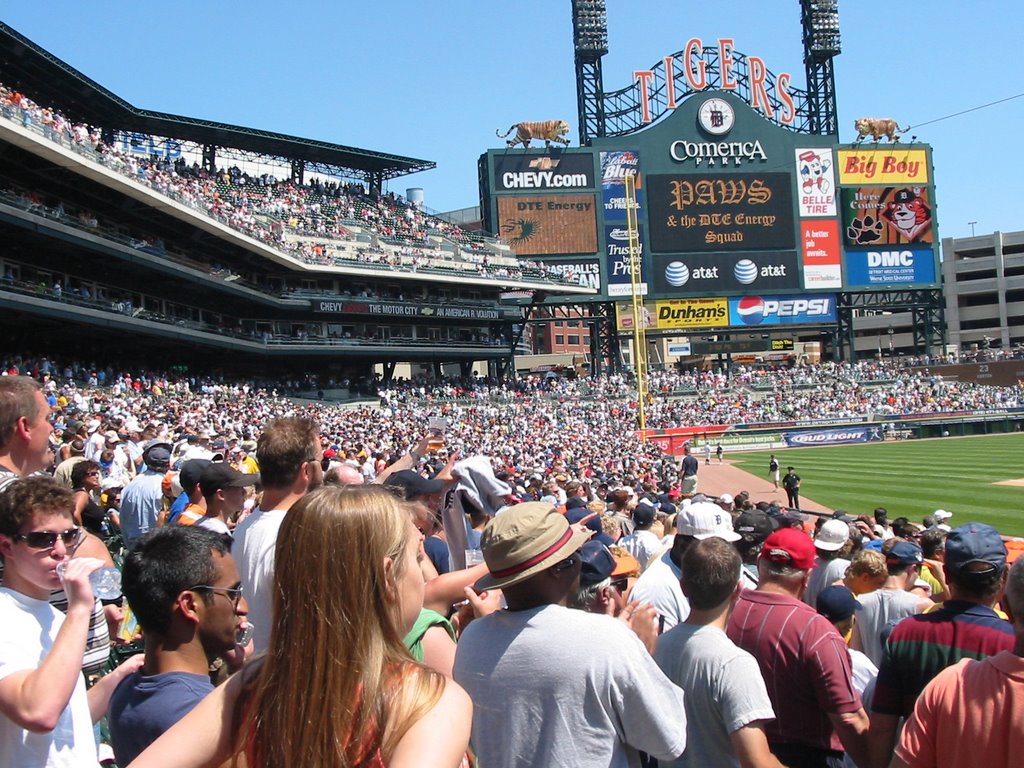
Today I visited the Detroit Tigers' new di
 gs for the first time. Okay, I guess the digs aren't so new anymore, but they're still new to me. Comerica Park is a veritable orgy of corporate logos. Cool off under the General Motors misters. Have a beverage on the Pepsi Porch. Little Caesars everywhere you look, of course, thanks to the synergy of the various Mike Ilitch (owner of the ubiquitous pizza chain, as well as the Tigers and Red Wings) holdings. No independent vendors out in the parking lot. No tailgating allowed. The latter, of course, perhaps having to do with Ilitch's hope that all will sate their pre-game appetites across Woodward at Hockeytown, his glossy sports and memorabilia bar.
Comerica Park is the antithesis of the old Tigers Stadium. No fancy suites. Park for a few bucks down Michigan Avenue. Get a cheap bag of peanuts outside of the stadium's gate. Afterword drink at the Gaelic League down the road. Opening days 1994 and 1995 I skipped out of classes to attend the games. Opening days attracted a notoriously rowdy crowd and I remember a guy tossing a toaster onto the outfield from the bleachers. Tiger Stadium, unused since 1999. Just tonight, Detroit's mayor announced he'll roll out a plan for the old stadium. Maybe the 'Little Caesars Pizza Pizza' Museum of Ancient
 Rome?
Rome?Enjoy the holiday snaps from this afternoon
at Comerica.
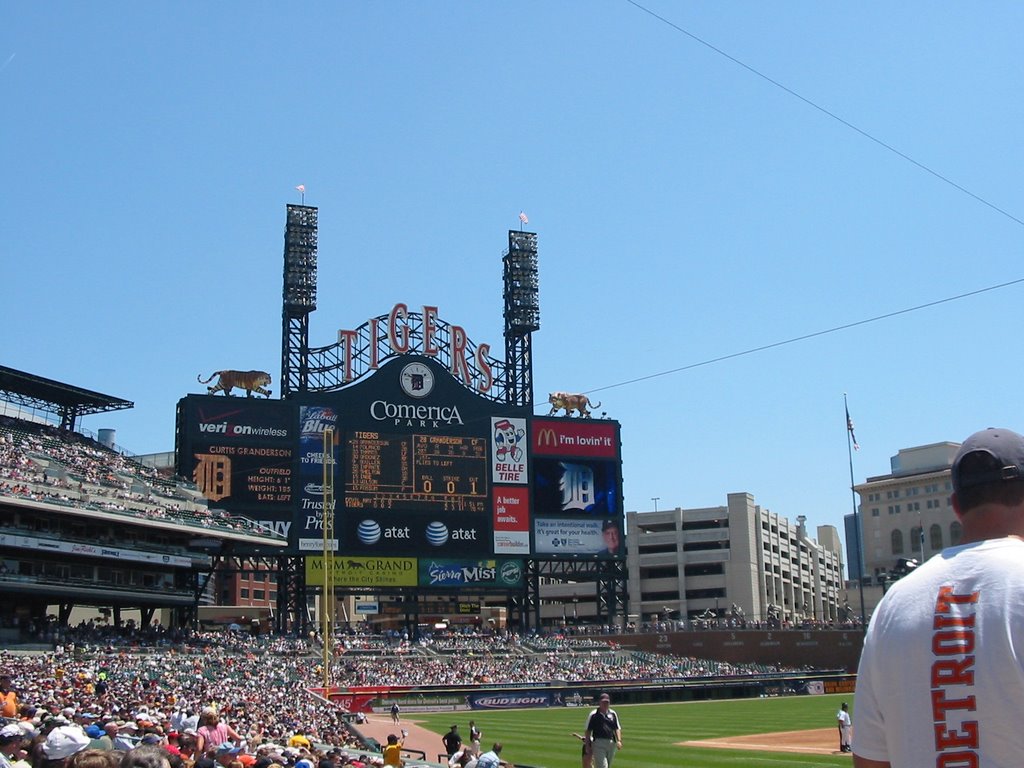
6/13/2006
writing as innovation
Met with my junior faculty writing group this afternoon for a leisurely lunch and set up our schedule for the rest of the summer. Like blogging, meeting with a writing group builds a structure (and a generative one at that) in which to write. A strategy for overcoming the temptation to delay writing. Being part of a writing group, like blogging, affirms what we know about writing: that innovation happens when we engage the process.
After writing group, I read with interest (my old friend from Arizona) Bill Endres' "Communicative Strategies for Administrative Practices: Evaluating Weblogs, their Benefits, and Uses" in the new WPA journal. Bill spends much energy in the piece foregrounding this idea of innovation--an idea bouncing around my head after today's meeting. Writing about administrative sites, Bill touts blogs' potential for innovation, a potential that grows from the technology's "media richness" (drawing on O'Kane et al). "Media richness" facilitates feedback, the affective components of language use, articulating multiple cues at once, and, really, language use writ large. Bill next turns to work in the diffusion of innovation and what I found interesting here was the idea that so-called "innovators" are those that can "cope" with "uncertainty."
Again, all ideas that jive well with what we tell students about writing. It's all about discovery and that which we find to be generative. Writing innovates. Writing copes with the uncertain. Writing contends with and grows out of media richess.
Less than a week until I leave for the Writing Project. For the past three summers, teaching teachers in this writing-intensive environment has provided me a media-rich environment, a safe place to innovate. I put these four weeks into a category with blogs and writing groups because of their generative possibilities. I anticipate what I might learn, discover, develop...write.
After writing group, I read with interest (my old friend from Arizona) Bill Endres' "Communicative Strategies for Administrative Practices: Evaluating Weblogs, their Benefits, and Uses" in the new WPA journal. Bill spends much energy in the piece foregrounding this idea of innovation--an idea bouncing around my head after today's meeting. Writing about administrative sites, Bill touts blogs' potential for innovation, a potential that grows from the technology's "media richness" (drawing on O'Kane et al). "Media richness" facilitates feedback, the affective components of language use, articulating multiple cues at once, and, really, language use writ large. Bill next turns to work in the diffusion of innovation and what I found interesting here was the idea that so-called "innovators" are those that can "cope" with "uncertainty."
Again, all ideas that jive well with what we tell students about writing. It's all about discovery and that which we find to be generative. Writing innovates. Writing copes with the uncertain. Writing contends with and grows out of media richess.
Less than a week until I leave for the Writing Project. For the past three summers, teaching teachers in this writing-intensive environment has provided me a media-rich environment, a safe place to innovate. I put these four weeks into a category with blogs and writing groups because of their generative possibilities. I anticipate what I might learn, discover, develop...write.
6/11/2006
dogville
I'm arriving extremely late on this one, but wanted to rave about Lars von Trier's Dogville, which I finally saw last night. Above all, von Trier shows his wide, all-encompassing ambition, thematically taking on gossip, violence, labor, exploitation, religion, small-town Americana, on and on. An amazing piece of work.
von Trier dismisses ethos, seeming almost giddy about opening himself up to critique. The American press likes to point out that von Trier's never set foot on American soil yet fancies himself qualified to comment on Americana. Little wonder he uses the 'everything but the kitchen sink' approach in Dogville. If you're going to offer an audacious look at our psyche, then you may as well spel audacious with a capital A.
Similarly, von Trier enters into a bombastic relationship with his audience. He provokes, prods, and challenges. Ok. Lots of directors do. But von Trier doesn't seem to like his audience. He has no desire to make us like him. He actively tries to alienate. I'm reminded of the twenty-minute cover of "Sister Ray" that Joy Division used to perform at their shows.
Indulgent? Yeah, that's kind of the point.
von Trier dismisses ethos, seeming almost giddy about opening himself up to critique. The American press likes to point out that von Trier's never set foot on American soil yet fancies himself qualified to comment on Americana. Little wonder he uses the 'everything but the kitchen sink' approach in Dogville. If you're going to offer an audacious look at our psyche, then you may as well spel audacious with a capital A.
Similarly, von Trier enters into a bombastic relationship with his audience. He provokes, prods, and challenges. Ok. Lots of directors do. But von Trier doesn't seem to like his audience. He has no desire to make us like him. He actively tries to alienate. I'm reminded of the twenty-minute cover of "Sister Ray" that Joy Division used to perform at their shows.
Indulgent? Yeah, that's kind of the point.
6/09/2006
getting ready for Ohio
One week from today I'm off to Oxford, OH. for a month of Writing Project. Five-days-a-week, six-hours-a-day in class doesn't leave much time for other writing, but I'm hoping to take a break from archival research and keep working on the Oates article as well as a few creative things I've been thinking about. Aside from that, looking forward to shifting into Writing Project gear if for no other reason than how rejuvenating the program always feels. Working with K-12 teachers who care about writing. Enjoying the radically different classroom feel of OWP-ers, who in every way are colleagues moreso than they are students. Should be a good month.
6/02/2006
writing habits
Not down at the archives today. Instead, writing at home in the basement office. A nice space for writing:
- Old futon lugged from
- Big oak library table for a desk. From an auction in
- Arizona Wildcats popcorn tin. Nicole brought this home during, I believe, the 2001 NCAAs.
- Laptop. Back and forth between futon and desk.
- Framed print of Youngstown Vindicator from
- Ohio Writing Project mug.
- Various legal pads with notes from meetings, notes from reading, notes from sitting around at Caribou Coffee (the preferred spot when *both* the archives and home office have grown stale.
- Miscelaneous books, including autographed Billy Collins, Jim Daniels, Elmore Leonard, and Naomi Shihab Nye; some rhet/comp stuff I never took down to school; a stack of Joyce Carol Oates novels from the library.
- Record player and vinyl collection.
The latter may be the most important component of the writing room. I like to listen to records while writing. Getting up every twenty-five minutes or so to flip sides or change discs is just about perfect. I need to stand frequently, look away from the screen, stretch, move around. The music gives as much rhythm to my breaks as to the writing itself. This a.m., while writing: Mahalia Jackson-You’ll Never Walk Alone, Mahalia Jackson-Songs of Faith and Devotion, Split Enz-Mental Notes (their weird, Eno-esque, early stuff before Neil Finn joined the band, produced by Phil Manzanera of Roxy Music, GREAT art rock), The Fabulous Wailers-At the Castle.
6/01/2006
Sirc on hip hop
The other TETYC piece on which I'm vibing (forgive me if this is scattered)...
It's rather difficult to nail down just what Geoffrey Sirc's "Proust, Hip-Hop, and Death in First-Year Composition" is about. Sirc, whose work interesting, hard-to-classify work prompted a previous post, reflects on how his students' (and his own) interest in local hip hop reveals something about when writing is art. Sirc works to legitimate hip hop by underlining its emphasis on the local, its emphasis on death, its emphasis on something real, and even its emphasis on that which is fleeting/"also-ran."
Regarding the valuing of the local, here's a snippet: "Local hip-hop seems to keep it the realest, I think, because it's us in time. When I hear Slug chornicling his everyday life, I think, 'Hey, I've been to that drugstore,' ' Hey, I've bought records there,' 'Hey, I'm dying too.'"
How true. I think of Youngstown moments in literature and pop culture: Kerouac's reference to the pie and coffee at the diners of Ashtabula and Youngstown, Richard Pryor's routine about getting started at mafia-run taverns there, the rise and fall of Y'town's favorite son/the great punk icon Stiv Bators, Trafficant-as-icon, Henry Hill picking up a copy of the Youngstown Vindicator at the end of Goodfellas (Scorsese's homage to mobtown USA) during the voice-over about lousy sauce, and the Springsteen song. Detroit's moments are countless, but I think of the ones that have prompted identification/affinity in me: the poems of Jim Daniels, Joyce Carol Oates' Them (with its pomo framing device as a story of Oates' years teaching at U of D), Gridlockd with Tim Roth and Tupac, White Stripes mythology, and a thousand others.
Connections: place, pop culture, passion, and what Sirc calls "perfect moments." These converge and lead to, well, art.
I'm not sure what to make of the ending of the article where he gets all "cultural crisis" on us. I read Sirc as being sarcastic when he writes: "You have no idea how different I wish things were. Art? Give me a break...[few read poetry, go to museums, listen to opera]...[T]hat's my world, and I must respect the life and the fashions of the children." There's a strange positioning of hip hop as second best at the article's end. If they ain't got high culture, at least they got the poignancy of hip hop. Sarcasm, I think. The poignancy of the local is more than second best, more than a stand-in for art.
It's rather difficult to nail down just what Geoffrey Sirc's "Proust, Hip-Hop, and Death in First-Year Composition" is about. Sirc, whose work interesting, hard-to-classify work prompted a previous post, reflects on how his students' (and his own) interest in local hip hop reveals something about when writing is art. Sirc works to legitimate hip hop by underlining its emphasis on the local, its emphasis on death, its emphasis on something real, and even its emphasis on that which is fleeting/"also-ran."
Regarding the valuing of the local, here's a snippet: "Local hip-hop seems to keep it the realest, I think, because it's us in time. When I hear Slug chornicling his everyday life, I think, 'Hey, I've been to that drugstore,' ' Hey, I've bought records there,' 'Hey, I'm dying too.'"
How true. I think of Youngstown moments in literature and pop culture: Kerouac's reference to the pie and coffee at the diners of Ashtabula and Youngstown, Richard Pryor's routine about getting started at mafia-run taverns there, the rise and fall of Y'town's favorite son/the great punk icon Stiv Bators, Trafficant-as-icon, Henry Hill picking up a copy of the Youngstown Vindicator at the end of Goodfellas (Scorsese's homage to mobtown USA) during the voice-over about lousy sauce, and the Springsteen song. Detroit's moments are countless, but I think of the ones that have prompted identification/affinity in me: the poems of Jim Daniels, Joyce Carol Oates' Them (with its pomo framing device as a story of Oates' years teaching at U of D), Gridlockd with Tim Roth and Tupac, White Stripes mythology, and a thousand others.
Connections: place, pop culture, passion, and what Sirc calls "perfect moments." These converge and lead to, well, art.
I'm not sure what to make of the ending of the article where he gets all "cultural crisis" on us. I read Sirc as being sarcastic when he writes: "You have no idea how different I wish things were. Art? Give me a break...[few read poetry, go to museums, listen to opera]...[T]hat's my world, and I must respect the life and the fashions of the children." There's a strange positioning of hip hop as second best at the article's end. If they ain't got high culture, at least they got the poignancy of hip hop. Sarcasm, I think. The poignancy of the local is more than second best, more than a stand-in for art.
Kynard on response theory
Several interesting pieces of work in the latest TETYC, which is becoming one of my favorite journals in the field (thanks to the publication's increasing receptivity to theory and history).
First, Carmen Kynard's personally and ideologically engaged take on responding to student writing. In "'Y'all Are Killin' Me up in Here': Response Theory from a Newjack Composition Instructor/SistahGurl Meeting Her Students on the Page," Kynard offers a useful discussion of the relationship she develops with students via written feedback on drafts. A well-worn topic, to be sure, but Kynard's got some new things to say.
Kynard writes, "I am all up in students' debates, not vocally but polemically." She procedes to advocate more explicit, more argumentative, intervention in the ideological discovery that students go through during the writing process. She quotes from her students extensively, citing their drafts as they write about Bill Cosby's commentary on African-American community values, and also cites herself responding to the students. I'm fascinated by the tone of her feedback, unapologetically partisan and polemical. She writes to one bright student who critiques gangsta rap:
Later on in the piece, Kynard admits to occasionally castigating a student, including one young woman who appeared in a sexually explicit music video. "I damn for sure put my best foot forward, threatened her, put the fear of God in her, and cussed her out something lovely for having her booty all up on a BET video. I guess some things you just can't nice up."
One problem (among many potential problematics) is that Kynard's approach seems to neglect the meta. I understand her justification for getting up in students' debates, but wonder if this practice leaves room for developing a meta-awareness, of process and working on a meta-cognitive vocabulary of the technologies/processes/genres/contexts of writing. I *also* intervene in the ways Kynard describes, but with less of an eye on polemics (although I certainly do challenge students' positions) and more of an eye on what I see happening with them as writers. Again, you can't neatly separate the "writing" from the "thinking" from the "existing as a politically situated member of the human family," but I feel like my contribution as the teacher of writing and rhetoric transcends a kind of "have you considered this?" mode.
Another problem, for me, is Kynard's foregrounding of argument. Why the allegiance to the thesis, to the linear polemics of the position paper, to the mythic world of argument? I'd be interested to see Kynard's article grafted onto a pedagogy of *generative analysis*, instead of a pedagogy of argument.
Again, extremely interesting article. Well worth checking out and reading alongside some of the foundational comp studies work in responding to student writing--a body of literature that Kynard herself nicely reviews.
First, Carmen Kynard's personally and ideologically engaged take on responding to student writing. In "'Y'all Are Killin' Me up in Here': Response Theory from a Newjack Composition Instructor/SistahGurl Meeting Her Students on the Page," Kynard offers a useful discussion of the relationship she develops with students via written feedback on drafts. A well-worn topic, to be sure, but Kynard's got some new things to say.
Kynard writes, "I am all up in students' debates, not vocally but polemically." She procedes to advocate more explicit, more argumentative, intervention in the ideological discovery that students go through during the writing process. She quotes from her students extensively, citing their drafts as they write about Bill Cosby's commentary on African-American community values, and also cites herself responding to the students. I'm fascinated by the tone of her feedback, unapologetically partisan and polemical. She writes to one bright student who critiques gangsta rap:
I feel what you're saying about rap music, really I do, but, for me, it is often used as a scapegoat because that is much easier than engaging a materialist critique of racism. We will chat more about that later in the semester so bring this up again and now you KNOW that I will call you out if you try to hide your opinions. Right now, I'll just limit myself to your comments on Bill Cosby and family values and tell you how I feel about all of that. Truth be told: I'd rather be with a brother like 50 Cent (assuming his media image is him anyway). At least he lets you know he's a womanizer. Bill Cosby really ain't doin' that much different with the ladies than 50 Cent if you ask me. He just knows how to cover it up in a kind of bourgeois Bill-and-Hillary-Clinton kind of way because the brother, married and all, done chased down more women than Jello puddin' pops.Kynard admits she wouldn't be quite so blunt with all of her students. This particular student, she writes, is especially bright and also open to verbal sparring with her. Again, the tone fascinates me, the emphasis on creating an (agonistic) agora-like space on the margins of student work. Kynard justifies this practice by talking about what a "dummy run exercise" it is to have students *imagine* opposing views.
Later on in the piece, Kynard admits to occasionally castigating a student, including one young woman who appeared in a sexually explicit music video. "I damn for sure put my best foot forward, threatened her, put the fear of God in her, and cussed her out something lovely for having her booty all up on a BET video. I guess some things you just can't nice up."
One problem (among many potential problematics) is that Kynard's approach seems to neglect the meta. I understand her justification for getting up in students' debates, but wonder if this practice leaves room for developing a meta-awareness, of process and working on a meta-cognitive vocabulary of the technologies/processes/genres/contexts of writing. I *also* intervene in the ways Kynard describes, but with less of an eye on polemics (although I certainly do challenge students' positions) and more of an eye on what I see happening with them as writers. Again, you can't neatly separate the "writing" from the "thinking" from the "existing as a politically situated member of the human family," but I feel like my contribution as the teacher of writing and rhetoric transcends a kind of "have you considered this?" mode.
Another problem, for me, is Kynard's foregrounding of argument. Why the allegiance to the thesis, to the linear polemics of the position paper, to the mythic world of argument? I'd be interested to see Kynard's article grafted onto a pedagogy of *generative analysis*, instead of a pedagogy of argument.
Again, extremely interesting article. Well worth checking out and reading alongside some of the foundational comp studies work in responding to student writing--a body of literature that Kynard herself nicely reviews.
Subscribe to:
Posts (Atom)