e-mail me at billdeg@umich.edu

6/01/2006

Kynard on response theory

Several interesting pieces of work in the latest TETYC, which is becoming one of my favorite journals in the field (thanks to the publication's increasing receptivity to theory and history).

First, Carmen Kynard's personally and ideologically engaged take on responding to student writing. In "'Y'all Are Killin' Me up in Here': Response Theory from a Newjack Composition Instructor/SistahGurl Meeting Her Students on the Page," Kynard offers a useful discussion of the relationship she develops with students via written feedback on drafts. A well-worn topic, to be sure, but Kynard's got some new things to say.

Kynard writes, "I am all up in students' debates, not vocally but polemically." She procedes to advocate more explicit, more argumentative, intervention in the ideological discovery that students go through during the writing process. She quotes from her students extensively, citing their drafts as they write about Bill Cosby's commentary on African-American community values, and also cites herself responding to the students. I'm fascinated by the tone of her feedback, unapologetically partisan and polemical. She writes to one bright student who critiques gangsta rap:
I feel what you're saying about rap music, really I do, but, for me, it is often used as a scapegoat because that is much easier than engaging a materialist critique of racism. We will chat more about that later in the semester so bring this up again and now you KNOW that I will call you out if you try to hide your opinions. Right now, I'll just limit myself to your comments on Bill Cosby and family values and tell you how I feel about all of that. Truth be told: I'd rather be with a brother like 50 Cent (assuming his media image is him anyway). At least he lets you know he's a womanizer. Bill Cosby really ain't doin' that much different with the ladies than 50 Cent if you ask me. He just knows how to cover it up in a kind of bourgeois Bill-and-Hillary-Clinton kind of way because the brother, married and all, done chased down more women than Jello puddin' pops.
Kynard admits she wouldn't be quite so blunt with all of her students. This particular student, she writes, is especially bright and also open to verbal sparring with her. Again, the tone fascinates me, the emphasis on creating an (agonistic) agora-like space on the margins of student work. Kynard justifies this practice by talking about what a "dummy run exercise" it is to have students *imagine* opposing views.

Later on in the piece, Kynard admits to occasionally castigating a student, including one young woman who appeared in a sexually explicit music video. "I damn for sure put my best foot forward, threatened her, put the fear of God in her, and cussed her out something lovely for having her booty all up on a BET video. I guess some things you just can't nice up."

One problem (among many potential problematics) is that Kynard's approach seems to neglect the meta. I understand her justification for getting up in students' debates, but wonder if this practice leaves room for developing a meta-awareness, of process and working on a meta-cognitive vocabulary of the technologies/processes/genres/contexts of writing. I *also* intervene in the ways Kynard describes, but with less of an eye on polemics (although I certainly do challenge students' positions) and more of an eye on what I see happening with them as writers. Again, you can't neatly separate the "writing" from the "thinking" from the "existing as a politically situated member of the human family," but I feel like my contribution as the teacher of writing and rhetoric transcends a kind of "have you considered this?" mode.

Another problem, for me, is Kynard's foregrounding of argument. Why the allegiance to the thesis, to the linear polemics of the position paper, to the mythic world of argument? I'd be interested to see Kynard's article grafted onto a pedagogy of *generative analysis*, instead of a pedagogy of argument.

Again, extremely interesting article. Well worth checking out and reading alongside some of the foundational comp studies work in responding to student writing--a body of literature that Kynard herself nicely reviews.

5/25/2006

wdet rebounding?

WDET, the local NPR station, cut back on its (outstanding) music programming earlier this year, opting to air during the day the same national programming that can be heard down the dial on the Ann Arbor affiliate. For decades 'DET had exposed Detroiters to local rock acts, old-time blues and gospel, and various electronic genres. The shift in programming disappointed many a music fan in these parts.

Just announced, very good news from the station. Local icon Mick Collins will launch a Saturday evening show called "Night Train" on June 3rd. Collins led the great '90s band The Gories and currently fronts the best Detroit band in the biz, The Dirtbombs. His show will likely be necessarily listening and, thanks to the online stream, will surely attract worldwide attention. Story at WDET's website.

random shuffle

soundtrack from the treadmill this morning:
  • dead kennedys, "holiday in cambodia" (fresh fruit for rotting vegetables)
  • black nasty, "party on 4th street, pt. 1" (funky funky detroit compilation)
  • ice cube, "it was a good day" (the predator)
  • big mama thorton, "hound dog" (the peacock recordings)
  • pavement, "in the mouth a desert" (slanted and enchanted)
  • jay-z, "hola holvito" (the blueprint)
  • clap your hands say yeah, "let the cool goddess rust away" (cyhsy)
  • new pornographers, "twin cinema" (twin cinema)
  • neil young, "cripple creek" (after the goldrush)
  • big mama thorton, "stop a-hoppin' on me" (the peacock recordings)
  • gram parsons, "i can't dance" (grievous angel)
  • etta james, "can't turn you loose" (etta james)
  • dee edwards, "i can deal with that" (searching for soul compilation)

5/23/2006

Chelsie on The Da Vinci Code

Chelsie, a former student of mine back in Ohio and a smart scholar of both Ginsberg and the British music press, with an interesting take on the Da Vinci Code phenomenon.

5/22/2006

usable past

Tonight I attended a Catholics for the Common Good event focused on organizing for November's elections here in Michigan. CCG works to promote civic action among progressive Catholics in Detroit. One of the evening's themes, locating a "usable past," echoed one of the prime reasons I began researching the histories of rhetoric and the rhetorics of history.

In theory classes back in grad school, Tom Miller used to emphasize the imperative to find alternative archives--texts, traditions, bodies of knowledge--that we can use to transform a particular rhetoric into a social praxis. For Miller, that transormation toward praxis involves avoiding the tendency to canonize as well as the tendency to vilify. So I took from Miller a vocabulary and methodology centered on locating usable pasts. The history of open-access education became a usable past for thinking through remediation and working-class encounters in higher ed. This summer, as I dig through the archives down at the Reuther, in the back of my mind: the words "usable past."

So I was struck tonight by the convergence. Speakers at the CCG event spoke about the need to make use rhetorically of the "usable past" of the Catholic social justice tradition, notably papal encyclicals like "Rerum Novarum," the influential 1891 letter in which Leo XIII critiqued the effects of the Industrial Revolution on the working classes (I'm using excerpts from this as well as John Paul II's early 1980s "Laborem Exercens," aka "On Human Work," in my honors working-class studies course in the fall).

Much of this corpus/archive/rhetorical tradition centers on the theological notion of the 'common good': civic duty, the sum total of all social conditions which allow all members of society to access resources that reach economic and social fulfillment.

So, how to turn this tradition into a usable past for defeating, for example, the Michigan Civil Rights Initiative, the euphemistically named anti-affirmative action bill in our state. How to turn this tradition into a usable past for slowing down the radical cuts in state expenditures to higher education in the state (since 2000, $226 million fewer public dollars to Michigan colleges and universities). How to turn this tradition into a usable past for resisting English-only and anti-immigration initiatives. Regarding the latter, we looked at John XXIII's Pacem in Terris tonight. Here's an excerpt:
every human being...must be permitted to emigrate to other countries and take up residence there. The fact that he is a citizen of a particular State does not deprive him of membership in the human family, nor of citizenship in that universal society, the common, world-wide fellowship of men.
Sounds an awful lot like a usable tradition.

5/20/2006

remember this test question...

Which of the following is the best title for this story?

What a ridiculous query. A classic (and, sadly, enduring) question for junior high language arts reading comprehension tests. I had forgotten about this testing nugget until yesterday when my twelve-year-old nephew critiqued the question's validity. What does this question ask for? Basically my opinion about what make an interesting title for some three-paragraph short story. I wanted to advise him to write in his own answer, something smarmy like "On Test-Takers Who Are Smarter Than Tests," or maybe "I Don't Know of Any Instances of Quality Fiction Whose Titles Are Perfect Plot Summaries."

I wonder if the writers of these tests came up with Snakes on a Plane.

5/17/2006

transcending normativity

David Wallace's piece in the new CE ("Transcending Normativity: Difference Issues in College English) interests me very, very much, as I've been writing--when I'm not digging in the Reuther archives--about race-class intersections here in Detroit (the identity politics of local garage bands, memoirs like Made in Detroit, the iconography of the D's mayoral archetypes, etc.).

Wallace's project is odd and, heck, I dig odd stuff. He really 'takes on the field,' a la Steve North back in the day, suggesting we haven't recognized the "limits of our subjectivities" or made "understanding systemic difference a foundational part of our scholarly and pedagogical practice." This, Wallace says, despite our theoretical allegiance to difference issues. He looks at three volumes worth of CEs and finds little explicit, authorial identification (beyond "shallow identification") with specific race, class, religious, sexual identity, etc. groups. Likewise, Wallace finds "spotty" references to those same identity issues in the subject matter of articles.

Wallace's project is quantitative, and he actually counts references to sex, race, class, etc. (an average of 4.26 references per page, for those keeping score at home). Here, too, coverage of difference issues is "shallow," in Wallace's analysis.

My concern is that Wallace subscribes so enthusiastically to the existence, stability, and usefulness of familiar identity markers. No mention of post-identity theories. Likewise, little attention to intersectional analysis as a critical lens. Wallace ends up with a thesis (because of both the materiality of privelege and the limitations of subjectivity, compositionists "need" to transcend normativity by attending to identity in our representations of self and others) that says DO MORE. More identity.

If the field's attention to identity politics has been weak (and I agree with Wallace: it has), why not look at identity differently? I'm puzzled by the argument (especially an argument about difference!) that says DO MORE instead of DO IT DIFFERENTLY. Let's look more at materiality. Let's look at how the familiar markers have failed us in various ways. Let's look at intersections (more on this if I ever finish that essay on Detroit). Let's look at venues, texts, and practices that suggest identity is not only socially constructed but socially obsolete and socially/materially ineffectual.

These reactions to Wallace's article are all pretty half-baked--just thinking out loud. Again, this is not to dismiss Wallace's article, which was interesting and useful.

5/16/2006

the blues are still blue

Who do you have to talk to about getting a single sunny day in Detroit? Hard to avoid the blues after nearly a week of rain and too-damn-cold-for-May weather. Detroit this week feels like Seattle without all the yuppies.

Also accounting for the blues, the overwhelming sense that my 22-year-old van may finally be reaching the end of the line. The inner core of the ignition has collapsed, which means the key (which Nicole somehow managed to jam in) must stay in the ignition at all times. This on top of all its other ailments. Gambling man that I am, on my research days I've been parking the car down at Wayne with the key in it. So far, no takers. If you have seen the van, you will not be at all surprised by this.

In less bluesy business, met my sociologist pal Paul down at Cass Cafe for lunch yesterday and enjoyed CC's signature lentil and walnut burger. Paul and I talked about putting together a proposal for a course we'd like to co-teach at Dearborn on Work & Identity. Paul is working on an ethnography of heroin addicts in the city, among other important projects. A great colleague.

My alma mater, a place that can't seem to retain a compositionist, is hiring for the umpteenth time and an old friend there asked me why I didn't apply and, while the romantic-nostalgic side of me would love to be back there, I didn't have much trouble answering her question. Dearborn is not a perfect place but the teaching I do here genuinely excites me and I wrote more in the past year than I've done in any single year since graduate school. So I think I'll stick around.

5/11/2006

today's research

"Even if they don't learn anything it keeps their minds occupied and gives them something to do and this way keeps them off the street and out of mischief." --A student in 1935 evaluating Detroit's experimental, free, Depression-era "freshman college."

I came across that in the archives today and the quote is not at all anomalous. One of the things I'm finding is that instructors, administrators, reps from the Federal Emergency Relief Administration and the WPA (the college was a New Deal program), and most especially students all felt that one of the great services of the program was keeping the unemployed busy and out of trouble. Today my research centered on student evaluations of the program, and words like loafing, idleness, wastefulness and even unuseful and unhealthy pasttimes kept popping up on the evals, referencing what students would be doing were it not for the freshman college.

Sociologist Burton Clark later called this the "cooling out" function of education in working-class communities, a trend Ira Shor has written extensively about. What I find striking, though, is the extent to which this rhetoric was rehearsed by the students themselves. Not a top-down mandate, but rather a trope that students relied upon to represent their relationship to higher education.

Back to the Reuther tomorrow a.m.!

5/10/2006

depressing quote of the week

From EW's review of the new Red Hot Chili Peppers record:
Stadium Arcadium ensures that graying Lollapalooza-era fans, indie teens, and rowdy lunkheads will all be satisfied.
Graying Lollapalooza-era fans? Ouch.

5/09/2006

Hard Lessons review

The E.P. format suits the brand of old-fashioned, non-pretentious rock and roll of The Hard Lessons. The band's new five-song, "Wise Up," doesn't waste a moment, cycling through a pair of rave-ups, a couple ballads, and a final rave-up for good measure. The Hard Lessons are three Detroit-area teachers and old college chums who last year decided to leave the classroom to rock out full-time. Their stripped-down but rich sound consists of guitar, drums, organ, along with shared vocal duties. The trio has gained a loyal local following by playing dance-friendly, audience-participatory, all-ages shows at schools and VFW halls as well as bars and clubs.

Oftentimes, bands like The Hard Lessons that become known for their high-energy live performances put out lackluster releases that reveal lots of showmanship but less musical prowess. Not so The Hard Lessons. "Wise Up" boasts tight performances from all three members, with Ko Ko Louise's organ sounding especially vivid. The two ballads, "It Bleeds" and "Move to California," are highlights, both spinning heartbreak yarns--stories populated by round, real characters. The latter is a great example of The Hard Lessons' characteristic, male-female duets, with vocal duties vollying between Ko Ko Louise and Augie the guitarist. Well worth a listen, and if you're in the Detroit area, check them out at Flint's Local 432 on May 27 or Ferndale's Magic Bag on June 10.

5/08/2006

only the names, locations, and events have been changed

Right-wing Vatican official Angelo Amato has gotten lots of press calling for Catholics to boycott the DaVinci Code film. It should be noted that Amato heads up the Congregation for the Doctrine of the Faith, a Vatican office that attempts to maintain a particular vision of Catholic dogma, one rooted less in Christian scripture and the social justice tradition and more in a medieval, church-as-rules-and-regulations model. Pope Benedict spent most of his career working for the same office.

Interestingly, all commentary on this rhetorical moment seems markedly simplistic. The Vatican's position--the novel and film are full of "lies"--of course demonstrates a bizarre lack of genre awareness. What, after all, does it mean to say a work of fiction is untrue? Few in mainstream society are taking the Vatican's calls for a boycott seriously, but the response--hey, it's just a book--is equally devoid of much analysis. And the academic world, of course, won't touch DaVinci Code for fear of being associated with such a low-brow text. (About three years ago I immediately went and got DaVinci Code from the library and read--and also enjoyed--it in a single weekend after I overheard colleagues at a department meeting at my former institution chatting about how they'd never get caught reading the crap their students read.)

DaVinci Code is a work of fiction, a narrative that plugs into the culture's optimistic and mythic hope that state apparatuses indoctrinate us through grand conspiracies, not through everyday practices. And speaking as a lifelong Catholic, the narrative also plugs into frustration with the persistence of the hierarchical, patriarchal structure of the Catholic church. The novel's success stems in part from the irony that Jesus spent his lifetime engaged in a ruthless but kind critique of religious hierarchy and then had his name attached to an even more vast and dominant hierarchy.

Archbishop Amato has recently said:

Christians should be more willing "to reject lies and gratuitous defamation."

He said that if "such lies and errors had been directed at the Koran or the Holocaust they would have justly provoked a world uprising."

He added: "Instead, if they are directed against the Church and Christians, they remain unpunished."

Now, that needs some unpacking because, again, the hey, it's just a book response just isn't enough. Amato tries to play the "reverse racism" card, implying that popular culture never disses the Jewish or Muslim faiths. Regarding the latter, check out nearly any Hollywood action film from the 1990s, Archbishop! Remember the scene in "True Lies" where dozens of Arabic Muslims pray over the nuclear warheads as they pack them into crates of priceless art for smuggling purposes? Such a scene became virtually cliche in most Schwartzenegger films from the era. Both Islamaphobia and anti-semitism are still pervasive.

But the chilling part of the quotation is Amato bemoaning that negative representations of Christians go "unpunished." How, exactly, should we "punish"? Who should we "punish"? Of course Amato is likely referring to economic punishment via a boycott, but it's telling that Amato has no qualms about using a violent, bellicose discourse. We should think about the significance of representations of Muslims, Jews, Catholics, and other Christians. Representations matter, whether they appear in non-fiction or fiction venues. But those genres do matter. And historical context also matters. Sorry, Archbishop, an anti-semitic representation has a different kind of weight than what you perceive to be an anti-Catholic representation. But anti-Catholicism *also* has historical weight in the U.S. where the KKK came to prominence in particular cities and regions (like my hometown) precisely to oppress Catholics (like my great-grandparents).

See, that's the point. There are lots of "but"s involved here. A complex rhetorical moment, one that I fear humanists will shy away from because they see this novel and film as being too lowbrow to care about. Perhaps the DaVinci Code film might consider cribbing the tagline from Will Ferrell's hysterical Anchorman:"The following story is true. Only the names, locations, and events have been changed."

5/04/2006

hanging in the archives

Today was day #1 doing research down at the Reuther archives. Learning all I can about Detroit's "freshman college" initiative, a multi-site program that used wpa money to provide a free year of college education to the unemployed and their kids during the Great Depression. I'm in awe of the amount of information. (Usually one of the biggest challenges of working with open-access learning is the lack of archives--since these schools often run on tiny budgets and lack a physical plant, info doesn't get preserved the way it does at universities.) Literally scores and scores of folders full of stuff: meeting agendas, minutes from meetings, memos, planning documents, course catalogues, syllabi, student evaluations, student work, assessments, pyschological inventories, budgets, payroll data, etc, etc.

One of the emerging themes: the aggressive marketing of "special interest" (non-credit-bearing) classes. It's interesting to see in the planning documents the search for rhetorical strategies for decreasing baccalaureate aspirations (changing the name of the institutions to "community colleges" seems to be one such strategy). One leader writes, "The undefined hope for a college degree is characteristic of most high school graduates." There's a whole slew of English and writing classes that fall under this "special interest" rubric--a lot of belletristic stuff, vocational offerings of course, and then also classes with odd names like The Magic of Words. It's going to be fun research.

Favorite quote so far from the director of the program: "Dancing, as such, may not be offered. Any dancing which is a legitimate part of a Health Education class is permissable." (from a memo to teachers)

5/03/2006

scribbling on the bathroom wall

Last night the Michigan Coalition for Human Rights screened the mediocre Rich Media Poor Democracy as part of their Spring film festival. The usual talking heads complaining about the state of journalism: corporate owned, suffering due to massive consolidation, skewed toward the interests of big business, etc, etc.

I don't disagree with this assessment of mainstream news media, but I grow frustrated at the failure (futility?) of the 'critical documentary' genre: get Mark Crispin Miller or Noam Chomsky or Robert McChesney to sit in his office, surrounded by learned books, dressed in tweed, to summarize his latest book in front of the camera. Juxtapose with clips of Respected Journalists From The Past (Murrough works best, but Cronkite will do in a pinch). Add a clip of superficial media coverage of the WTO or Iraq war or UN Sanction protests. Add a clip of Tom Brokaw and his ilk fawning over an army general or CEO. Add a clip of celebrity "news" coverage. Stretch to either 50 or 75 minutes (coincidence that the length of these docs is usually the length of a college class?).

Sorry to sound harsh. Again, I'm on board...but I'm also bored. This genre is as pre-fab as the public relations genres that Miller, McChesney, et al often critique. Look at this "news article" that really just takes sound bites from press releases. How lazy. What a breakdown of objectivity. Presented as if it's legitimate information. More importantly, I'm struck by the genre's ineffectuality.

Anyway, Jack Lessenberry moderated the film and subsequent discussion. Lessenberry professes journalism at Wayne State and writes a weekly column in Detroit's alt weekly. Interesting writer. I've used his columns to teach irony and sarcasm. Lessenberry offered a useful (but again, not terribly original) formulation of the issue of media monopoly, suggesting that "deregulation" is a misnomer for something akin to regulation that benefits corporations instead of public interest. He's an engaging and funny speaker, too, and when one audience member suggested she had given up on countering the sad state of the media, Lessenberry asked why, if that's the case, she wasn't at home watching coverage of Lindsay Lohan.

But Lessenberry seemed completely disinterested in talking about podcasts, blogs, and even independent media. Why? He bemoaned the lack of solutions for the problems of media consolidation, but shut down discussions of new forms of media, giving the usual critique that online venues lack rigor. What about blogs?, an audience member asked. Nothing more than scribbles on a bathroom wall, Lessenberry replied. Now, Lessenberry was clearly reveling in his curmudgeonly persona, but still, I was struck by the lack of imagination, the lack of optimism, and the adherence to a nostalgic vision of media. Mostly I was just bummed.

5/02/2006

Colbert

This is making the rounds, but for those of you haven't seen Stephen Colbert at the White House Press Correspondents' Dinner, here it is.

My favorite part: "Let's review the rules. Here's how it works. The president makes decisions, he’s the decider. The press secretary announces those decisions, and you people of the press type those decisions down."

book meme

From blogos...

1. Grab the nearest book
2. Open it to page 123
3. Find the fifth sentence
4. Copy it onto your blog along with these instructions

"This surprised me."
(From Norah Vincent's Self-Made Man)

4/26/2006

finals week grading: a score card

25 portfolios done. Whew...

6 seminar papers & 21 final drafts of term papers still to go. Bring 'em on!

4/25/2006

violence on film

What do A History of Violence and Hostel have in common?

First and foremost, my impression of both films was shaped by the fact that I had just attended Michigan Pax Christi’s (a Catholic organization devoted to peace education and activism) statewide conference. Conference keynote speaker John Dear, a Jesuit priest, suggested in his address that no matter how counter-intuitive peace action may seem, we must continue to resist the culture of violence in which we live. Dear described a morning at his rural New Mexico home (he pastors several poor, rural churches there) several months ago when a local Army unit was preparing to deploy to Iraq by marching through the village chanting various military mantras (“sound off…one, two”—that kind of thing) all touting their ability to kill. Dear reported that he quickly threw on clothes, ran outside, stood in front of the unit, and asked them to refuse to kill. Later in his address, Dear discussed several versions of the Beatitudes (“Blessed are the meek…”) that translate the repeated line as “Stand up” instead of “Blessed are,” suggesting the pro-active nature of peace-making.

This was my personal context for viewing these two very, very different films and probably had everything to do with how I responded to them. History of Violence tells the story of a small-town diner owner who defends his café from two brutal thugs intent on robbing and brutalizing his customers. The protagonist, played by Viggo Mortensen, becomes a local hero and gains attention from the press and also from shadowy figures who may or may not be from his past. Mortensen offers a disturbing embodiment of how violence changes him—and how violence may or may not have shaped him. His performance is amazing, moving in and out of his shifting identities: small-town good guy, justified vigilante, ruthless tough guy. Ashton Holmes gives an equally multi-faceted turn as the protagonist’s teen-aged son, bullied at school until his father’s actions inspire him to fight back. David Cronenberg (Dead Ringers, Dead Zone, Scanners) directs, so black humor provides something other than levity or comic relief—the jokes instead offer wry commentary on American attitudes toward justice, community, and crime.

I’ve written before about my life-long love affair with horror movies, so I won’t go into any apologies for dropping two bucks on a piece of pulp like Hostel. Let’s just say the movie takes its aesthetic cues from ultra-violent Asian horror films. Two college kids backpack through Europe, engaging in raucous behavior that goes beyond teen-slasher-film sex and moves headlong into the realm of the exploitative. They end up in Slovakia, for example, because they hear that many of the men there died in “the war” (don’t ask—nobody claimed the film was a history lesson) and that the women are poor. That equoation adds up to "great place to score." Charming guys. The NYTimes review accurately pointed out that, once the carnage begins, it’s hard to feel sorry for these dudes. Anyway, they end up at a horrific dungeon-of-sorts where rich men from the western world can pay to commit murder in any way they see fit. Part “Most Dangerous Game,” part Dateline NBC special on atrocities that go on every day in Eastern Europe and southeast Asia. As an Asia-ultraviolent-wannabe, Hostel suffers the limits of its own genre: weak acting and predictable plot trajectory. But, on another level, the film meditates on what happens when capitalism comes to town overnight—not to mention what happens when the violent, the depraved, are given a playground.

Two meditations on violence. One, a great film. One, a poor film. But both in their own way confront the culture in which we find ourselves living. Stand up, peace-makers.

4/23/2006

Crowley Carnival, Post #1

I've never participated in a blog carnival, but, picking up on Jeff, Jenny, and Debbie, here goes...

Let me say that I find Sharon Crowley's Toward a Civil Discourse: Rhetoric and Fundamentalism to be a smart analysis of political discourse at the current cultural moment. Let me raise some questions that aren't meant to be dismissive of Crowley's argument or the value therein. Rather, I just want to bounce my experiences and ideas up against hers.

1. Does Crowley set up a false binary between liberalism and fundamentalism? Both groups rely a great deal on emotional appeal to advance agendas. I walked away from the early chapters of Crowley not really buying the rationality she seems to ascribe to liberals. The value system of a "liberal"--equality, individuality, personal freedom, free market, etc, etc--consists of tropes and ideologies that rely on an affective mythology to maintain their hegemony. I'm thinking especially about individuality and personal freedom--think of the visual images, the pop culture artifacts, the narratives that western culture has drawn on to keep the viability of those notions afloat. There's lip service paid to the rational in particular venues (news media's claims of "objectivity", empirical research, the justice system), but, honestly, is there much more than lip service? If not, then the gulf between liberals and fundamentalists is about something other than types of appeals.

In some ways, fundamentalism relies upon a LESS AFFECTIVE mode of circulation of values/ideas/narratives. Crowley acknowledges that fundamentalists attempt to conform to "a set of beliefs derived from a fundamentalist reading of the Judeao-Christian religious tradition" (3). Okay, but liberals proceed from a fundamentalist reading of hegemonic documents of western political economy, no? Fundamentalists rely much, much more on "logos" ("I am the word...").

2. Couldn't one make the argument that polarization is quite healthy for the practice of democracy? Certainly I share Crowley's concern over how issues are handled reductively, how folks are arguing at cross purposes, how much of the culture lacks a rhetorical vocabulary. But I'm not always comfortable with the "crisis tone" that Crowley utilizes. The blogosphere. DIY news media. Podcasting. There's also evidence that the democracy is thriving.

Sometimes Crowley seems to waiver between claims that there's a lack of debate and claims that there's a lack of particular kinds of debate. There's a kind-of liberal fear in the book about agonistic discourse. Crowley worries about "acrimonious" exchanges, for instance, and I have to ask: why exactly? Like I said, there are significant limits to models of civic discourse that reduce issues to sound bites, to black/white arguments. But I'm not sure the acrimony is a bad thing. Acrimony feeds the affective. Polarization can be productive.

3. Where is Lazere's "Rules for Polemicists" and Graff's "Teaching the Conflicts"? At times, I get the sense Crowley is *grasping* for a response (pedagogical, discursive, etc) to the current political climate. It seems like an ommission not to take up Don Lazere's and Gerald Graff's schemas for responding to many of the same symptoms that Crowley diagnoses (the reductivity, the polarization, the absense of rhetorical paradigms of analysis/argument). I wanted Crowley to situate her conclusion within some of these other models. Not necessarily pedagogical ones (though, again, I think Lazere's in particular is extremely useful), but within other attempts to rhetorically engage with troubling political moments.

4. What does it mean to define "beliefs" as necessarily being "useful to the believer" (69)? Crowley discusses this brand of conjecture as serving the person who makes the conjecture...really? Aren't "beliefs"--especially those put forth by fundamentalists--often in service to SOMEBODY ELSE? These beliefs serve larger, structural systems more than individuals. The tv evangelist getting rich off checks from senior citizens. The fiscal conservatives whose economic interests are advanced by "values voters. The beliefs aren't useful (materially at least) for the "believer" in these instances.

--

Ok, those are just some starting points for me. More later. Now, I can go read others' posts in more detail...

4/20/2006

Summer Plans

This afternoon I'll collect 25 portfolios from my creative writing students, this evening seven term papers from the master's students, and over the weekend 21 final drafts will trickle in from the first-year comp students. Tomorrow: three lengthy on-campus meetings, followed by setting up in the evening for Pax Christi Conference. Saturday at the conference: introduce a couple speakers, be a greeter, help serve lunch, take down/clean up afterward.

So, let me be the first to admit that talking about summer plans is probably premature, at least for the next five or six days. But I'm going to partake in such talk anyway...

1. Four weeks (mid-June to mid-July) teaching down in beautiful Oxford, Ohio, with the Ohio Writing Project--my third summer working with OWP. Leading the Writing Project workshop has been one of the best teaching experiences ever, so I'm flattered and thrilled they're having me back despite my leaving the buckeye state. And I'm staying in a Miami U. dorm, so I'm thinking late nights, cheap beer...the whole package!

2. Doing research on the Wayne State-Freshmen College initiative of 1934-1940. This will be the big scholarly project of the summer--and hopefully beyond. Wayne sponsored a "junior college" program in hopes of increasing educational access to the working poor during the worst years of the Depression. Little has been written about the initiative. Can't wait to dig in.

3. On the less-scholarly side of things (though there may be a paper in this, too), I'm going to try out the weekly Punk Rock Aerobics classes at the Belmont. Get your exercise, then hang out in a smoky bar and have a few beers. Makes sense, right?

4/17/2006

The Rejection

Getting a rejection letter stings. What's wrong with my writing? What's wrong with ME? Then the p&t anxiety kicks in. Oh no, was I working on this for the last eight months for nothing? More than anything, though, that sting stems from a desire to not be working in a vacuum. To be working on something generative, something of interest and use to a readership, something that's in conversation with other things and other people.

Most of the publishing I've done has been somewhat specialized (open admissions learning, rhetorics of social class), so I've placed articles with journals whose readership is likewise specialized. I got a rejection letter today from one of the Big Journals in rhet/comp. Actually, an e-mail from the editor outlining some suggested ways to make a major shift in the essay's organization and focus, and urging a resubmit. But it wasn't just a "revise and resubmit"--it was more like a "change things big time and then try again!"

So I'm not sure whether to return to more familiar pastures (I'm proud of the work and think I can place it elsewhere), or embark on major revisions and try to reach a larger audience. I like that the field has niches, sub-genres, etc, etc., but I'm also mindful of the value of articulating implications that go beyond niche.

Oh, and I'm also eager to start several big summer projects, at least one of which would have to wait if I re-visit said article in global ways. I'm wondering how others have approached choices like this.

4/12/2006

I've got the second best job

CNN and Money Magazine report on the 50 Best Jobs in America (sic):
1. Software Engineer
2. College Professor
3. Financial Adviser
4. Human Resources Manager
5. Physician's Assistant
6. Market Research Analyst
7. Computer IT analyst
8. Real Estate Appraiser
9. Pharmacist
10. Psychologist

Money grades occupations on four factors: Stress, Flexibility, Creativity, and Difficulty (which means difficulty in "breaking in"/actually getting a job. College Profs get a B for stress, A's for creativity and flexibility, and a C for difficulty. Of course the fine capitalists over at Money offer no critique of the over-reliance on exploited part-time labor, simply referring to the fact that the category includes "moonlighting adjuncts."

I'm interested in the categories, particularly the flexibility and creativity criteria, both of which are consistent with Michael Zweig's conception of social class as an indiciation of power and agency in the workplace. Zweig's thesis is that in the U.S., the majority of workers are "working class," due to this issue of agency. A line worker may make a boatload of money, but has little quantitative (mandatory overtime, etc.) or qualitative (routizined tasks, etc.) control. Money Magazine seems tuned in to the degree to which power/agency affect lifestyle, and "creativity" and "flexibility" both get at such issues.

The piece goes on:

What's cool Professors have near-total flexibility in their schedules. Creative
thinking is the coin of the realm. No dress code!

What's not The tick-tick-tick of the tenure clock; grading papers; salaries at the low end are indeed low.


Interesting representation of the job: "Yeeah, I can wear jeans. Boo, I have to grade all these papers." This could have been written by somedbody over at the Chronicle of Higher Ed!

4/11/2006

ohio road trip

Just got back last night from a too-quick trip down I-75 to my former school, Miami U. Melissa F., a student in the 'research methods in rhetoric and comp' and 'rhetorics of social class' seminars I taught in Spring 04 and 05 respectively, sat for the oral portion of her comprehensive exams...and performed swimmingly, speaking with authority on ethnography, working-class culture, literacy, and other sundry topics, and I was damn proud to be a committee member. Good work, M.

I was somewhat blue last night, thinking about how much I miss working with PhD students and, then, approaching Detroit's cityscape just past dusk, leaving down river behind and entering the city proper--the hotel yorba, the tamales of mexican village on one side; the ambassador bridge, memories of Worst Job Ever, the river, and, beyond that, canada on the other side--and then minutes later seeing from the freeway the lights circling the fox theatre marquee, I remembered why I left ohio behind.

One year ago, "Should I Stay Or Should I Go" looping in my head, sage advice: find your place, go where you're happy, and other things will fall into line.' I made a good choice. Hello again, motown.

4/08/2006

progress on article

Thanks to my good friend Luisa and also to members of my 'Investigating Academic Literacies' class for feedback on a very rough draft of article-in-progress. This a.m., over bagels and coffee ("Puerto Rico style") Luisa gave her usual, insightful suggestions on where to go next on the piece. And, I should add, I got to read her ongoing analysis of Latina Rhetorics. My grad class on Thursday also gave the draft a read--we're workshopping papers and, since it's such a small class, I'm taking part too.

I came home this afternoon and made lots of changes based on the feedback. Nice to be practicing what I preach in the classroom. Nice to have good readers around, too.

4/07/2006

photo essays

For the past two terms, I've been having first-year students compose photo essays using blogger. We discuss visual rhetoric for a few weeks, using mostly Detroit-area photobloggers as examples, and students put together their own projects, revolving around issues of concern to their own neighborhoods. I like the process for a number of reasons:
  • student engagement during peer review process. on days when we use class time for peer review, students make substantive comments and really engage with each other's work, giving global commentary
  • moves beyond analysis/consumption/spectator mode. the fy comp program where i did my graduate work was so rooted in Rhetorical Analysis (notice the capitals!) that for a long time i neglected writing-as-doing, as *production*-of-primary-texts
  • opportunity to foreground the local
  • transitions nicely into sustained attention to whatever issue students choose, as they move to a more traditional argumentation project (on the same issue) at the end of the term

Here's a few random samples. Enjoy...

Industrial Wasteland

Legacy Initiative

Graden City Library

Belleville High School: A Diamond in the Rough?

Abandoning Homes, Perpeatuating Problems

4/05/2006

dissin' the d

Et tu, onion.com? How can you play motown like that?

100 years old...

The age of the guy who cut my hair this morning. Okay, 99 years and 11 months. I go to the David Pressley beauty school in beauty-ful downtown Royal Oak and sign the requisite waiver that says that I won't sue regardless of what their students do to my head.

I usually get my hair cut there because of the low price and the great people-watching. Today one student two chairs down is graduating and the beauty school fills with balloons, flowers, and proud relatives chatting with the young, colorfully haired, beauticians-in-training. (Seeing the latter, I immediately flashback to May 2002, the night before my own graduation, when my parents, oddly, were hanging out with my dissertation committee at El Torero in Tucson...worlds were similarly colliding.)

The young woman cutting my hair frequently confers with her mentor who makes comments like "obviously this doesn't look good yet" and "that's not how we do this." My glasses are sitting on the counter nearby so, as is always the case when I get my hair cut, I have no clue what's happening. For whatever reasons, my hair is quite the challenge, so the mentor goes and gets...

Davis Pressley himself. He who is one month away from his one-hundredth birthday. A few years back David sold the beauty school he founded, but he still comes into the shop every day to cut some heads and teach the students who he clearly loves. David sports a very wide red necktie (I'm guessing he calls it a "necktie," not just "tie") with paisleys and I only understand about every third word he says.

Davis takes over the cutting and, man, is he moving quickly. Eventually he starts trimming my eyebrows and makes what I'm pretty sure is a crack about how, based on my facial hair features, I must be Italian. (Later, as he's brushing off my neck, he says he hopes no hairs fall in my spaghetti. So I'm pretty sure the earlier comment was indeed about my suspected ethnicity.) I smile.

He asks if I live in Royal Oak. I nod (bad idea when the scissors are close to the ears). He immediately begins to talk about how the population has gone down. He says what sounds like "The pale is doing its job" and gives quite the belly laugh. What? The pale? Is that some kind of racist... "Yeah, families only having one kid, or no kids," he offers. Ohhhh, the PILL is doing its job.

So a little commentary on birth control, the facial hair of my people, and the changing population of Royal Oak, PLUS a pretty decent hair cut. On my way out, I see the flyer advertising David's one-hundredth birthday party next month...a friar's club style roast.

I'm thinkin' about going...

3/29/2006

race, class, rock and roll part 2

This a.m., I worked more on article about race/class intersections in Detroit memoir, cranking out about two single-spaced pages on Erma Henderson's work, but I'm still thinking about integrating more on indie rock. Thought I had a neat and tidy article in the works, but I'm liking how this connection might complicae things. Maybe a wholly different article? Maybe a component of this same one. Dunno. Anyway, this is basically continued from yesterday, more on The Soledad Brothers (whose new album The Hardest Walk I'm enjoying very much)...

In that Guardian interview I talked about yesterday, Soledad Brothers also reference gender as an interlocking component of the futility of identifying solitary markers of difference as essential signifiers. Gender need not craft a particular narrative about empowerment, in this particular worldview. But the band does not ascribe transcendence of gender disempowerment to individual achievement, but rather through connection to the music and connection to a broader awareness. The blues are transcendent in a way that the liberal notion of the individual is not. The band references Rachel Nagy, frontwoman of garage rock covers band the Detroit Cobras, who creates an agonistic, aggressive persona on the stage, performing traditionally masculine rituals like making reference to sexual conquests and swearing. As the Soledad Brothers suggest, “nobody can mess with her.” (Reminds me of the scene in School of Rock where Jack Black's talking to "Turkey Sub" about her stagefright: "Aretha's a big lady too but people WORSHIP her")

Likewise Wendy Case, the frontwoman for another band associated with the Detroit scene, The Paybacks. Case writes lyrics that reject liberal notions of propriety and decorum. Gritty lyrics are not at all unusual in the world(s) of rock and roll, but Case’s lyrics specifically take up intersecting identity markers. For example, the song “Black Girl” appeared on the influential 2001 compliation Sympathetic Sounds of Detroit, produced by Jack White of the White Stripes in the months before they gained national attention. In the song, Case sings lines like “The blacker the berry the sweeter the juice,” in a build-up to a chorus that repeats the line, “She’s a real black girl.” Throughout, Case, a white woman leading a band of white males, extols the sexuality of African-American women. A moment of post-identity? A rejecting of liberal narratives about who does and does not possess cultural power.

Another song on the same compliation, “I’m Through With White Girls” by The Dirtbombs, takes up the same theme. The Dirtbombs track is filled with lines about “brown-skinned honies dancing” and “watching Soul Train on a Friday night,” all sung by a band comprised mostly of young white men, but fronted by Mick Collins, a veteran of the Detroit rock scene (formerly of great 90s band The Gories) who happens to be one of the few African-Americans associated with the movement. In their current incarnation, The Dirtbombs also feature an Asian-American woman playing bass.

So whose perspective does a song like “I’m Through With White Girls” come from? From the perspective of the white band members? The African-American band member? From the perspective of the primarily white audience? Is the song racist and/or sexist? Detroit garage rock likes to distance itself from earnest, socially conscious pop music, yet the Dirtbombs track foregrounds race and gender, stressing difference, emphasizing that both race and gender signify something. To liberal ears accustomed to platitudes about equality, the lyrics sound harsh and bombastic, more than a little offensive, perhaps reminiscent of Sly Stone in the 1960s, singing “Don’t Call Me Nigger, Whitey.” Key for the Dirtbombs lyric is the subversion of point-of-view, as the band calls attention to markers of identity (that of the multi-racial band, the “white girls” they sing about, the audience) in order to juxtapose shifting loci of attention. The song references Collins’ own African-American identity as well as the racist mythology of black men as a threat to white women. In the meantime, the lyrics highlight the white identity of much of the indie rock audience, allowing them to live vicariously the stereotypical markers of black life that the song outlines.

The latter relationship—the one between Mick Collins and his white fans—stands in as synecdoche for the contentious relationship between city and suburbs, perhaps the defining conflict of Detroit identity. Members of the Dirtbombs, like many members of Detroit’s rock scene, refer to growing up in the city (unlike hip hop stars like Eminem and Kid Rock), whereas their mostly white fan base resides primarily in Detroit’s suburbs. In the liner notes of the Sympathetic Sounds compilation, The Dirtbombs include in their list of band members Coleman A. Young. Instead of an instrument, Young’s band duties read simply “Mayor.” The liner notes joke alludes to Detroit’s long-time mayor, a polarizing figure loved by many African-Americans within city limits but despised by most whites living in the suburbs. Young utilized a rhetoric that sounded radical to most white ears, as he challenged the suburbs for siphoning resources and jobs from the black community in Detroit. When the compilation was released, Coleman Young’s successor, Dennis Archer (fair and full disclosure: I interned in ARcher's office in summer of 96), was in office. Archer used a much more conciliatory rhetoric and advocated cooperation between city and suburb. A moderate democrat, Archer embodied the liberal values of equality and tolerance. Like the Soledad Brothers associating themselves with a radical race consciousness, so too do the Dirtbombs suggest an aesthetic connection with a more radical political program, albeit in the context of a liner notes joke.

So 'whassup with all that?

3/28/2006

race, class, rock and roll

Detroit Cobras frontwoman Rachel Nagy:
I don’t think any of us come from money, so it’s like our parents didn’t go out to dinner and dancing on the weekends, they had house parties…We didn’t grow up in the suburbs, so it’s like you’ve got [African-America] music all around you. You grow up with it and it’s just kind of an afterthought in your subconscious.
I've been working on an article about several recent memoirs written by Detroiters. Another site--one I'd like to incorporate into the article--for considering how Detroit acts as a locus for intersecting identity markers is the city’s indie rock scene, especially the most recent wave of garage rock bands. The members of the bands are mostly white but they work within a black aesthetic: southern blues. In this way they cultivate a hybrid racial identity. This movement largely rejects the values of liberalism, liberal anti-racism, and essentialized narratives of race and class. Race consciousness and class consciousness are elements of the ethos projected by these bands. They wear the dual consciousness on their sleeves, often in self-conscious and self-referential ways. For example, the band Soledad Brothers, technically from outside Toledo, Ohio, but closely aligned with the Detroit scene, borrows its name from the famous offshoot of the Black Panthers, a militant Marxist prison collective. So their name invariably invokes a radical version of race awareness. In a recent interview with The Guardian, the band, whose members are all white, pontificated on intersecting identity markers and blues music:

The blues is nothing to do with colour. It’s to do with intelligence and cultural awareness…There are loads of white guys who’ve made shitty blues music, but there are loads of brothers who’ve made shitty blues music…Women can be bluesmen, absolutely. Some of our favorite shit is by
women—Memphis Minnie, Jessie May Hill—in the 1930s, they were singing songs about “every married woman’s got a backdoor man.” They didn’t give a f***, man. In 2006, there’s Eria Wennerstrom from the Heartless Bastards, and Rachel Nagy from the Detrot Cobras—nobody can mess with her. The blues is about if you’ve been through some shit and you feel what you’re playing.

It would be easy to dismiss the band’s comments as tangents, as attempts to articulate a mythology of equality in which race doesn’t matter. But they foreground something vague that they call “cultural awareness,” certainly a signifier for musical and artistic credibility, but also a possible referent to a consciousness that exists independent of the racial identity of the individual.

3/27/2006

march madness

What a year for college basketball. The best that I can recall, although I'm a little blue about Arizona not getting past the second round. I saw yesterday the last five minutes of regulation, plus overtime, of the George Mason-UConn game. Like a feel-good sports movie. Fluke? You don't get to the Final Four on a fluke. Remember, too, that George Mason beat three of the highest-prestige programs in the country: NC, UConn, and MSU. Having done my undergrad degree at a "mid-major," I couldn't help but cheer on a school I still know nothing about (where is their campus?). Saw part of the Florida-Villanova game, too. Was there a better player in the second weekend of play than Florida's Joakim Noah? Based on the last few days of play, I suppose smart money's on Florida edging out LSU for the championship. How'd I do with my brackets? Lousy for the most part. I did pick UCLA to still be standing, so I'm batting .250 on Final 4 picks.

3/26/2006

some 4C's randomness

Wednesday:
Best day of the conference. Rhetoricians for Peace all-day workshop, with a focus on propaganda. Illuminating discussions of LeBon, Freud, Lippman, Ellul (must read his "The Formation of Men's Attitudes"), and Lasswell. Most theoretically engaged of the three RFP workshops I've attended over the past three years. Wonderful short film: "Happiness Machines," from a four-part BBC series called Century of the Self. Film outlined the storied career of Edward Bernays, nephew of Freud, who fathered the modern profession of public relations. Bernays sought to channel Uncle Sigmund's notion of the "all-consuming self" and turn various inert desires into profit. Started out as press agent for Caruso, but made name for himself working for Woodrow Wilson's regime, crafting their WWI message. Responsible for turning public support toward entry into war by using a "make the world safe for democracy" message, a rhetoric markedly similar to that used during run-up to Iraq war. Bernays also known for breaking taboo on women smoking by creating soundbites like his famous "torches of freedom" line, meant to sell smoking to women as an act of independence. Bernays virtually invented the media event by planting debutantes with cigarettes at various civic events. Goebbels later used the writings of Bernays (notably his masterwork Propaganda) as a template. And Bernays worked with industry during New Deal era to shape a pro-business 'democracy=capitalism' message (e.g., "manufacturers built America") to try to squelch great society social programming. Must read Bernays' Propaganda, as well as Larry Tye's biography. Absolutely fascinating stuff.

Wednesday Night, Arizona party...catching up with various AZ pals: Tilly and John, Sharon, Marvin, Patty, Amy, Michael, Tracy, Glo. Later, very nice dinner at Italian Village.

Thursday:
WPA breakfast...catching up with John and John. Both wpa grants given to research teams led by folks who used to teach in Youngstown (yeah!). Keynote address, which was enjoyable without really saying much. Great session on the rhetoric of loyalty oaths (Karen Powers-Stubbs, Cathy Chaput, and Tina Whittle), outlining mandated signed oath policy for teachers at state schools in Georgia, contextualized by interesting discussion of Horowitz/right-wing movements against academic freedom. Usually hard to take these threats too seriously, until being reminded that policies like the oaths really do exist. Another good session: "Film, Print, and Physical Embodiment: Working Through Binaries and Toward Rhetorical Activism." There, Cynthia Ryan did a kind of show and tell of her work on African-American women's magazines, tracing symbiotic relationship of individual and community identity construction. Also, Kristie Fleckenstein walked through theory of osmosis as methodology of consuming visual rhetoric, using 'women in black' peace marches as her text. My old U of Detroit mentor Hugh Culik presented with Anna Culik on a dual-enrollment program for "at risk rich kids" from Grosse Point (tony Detroit suburb), which during the 90s (shortly after I graduated) used an electronic critique curriculum to engage disaffected kids who were failing out of high school but largely turned things around during the project (most graduated, went on to college, and several are in high-prestige grad programs now).

Went to publisher's party over at Field Museum. Neat gathering, which I usually opt out of, but did end up having a good time. Later Nicole and I had burgers and drinks at Miller's Pub--which fast became the official C's late-night gathering spot--with Jay and Heather.

Friday:
Misc. sessions, hanging out in book display area (staffing Rhetoricians for Peace table), pizza at Pizzano's (pretty good), prepping for presentation. Our panel went well. Roxanne had travel problems and didn't make it. Jay and Cindy talked through universal design theory and outlined anti-remediation writing course they've designed down at Miami. Stephanie Kerschbaum showed transcripts of peer review conversations that her students had during review of papers where she foregrounded attention to intersectional markers of difference. I talked through critique of Million Dollar Baby as a case study for intersectionality's use of juxtaposition and metaphor. Good feedback afterward, and we had a super audience (one of the largest audiences I've had at C's). Fun stuff.

Nap, followed by working-class studies special interest group. Irv Peckham and Leo Parascondola did short papers, but mostly sig co-chairs Bill Thelin and Jen Beech had participants discuss in small groups competing definitions of class and their respective usefulness within the academy. Important stuff, to be sure, though class studies often gets bogged down in the definition mud.

Miami U. party that night, and those cats at Miami are goodly enough to invite even *former* employees! Lots of catching up with my former grad students there (no fewer than four students from my 'rhetorics of social class' course last spring were presenting versions of their seminar papers from said class...good job guys!). Spririted conversation with John Heyda about the art, ethics, and general ins and outs of CD reissues...when outta nowhere the fuzz busts in. Yes, the fine security crew at the Palmer House--same folks responsible for the Being John Malcovich-esque only slower elevators?--shut down the fiesta due to noise complaints. We adjourned to the over-priced hotel bar and vowed to spread wild, hyperbolic rumors about why the party was broken up. Nicole and I went up to the rock and roll party (hadn't been to that in years) where the band that I'm pretty sure played at my brother's wedding in 1984 was wowing the crowd. Seriously, folks, if this mother's ever held in Detroit, I must convince the fine folks at McGraw Hill to show this crew what real rock and roll is (I'm thinking Detroit Cobras). We danced for about an hour (am I making stuff up, or did the band seque from Otis Redding's "Hard to Handle" into "Like a Virgin" at one point?), and turned in.

Saturday, made the drive back to motown in the a.m., thinking about Edward Bernays, intersectionality, and possibilities for next year's working-class studies sig.

3/20/2006

intersections, part II

Speaking of intersectionality, a taste of the introduction of my 4Cs paper:

--------
Above all, there is an ethical imperative to pursue intersectionality as both theoretical lens and methodology. Intersectionality provides nuance, complexity, and synergy to socially and politically engaged scholarship in and out of composition studies. A broader and more compelling understanding of oppressions, identities, and justice movements.

But, aside from the transformative ethics of intersectionality, I want to focus on what is pragmatically useful about intersectionality. First, intersectionality fosters a collaborative and dialogic spirit. Even a superficial review of recent literature in the area of intersectionality reveals a great deal of collaboratively written scholarship, and oftentimes these collaborations represent multiple disciplines. Likewise the theories and bodies of research this literature draws upon is varied. Less myopia, less in-breeding. More exchange between disparate perspectives.

Second, looking at multiple identity markers as they intersect can facilitate breaking down persistent, problematic essentializing moves. Moving in and out of race/ethnicity, class, gender, sexuality, ability and disability, and so on, can offer an alternative to linear and reductive narratives about identity—indeed intersectional analyses can create useful, theoretically engaging narratives of post-identity.

Finally, intersectionality provides specific counters to essentializing: juxtaposition and metaphor. It seems to me that identity markers can interact with one another in the context of intersectional scholarship as metaphors. Class as metaphor for race. Queerness as metaphor for disability. And so on. That is not to imply that one identity is more or less important. Metaphor does not necessarily—and in this context, should not necessarily—subordinate. Rather, the use of identity markers-as-metaphors opens up generative possibilities. Queerness opens up new understandings of difference and transgression. Class opens up new understandings of power.
---

Hear more:

J.16 Friday, March 24, 2006 3:30:00 PM to 4:45:00 PM
Mobilizing Intersections of Difference in Composition Research, Teaching, and Activism

Jacqueline Jones-Royster, Chair
1. Stephanie Kerschbaum, "Beyond Categorization: Using Markers of Difference to Enable Intersectional Analysis"
2. Roxanne Mountford, "Vertigo in the Field: Difference and the Ethnography of Relation"
3. Cynthia Lewiecki-Wilson & Jay Dolmage, "Intersecting Identities: Theories and Models of an Inclusive (Dis)Composition"
4. William DeGenaro, "Disability, Class, and Million Dollar Baby: The Possibility of Intersectionality"

intersections, part I

I was reading the new College English yesterday and finding Jill Swiencicki's "The Rhetoric of Awareness of Narratives" tremendouly interesting. Yet I was also wondering why Swiencicki glosses the race-class intersection. Writing about stories of coming to (race) consciousness, she quotes an internet discussion in which a participant says: "Nothing is going to change so long as white people feel they can evade the real issues with tangents about class and blithe proclamations about how they're certainly not racist..." What I find puzzling is that Swiencicki doesn't engage with this statement, nor with the whole race-class intersection.

Instead, she uses that quotation to posit the "tangents" as being somehow opposed to "self ... experience ... authentic antiracist work." Huh? Class as a tangent?

There's much that's useful in the article. Swiencicki analyzes the limits of "liberal antiracism" and "liberal social projects" (and the attendant tropes of guilt and shame--tropes which provide a kind of comfort and catharsis, but don't affect change). But I think she misses an opportunity, I think, namely the possibility that a critical, working-class consciousness can sometimes mediate the same limits she speaks of.
The shame/guilt tropes can provide a productive starting point, Swiencicki writes, when they lead to "self consciousness of how one's notion of self is contingent upon others in a power dynamic."

Yes, and understanding power through the lens of class (understanding class AS power) can aid in that consciousness.

3/16/2006

brackets

Busy getting ready for 4Cs, but I always make time for March Madness. Tucson nostalgia, as always, clouds my picks, and so I root for the Arizona Wildcats. And while the current crop of 'Cats lack the star power of the first few years of the milennium (tireless point guard Jason Gardner who used to average like 39.75 minutes-per-game, Gilbert Arenas now the all-star Wizard, Richard Jefferson now with the Nets, Loren Woods who broke shot-blocking *and* goal-tending records, old school Gene Edgerson who famously red-shirted so he could complete his student teaching and who now plays for the Globetrotters, Luke Walton who regularly beat up on his dad's alma mater)--my final years in Tucson--they go into the tourney with a record nearly identical to the record of the 1997 national championship Wildcats. So who knows?

Four early upsets: NC State over Cal, Bucknell over Arkansas, George Mason over MSU, UW-Milwaukee over Oklahoma. Stay tuned!

3/15/2006

conference travel

I'm getting ready to go to 4Cs next week, the first conference I'll attend as a representative of U of M Dearborn, and I'm thinking of the ways that academics must document their attendance at conferences for their home institutions.

At my former school, I got a per diem reimbursement for food, so no need for meal receipts, but I had to present receipts for conference registration, airline tickets, and the hotel. Okay, easy enough. But if you paid by credit card--and who doesn't use plastic when paying for such expenses?--you had to have a receipt AND the credit card statement with charges corresponding to the receipts. That meant 1) waiting to turn in paperwork until you received the statement the next month, 2) gathering multiple statements (the pre-paid conference registration charge from back in October, the "live" charges made at the conference during March, etc.), and 3) feedling your whole credit card statement into the University's bureacratic works (I blacked out the number with a marker, but there were always a weird array of charges listed on the statement that had nothing to do with the conference--yeah, yeah, I know, I could have gotten a credit card just for conferences, but I didn't, ok?). I always kiddingly gave the office manager a hard time, asking her if she thought I had worked out an elaborate plot to cheat Miami out of $400.

UMD doesn't have such a requirement, happily, but they *do* require that I save the conference badge, in order to prove there really was a conference. Yes, Margaret, there really is a 4Cs conference. And, really, how could anyone possibly fake a self-adhesive white sticker with his/her name typed on it? Not that I'm mad about it. It's a benign, albeit strange, request with which I'm happy to comply.

3/14/2006

toward historical memory

Neal Lerner in the current issue of Teaching English in the Two-Year College reports on a progressive writing laboratory that was an integral part of the U of Minnesota's General College in the early 1930s, narrating how the lab's writing-as-civic-action mission and process-oriented pedagogy reflected and contributed to the ethos of the new open-access campus. Those doing historical work in comp should have a look: "Laboring Together for the Common Good: The Writing Laboratory at the University of Minnesota General College, circa 1932."

But what thrills me about this article is the attention to history. TETYC has remained a largely ahistorical source of scholarship. (There are complex reasons for this, not the least of which is the relatively sparse archives at most two-year colleges and open admissions branch campuses. Many of these campuses began offering courses before the institution had a permanenet physical plant, so records, often, were lost. Plus, workload of course. Many practitioners at these institutions have heavy teaching loads, leaving little time to dig in the archives anyway.) The first peer-reviewed article I published appeared in TETYC about five years ago--Social Utility and Needs-Based Education: Writing Instruction at the Early Junior College--and I had a kind-of grad school fantasy at the time the piece would spur along huge amounts of historical research in the journal.

Didn't really happen and I subsequently had work (work that I succesfully placed elsewhere) rejected by TETYC for "not connecting enough with the two-year college classroom of now." Historical work provides context, serves as a starting point for praxis, fosters institutional memory, and helps us move beyond what Mary Soliday calls our notions of "always newness." Bravo to Lerner, and to the journal, for being receptive to such possibilities.

3/06/2006

what i did over spring break

Back to school tomorrow. So why not do a wrap-up...

Part I: Academic Stuff

1. Completed marketing report for Pitt. First book project's now in press at Pitt (finally!) and I had to complete a *lengthy* form. Didn't realize this would take so long, but I was glad to give a bit of input into the business side of the process.

2. Planned "Working with Sources" writing workshop for our master's in liberal studies students. Workshop this coming Saturday, and I'm ready to roll.

3. Graded a big 'ole stack of term papers.

4. Wrote two letters of recommendation.

5. Wrote most of the 4Cs paper. Not done yet, but I've got a few weeks.

Part II: Non-Academic Stuff

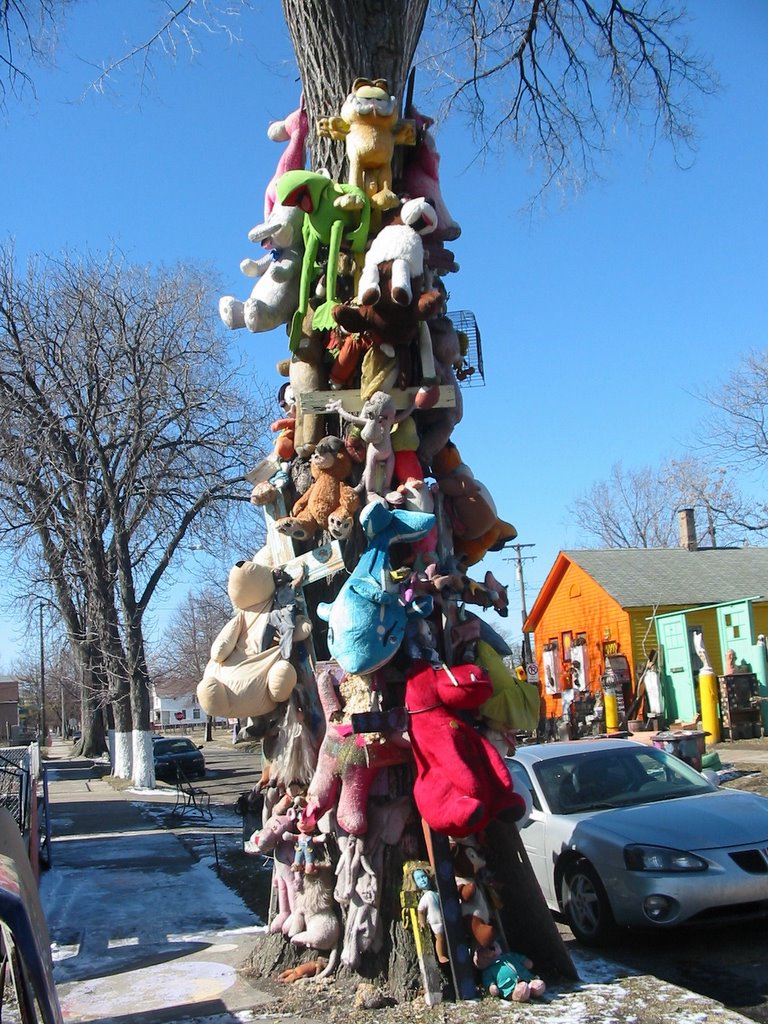
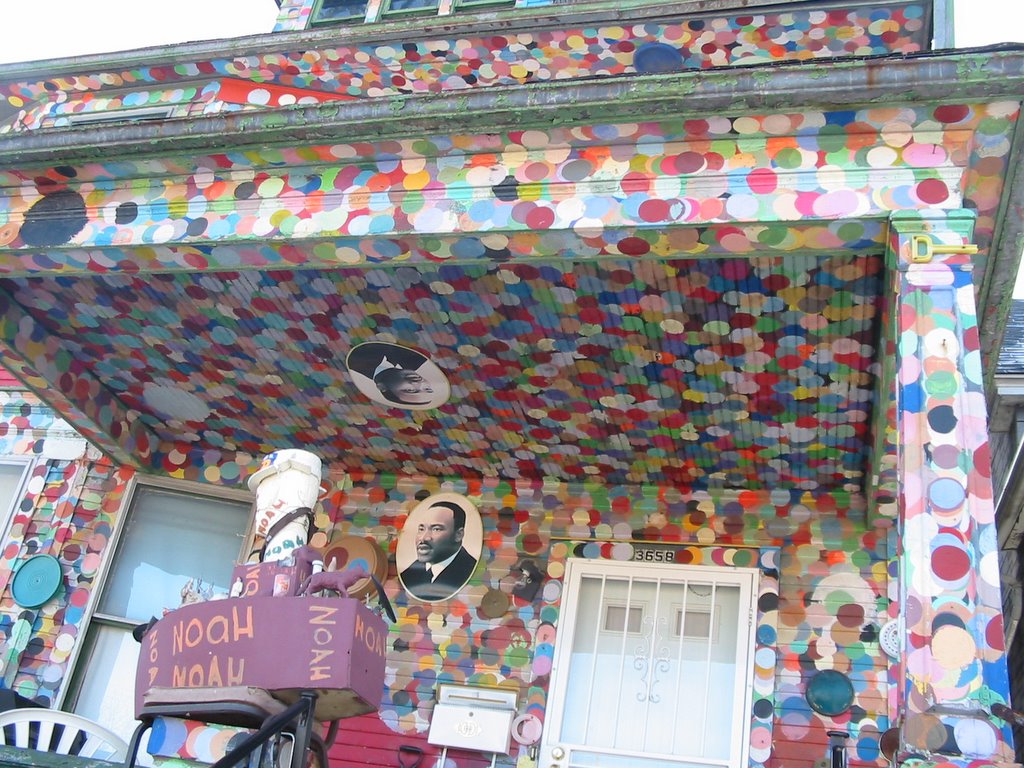
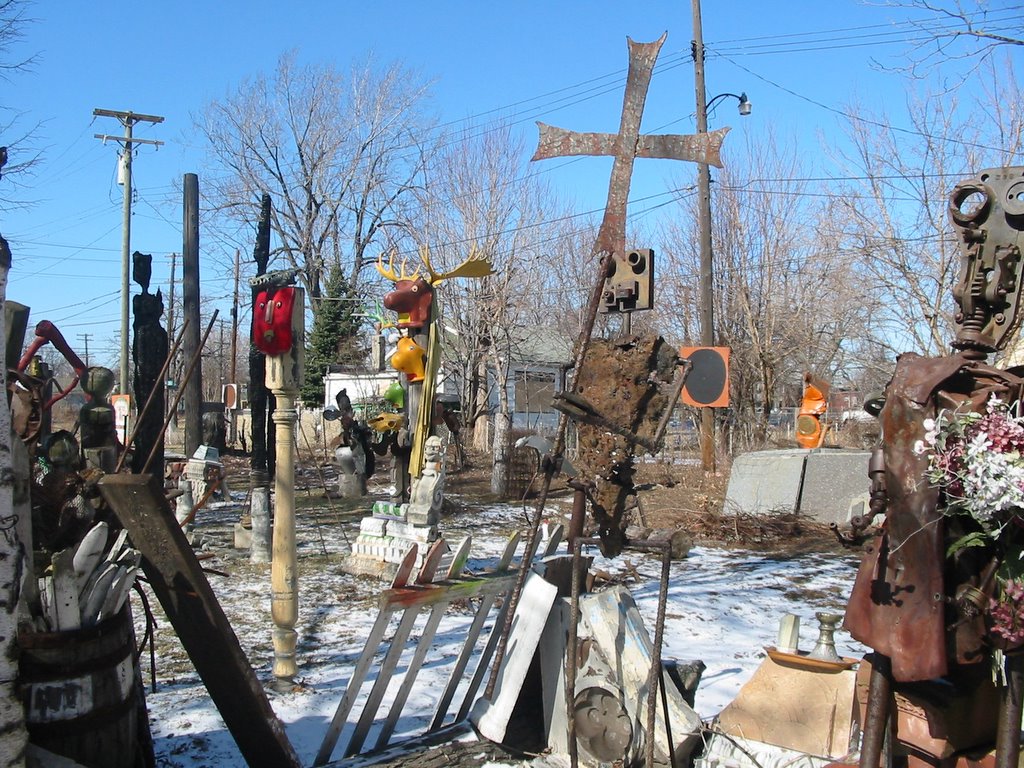
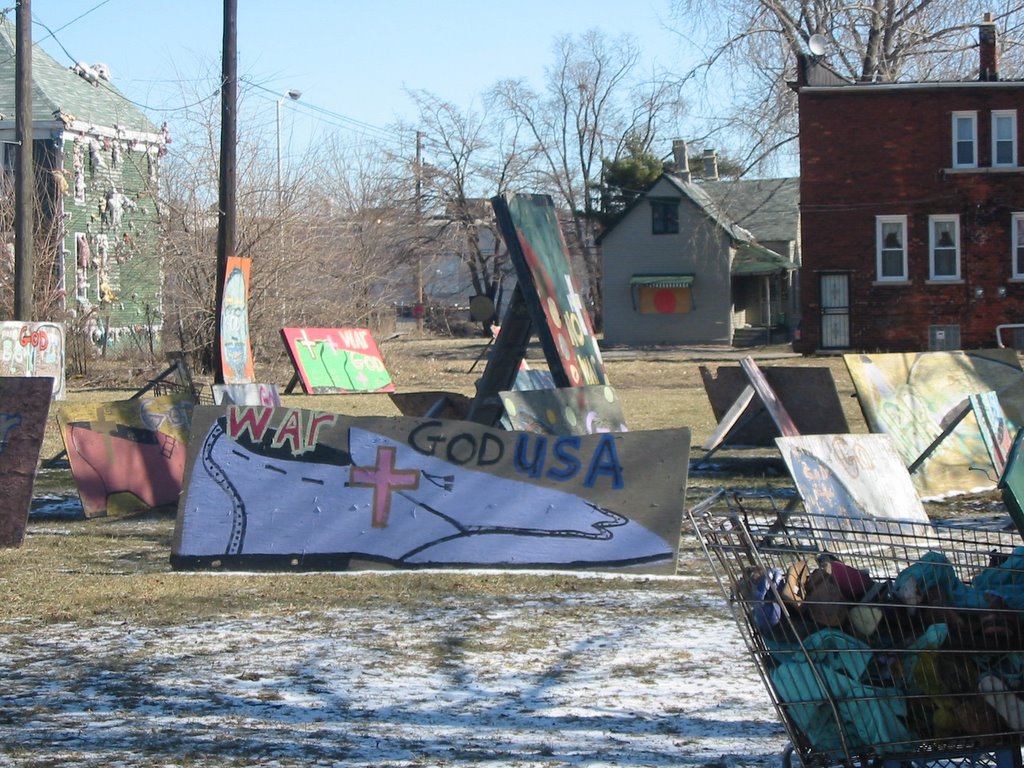
1. My buddy Lew visited from Ohio and we did Detroit-y kinds of things: Heidelberg Project (see photos below), Windsor's Little Italy, The Solanus Casey Center, Eastern Market/&subsequent cooking.

2. Played some guitar.

3. Enjoyed some Titan basketball.

4. Reading: Wicked (bad, but I had put this down a few weeks ago and for some reason I had to get through to the end), Chester Himes' Third Generation, finally finished Made In Detroit, which I had also put down for a while.

5. Rented Bride & Prejudice. Postcolonial critique, served up with a little bubblegum. Gurinder Chadha's follow-up to "Bend It Like Beckham," and this was almost as enjoyable as predecessor.

Heidelberg Street, Detroit

In its wisdom, the city of Detroit has dismantled much of artist Tyree Guyton's installation on Heidelberg Street, but some displays remain. The noted "Heidelberg Project" resides on Detroit's eastside, just off Mt. Elliot, south of Mack Avenue.

Graveyard of vacuum cleaners, ironic commentary on the "clean up" rhetoric of gentrification.


Collage of shoes.


MLK iconography


Kwame Kilpatrick iconography.


3/02/2006

you tube

Via Culture Cat, the joys of YouTube. Amateur video and film, juxtaposed with obscure tv/movie/music clips of everything and everyone, searchable by tags. I suspect content--eclectic but low-in-volume--will continue to grow. Two worthwhile clips:

Beefheart on Letterman. Two clips from early 80s appearances on David Letterman's show. Captain Beefheart's talents don't lie in the arenas of the glib or flashy or self-promotional, so he and talk shows don't play together nicely. Could somebody like Beefheart get booked on network tv today?

The Gories: "Nitroglycerine." Detroit rock and roll, '90s style. To call this music video lo-fi would be an understatement--the band performing on what looks like the "Reservoir Dogs" set while a go-go dancer shimmies in, on, and around an old car. Before Mick Collins started the Dirtbombs, he headed up The Gories, the band that influenced the turn-of-the-milennium scene out of which The White Stripes rose to fame and fortune. This clip comes from what appears to be an English-language cable-access show in Germany, although the host is Hispanic. Also featured in the clip, an interview with Gories contemporaries the Oblivians.

2/28/2006

for Mardi Gras...

My friend and colleague Randy is on location in the Big Easy, reporting on Carnival. Check out his dispatches, including great visuals, on his blog The Portable Carnival.

2/27/2006

a restaurant CV

Autobiography through food, 1996-2005

2002-2005. Southwest Ohio.
  • Saigon Dragon, on Route 4 in Fairfield. Their Pho cures what ails you. If I felt a bug coming on, straight to Saigon Dragon for a bowl of pho--beef broth spiced with chili paste and fish sauce, full of noodles and served with heaping plate of sprouts, cilantro, thai chilis, and basil.
  • Santo Domingo, the corner of Pershing and Third, on the eastside of Hamilton. Less than a mile north of Miami U's Hamilton campus. An odd combination of Carribean food and soul food and pseduo-creole. Ox tails, peppered steak, dirty rice, fried plantains. Everything you order comes with a big mound of fried onions. I always wanted to take job candidates there, because it was one of the only interesting places to eat in Hamilton, but I was always overruled based on the place's less-than-glitzy decor and fattening menu options.
  • Anywhere but those awful Skyline Chilis where they muck up the chili with cinammon and cocoa.
1998-2002. Tucson, Arizona.
  • Tortilleria Jalisco, on Irvington in south Tucson. Nobody speaks English there, and you're never exactly sure what you'll get, not just because of my barely inteligible, midwestern-accented version of Spanish, but also because they use whatever ingredients they have. Sometimes the tacos have cilantro on them, sometimes a little bit of cabbage, etc. But they always serve a little plate of radishes and lime wedges with the tacos, just like they do south of the border. And bottles of red Fanta from Mexico. Best tortillas in Tucson, too.
  • Sausage Deli, Grant and Euclid, a block from my Los Altos apartment, one mile north of the U of A. I used to hop off the bus one stop early on the way home from school to go in and get huge vegetarian or Italian subs. They serve at least fifty kinds of beer--all bottles, all displayed on cheap shelving around the perimter of the shop. I remember getting take-out there the night U of D beat UCLA in the first round of the NCAAs in 1999.
  • El Torero, can't remember which road it's on, but in the heart of south Tucson, about five or six blocks south of 22nd St. A huge, tacky marlin hanging on the wall. The tacos come with cotijo cheese and strips of bistec (no ground beef there!). We took Robert Connors there when he came to speak to us TAs in probably early 2000. Used to go there for lunch and spend maybe $6 including tip.
1996-1998. Youngstown, Ohio.
  • Little Pepino's. Where 304 dead-ends into 422, Girard. Little family-run Italian place. Wedding soup, gnocchi, strombolis. They used to do these $4 take-out box lunches, including one with a sandwich with fried bologna and greens, served on crusty bread with sesame seeds. Second best place to get Italian food in Youngstown...
  • Which leads to the BEST place for Italian food in late 90s Y'town. My grandma D's apartment, off of my parents' house. I moved back home after college in 1996 to work on my master's and teach at YSU, about a year after my grandparents sold their house and also moved there. Seems like everyday my grandma would make what she called "pizza"--actually just homemade bread dough brushed with olive oil and sprinkled with a little garlic and a lot of black pepper. Also "greens and beans" on a regular basis: escarole or whatever greens were around, great northern beans, diced bits of celery and potato and onion and garlic, all in chicken stock and served with parmesan cheese and red pepper flakes.
  • Inner Circle Pizza, Lincoln Avenue, on the YSU campus. Definitely the white pizza, and 3-4 "tall" (these skinny 22-0z. glasses they have) beers. Best post-TA practicum lunch ever. Every Wednesday during the 96-97 school year. Alright, all three Youngstown places are Italian. What can I say? It's Youngstown.

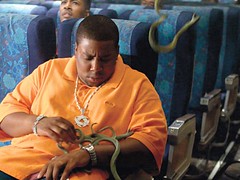
where have all the bad films gone?


SnakesOnAPlane_scene
Originally uploaded by bdegenaro.
A few months back, the New York Times asked that very question, in a piece that bemoaned the proliferation of mediocre Hollywood movies at the expense of both great and truly awful films.

Enter 'Snakes on a Plane,' which has been in production for years and hopes to see the light of day this coming summer.

Will I see this movie? Duh. Do you see that publicity still? Of course I will. Yes, that's Kenan Thompson, he of the SNL Bill Cosby imitation. Yes, he's got snakes crawling all over him. Plus, Samuel Jackson plays an FBI agent tracking down a bad guy who releases snakes...oh forget it, all you need to know is Sam Jackson's in the house. Or, I guess, on the plane.

The phrase "snakes on a plane" has already become shorthand for something that is excessively silly. As opposed to something that's just a little bit silly. Show up in tracksuit pants and loud aloha shirt and folks might remark, "That outfit's kind of snakes on a plane, friend."

2/26/2006

Titans

Went down to U of D and saw the Titans win their last regular-season game yesterday, and what a game it was. Homecoming, and they did us alums proud. Guards Jon Goode and Brandon Cotton combined for 41 points, and what you need to know about these two is that Goode's 5'10, former-MSU-Spartan Cotton's 6', and both are confident enough in traffic that you'd never know they were running circles around guys four and five inches taller than themeselves. Next up, Tuesday night's first-round Horizon League tourney game against Cleveland State, also down at 6-Mile and Livernois. Happily, I'm on Spring Break and will be there. Go Titans.

After game last night, drinks at Honest?John's down in Cass Corridor. Hadn't been there since they moved about three years ago from their original location across Jefferson from the bridge to Belle Isle. Honest?John's is no longer the dive it once was, but they still have a fine selection of beers, an even better selection on the jukebox (upon arrival, I quickly selected a combination of Lou Reed, Etta James, and Sly Stone), and a clientele that's almost absurdly diverse in terms of age, race, class, levels of intoxication, etc. Some things don't change.

2/23/2006

Detroit's working poor

This week, my church hosts a roving shelter. For a week about fifty people sleep in the gym and eat their meals in the cafeteria. Next week they'll do the same at a different place. The following week, a different church or school. Nicole and I have spent several evenings distributing towells and toiletries, bagging popcorn for the night's movie (Crash, interestingly enough), making lasagna, chatting.

Nearly everyone I've talked with has a job. Cass Community Services picks them up from their temporary homes each morning and takes them to jobs that don't pay enough to save up a deposit and first month's rent. (CCS and cooperating churches, I suppose, are in effect subsidizing the employers. A familiar, all-too-common arrangement.) The mythology of homelessness still revolves--in addition to stories of mental illness--around stories of laziness, joblessness, shiftlessness. But the stories of the underclass are also stories of industry, stories of corporate decision-making, stories of lean operating budgets, stories of how wealth is distributed, stories of American capitalism.

But stories of laziness are more compelling, more interesting, more worthy of outrage, and more firmly (permanently) cemented in our national consciousness. That line from last night's poetry reading keeps echoing: "too right wing to do the right thing."

2/22/2006

the poetry of anger, the rhetoric of anger

Here at UM-Dearborn tonight, an explosive poetry exchange featuring Arab-American and African-American spoken word artists and poet-activists. Dubbed "Over the Counter, Under the Skin," the event at once provoked audience members and celebrated the power of words.

Anger served as the dominant motif of much of the poetry. Omari King Wise of Detroit's own 3rd Eye Open collective performed several pieces about various intersections of injustice including a raging poem addressed to Bush-Cheney about the invasion of Iraq: "Are you too right wing to do the right thing?" And riffing on the name of Saddam Hussein: "You got me so damn mad, I have to wonder who sane?" Karega Ani was the evening's standout, and, taken with his pitch perfect slam-poetry delivery and his Last Poets-esque voice, I picked up one of his CDs afterward. Ani juxtaposes neo-soul and radicalism, moving between spoken and sung words. Really engaging stuff. Definitely hope to see more of him around Detroit.

Legacy Leonard ended the night with a poem about perceived mistreatment of African-American shoppers at the hands of Arab-American shopkeepers in Detroit. An interesting cultural moment. The evening's performers: half black, half Arab. The audience (according to my *extremely* rough estimate): one-third black, one-third Arab, one-third white. The topoi: as divisive as any tackled during the whole performance. A very "Detroit" moment, too...blunt, raw, agonistic. Another reminder that the evening's version of "multiculturalism" went beyond tired tropes of one-ness. Anger as a teaching tool, as a mode of learning.

During the q-and-a, a man self-identified as an Arab-American store-owner in the city and articulated offense at what he perceived to be the poem's generalization and stereotyping. He referenced several violent crimes and explained that he never refers to the perpetrators by their race, but rather as criminals. Another moment, also uncomfortable, blunt, raw, personal. Vigorous discussion followed. No consensus, but many points-of-view stated in a public forum (and I would say a safe one, too, though I hesitate to characterize the atmosphere, as others perhaps felt differently).

In the world of rhetoric--and often in the worlds of poetics too--anger too often becomes yet another subset of emotion, a lesser motivator, a lesser (base) strategy for knowledge construction, for communication, for social change. The ineffectual step-sibling of rationality. Indeed, somebody after the event suggested to me that the anger at times gave the poetry an err of superficiality. She suggested that anger is the superficial emotion, that *pain* is the deeper emotion that the poet ought to expose.

But I say, why? At this performance--a rhetorical *and* poetic space--anger, emotion, affect all took a collective bow, becoming a prompt for reflection, a prompt for more discourse, more language, more dialogue. Why is anger a lesser starting point? Why does anger need to be seen only as the surface experience with the material world? I need to think more about the role anger plays in rhetoric. This was extremely scattered--sorry about that--but I wanted to get all of this down right away.

2/13/2006

blogging in crisis

Clearly blogging has become the dominant form of online communication...overtaking chatrooms and instant messaging in terms of popularity, and also in terms of attention from mass media. Just today, myspace--a kind of amalgam of blogging, social networking, and self-promoting--has gotten more ink than Vice President E. Fudd.

Locally, this story out of Dearborn:
On Friday, prosecutors charged two Dearborn High School sophomores who in a note on My Space threatened to shoot up the school. The teens, ages 15 and 16, told police the threat was a prank, and school officials said it appeared to be a hoax. But authorities took the case seriously, arresting the boys initially on suspicion of terrorism and holding them in the Wayne County Juvenile Detention Facility in Detroit.
The language of the post is at once chilling and goofy: "I'm sure they'll show the footage on the news or something." The language of the "adult response" sounds stodgy, a list of cliche tips for parents ("oh, so I SHOULD talk to my kids about what they're doing?"). The language of the media reports reveals a lack of understanding of the technologies involved, especially of the differences, nuances, and overlaps between blogging and social networking programs. I kept thinking, especially with regard to the obvious tips for parents, of a term Mary Soliday uses in describing literacy crisis rhetoric: "always newness." No matter how old, tired, and familiar the rhetoric, always the implication of novelty.

In the more national (not to mention more sublime, more riduculous) arena, a story about the underage children of Bobby Brown and Whitney Houston, posting to my space about, GASP!, drinking. And the young son of P Diddy blogging about--and here comes another connection to the wonderful world of the literacy crisis--how he has no interest in, or use for, GASP!, reading.

2/08/2006

Gossip: Standing in the Way of Control

Been reading lots of student papers this week and the newly released album from dance-punk trio Gossip has provided the soundtrack. Led by the soulful, sometimes-angry, always-hopeful Beth Ditto, Gossip churn out noisy gospel with a beat. The band has roots in the south and it shows, as they begborrowsteal readily from every homegrown genre one might associate with that region. Gossip has no bass player and have a raw aesthetic that begs comparisons with garage rock revivalists, but here's the difference: Beth Ditto's voice. The guitar and drums avoid extra flourish, preferring down-and-dirty blues, but Ditto's vocals stand in sharp contrast. All flourish, flash, and show. And she's got the chops to back up her performative flair. More Big Mama Thorton than Patti Smith, Ditto could be a fine gospel singer. She could hold her own with the purveyors of what passes for soul these days. She has a vocal range beyond the singers of most punk bands (exception: Poly Styrene of X-Ray Spex, whose influence drips from every Gossip track).

Thematically, "Standing in the Way of Control" tackles familiar riot grrrl themes. At times there's too much angst, too much bemoaning one's "outsider" status, but Gossip balances the anger with an eternal optimism. Not only in Ditto's lyrics, but also in the pervasive rhythms and upbeat tempos. Nine out of ten tracks on the album are uptempo and would fit on a club dj's playlist. Refreshing, this juxtaposition of critique and revelry. LeTigre, also one of Gossip's cited influences, come to mind. "Keeping You Alive," the title track, and most especially "Yr Mangled Heart" are standouts. Occasionally the lyrics move too wildly from statements of angst to abstractions of hope, but mostly Ditto gets it just right, with ambiguous and provocative lines like "If everything you do has got a hold on me/Than everything I do has got a hole in it." Recommended.

2/07/2006

looking for a job at ABC

UMD keeps me busy, don't get me wrong, but I gladly would have picked up a little work on the side planning the Super Bowl halftime show. First thing, we need multiple acts, duets, collaborations, musical synergy. Second thing, we need two segments for the show.

Set one:
Eminem comes out and performs "Lose Yourself." What Detroit anthem is more custom-made for the spirit of the Super Bowl? Crowd goes crazy. After, Em introduces Detroit's own Dirtbombs, who take the stage with city councilperson Martha Reeves and back up the motown legend on her hit "Nowhere to Run." Reeves exits and Dirtbombs frontman Mick Collins introduces Stevie Wonder who comes out and trades verses with Collins on a "Livin' for the City" duet. Crowd loves it. End of set one. Break for overpriced commercials.

Set two:
Now the Rolling Stones come out and do the obligatory "Start Me Up," but this time the sound system's already had the kinks worked out. Then, Mick introduces Jack White, who joins the Stones on a version of "Stop Breakin' Down" (The White Stripes did a sped-up version on their first record and of course the Rolling Stones did a slowed-down version on "Exile on Main Street"). Jack White alternates guitar solos with Keith Richards, then takes a bow and exits. Mick introduces Aretha Franklin who comes out and duets with Jagger on "Jumpin' Jack Flash." Crowd again goes nuts. End of set, end of halftime show.

2/03/2006

gender, body, super bowl

Here in Detroit this week, celebrities and representatives of the national media have flooded town in anticipation of the Super Bowl, throwing parties and throwing around money. Mayor Kwame Kilpatrick's administration has led efforts to mask Detroit's abandoned buildings with fake facades and little-to-no-mention has been made of Detroit's status as the nation's poorest city, where one-third of the population lives below the poverty line, nor of last week's news about the auto industry's latest crippling round of lay-offs.

But perhaps the most striking feature of the pre-Super Bowl action has been the prominent place of mainstreamed softcore porn. Two of the most talked-about (in the mainstream press)parties are the Playboy party and the Maxim "are you hot?" shindig. The hook of the latter party: local women e-mail their photos to Maxim and receive invitations based on hotness. Slightly less racy fare included a party on Belle Isle where guests could pay top dollar to hang out and have their pictures taken with hot twins.

A Penthouse party admittedly has received less ink, but is part of the festivities nonetheless. And Jimmy Kimmel, Kid Rock, Tommy Lee, and Snoop Dogg (who produces pornography videos on the side)--the latter two host the Penthouse party--are four of the high-profile revelers in town, so lots of lines are blurring between "mainstream entertainment" and the once-marginal world of "adult entertainment." Lots and lots of jokes about Detroit's storied stripclubs (never anticipated a joke on national tv about 8-Mile's Booby Trap club). Detroit alt-newsweekly Metro Times includes a story in its Super Bowl issue about the stripper district along 8-Mile, which is anticipating big business this weekend.

And a not-unrelated dynamic of the media coverage this week: the acceptability of fat jokes regarding Aretha Franklin, who will sing the national anthem. The Detroit News speculates that perhaps Franklin will join the Stones during halftime, tacking on the smarmy headline, "Franklin may provide a Super-size surprise." Various news outlets and commentators have made the obligatory joke about how appropriate it is for Franklin to perform at Super Bowl XL (get it? extra large? wocka wocka, stick around folks I got a million of them). Not just late-night comedians. Mainstream news outlets. Because bodies--whether the disciplined, elevated, valued bodies of strippers and hot twins and Playboy playmates or the transgressive, ridiculed body of Aretha Franklin--are here for our consumption and critical commentary, like a well-executed ("that was awesome") or flubbed ("aww, would ya look at that") touchdown pass.