Another Thanksgiving in O'Fallon, Illinois. Very little writing, very little grading of student papers, and very little anxiety over tenurewritingdeadlinesuniversitypolitics. And I was thankful for *the absence* of that trio of real-world realities.
Since our O'Fallon pals have three small children--younger even than my siblings-in-law and most of my nieces and nephews--we immersed ourselves in kid culture. A little Go Fish, a little Dinosaur Dominos, a little bit of cruising around to look at the Christmas lights illuminating suburbia. And a weekend double-feature of "Harry Potter and the Goblet of Fire" (the best HP film so far) and "Chicken Little" (Q: is it possible to be "extremely mediocre"? A: yes).
I knew Thanksgiving had to be a real, albeit short, break. The winter hiatus will be a whirlwind, thanks to a January 1 deadline on the book manuscript (not to mention a self-imposed new year deadline on the working-class poetics article), interviews with job candidates, and a new syllabus to finish.
11/28/2005

11/22/2005
tuesday round-up
- It must be the end of November. I'm starting to get that burned-out feeling.
- Thanksgiving. The long weekend couldn't have come at a better time. Tomorrow a.m. we're off to O'Fallon, IL. to visit old pals from Tucson, who now live in suburban St. Louis. I'll do the cooking on turkey day. I love cooking, and I'm pretty good at it, but being responsible for Thanksgiving food always freaks me out.
- Saw the Johnny Cash film Walk the Line over the weekend. How could a film about Cash fail to please? Full of affecting moments: singing "Cocaine Blues" to prisoners at Folsom, watching a violent filmstrip about Folsom while still in the military and identifying with the hard-timers, singing "It Ain't Me Babe" as a duet with June Carter while his wife sits in the frontrow and being too strung out and confused to know who he's singing those words to, etc. etc. The pic uses rags-to-riches and salvation-via-the-love-of-a-good-woman and even VH1 trappings and tropes and probably neglects Cash's religious conversions and ambivalences, but comes out a winner anyway due to the unbelievable music and the performances of the two leads.
- Best Johnny Cash song ever: "One Piece at a Time," about an auto worker who devises a plan to steal a Cadillac: "I'd sneak it out of there in a lunchbox in my hand. Now gettin' caught meant getting fired, but I figured I'd have it all by the time I retired. I'd have me a car worth at least a hundred grand." Song did NOT appear in the film, sadly.
- Current writing projects: three entries ("Community Colleges," "Higher Education," and Vo-Tech Education") for Greenwood's Class in America encyclopedia; revisions to the introduction of New Rhetorics of Working-Class Consciousness, now--at last!--under contract with Pitt; article on working-class poetics and my grandpa's writings; a reflective piece about teaching the rhetorics of class for a special pedagogy issue of Living Forge; next term's syllabi.
- UM Dearborn's hiring a writing program director. Not too late to apply.
- Tonight's the last in MCHR's film series. 7:00, St. John's Church at 11-Mile and Woodward. Tonight's film: "Oil Factor: Behind the War on Terror," narrated by Ed Asner. Followed by what's sure to be a heated discussion.
more photoessays
I posted a few weeks back some links to photoessays that my Comp. 106 students had been working with online. I wanted to follow up that post by linking to a sampling of my students' Detroit photoessays, many of which are intriguing, rhetorically and visually. I need to do more reading on visual rhetorics (recommended sources anyone?), and perhaps think about a paper on photo essays for the Detroit edition of the Computers and Writing conference.
Anyhow, from the Comp. 106 group, here are some good reads (most of these are still works-in-progress):
The Game is Over
Tombstones
Open Space
American Baby
Out and About in Ferndale
These photo essays all use blogger as a canvas. Other students are using Power Point. I noticed that students were more engaged than usual when we did various workshopping and peer reviewing activities. I think that engagement had a lot to do with the visual component of the project. Next time I'd like to use the Photo Essay assignment earlier in the term, so the visual can become (early on) a heuristic for other writing and blogging that the students do.
Anyhow, from the Comp. 106 group, here are some good reads (most of these are still works-in-progress):
The Game is Over
Tombstones
Open Space
American Baby
Out and About in Ferndale
These photo essays all use blogger as a canvas. Other students are using Power Point. I noticed that students were more engaged than usual when we did various workshopping and peer reviewing activities. I think that engagement had a lot to do with the visual component of the project. Next time I'd like to use the Photo Essay assignment earlier in the term, so the visual can become (early on) a heuristic for other writing and blogging that the students do.
11/18/2005
Bait and Switch
I finally finished Barbara Ehrenreich's Bait and Switch, a somewhat tedious look at unemployed corporate America. Ehrenreich goes undercover, as she did in the superior but flawed Nickle and Dimed, this time to study the lifestyles of a white-collar workforce rightly fretting over increasing job insecurity. Essentially, Ehrenreich repeats the Nickle and Dimed experiment--to document her attempt to survive in low-wage jobs--this time with higher-prestige corporate jobs. Maybe because of the rehashed premise, Bait and Switch often reads like a movie sequel. Nickle and Dimed made waves in 2001 and had some revelatory moments, like the ruthless treatment Ehrenreich endures during her tenure as a waitress who is not allowed to rest for even a moment. Ethically, though, Nickle and Dimed was often on shaky ground, treating the real-life low-wage workers in the book like circus performers. And, as my students often pointed out (I taught the book for several years), Ehrenreich let her classism (ewwww, look at all the mayonaise and red meat they're eating...look at them sitting in church like fools) undermine her credibility.
In Bait and Switch, undercover Ehrenreich can't actually GET a corporate job, so she documents white-collar unemployment. She points out that 44% of the unemployed are from middle-class, "professional" and/or corporate lines of work. In the book she describes corporate job searches, networking events (with their frequent religious agendas), career coaches, internet pseduo-businesses meant to aid the job search, and the desperation of those using these services. Overwhelmingly (and not at all surprisingly), these job search services use a rhetoric of individualism and blame-the-victim that divert attention from the context of corporate unemployment (greed, downsizing, etc.). It's a familiar narrative and Ehrenreich offers few new insights, and fewer solutions to the problem.
How should folks concerned about these issues organize? How might the unemployed middle class and working class take common cause to fight the systemic abuses Ehrenreich describes? These questions, or other productive/proactive queries, aren't pursued in the book.
In fact, I kept thinking as I read Bait and Switch that the book underscores the limits of rhetorical analysis, or rather that the book uses a limited version of rhetorical analysis. What I mean is that there's no praxis, only a critique of language with no identified implications. Ehrenreich shows the uses of terms like "self adaptation" and "in transitions," obvious euphemisms, but doesn't reveal much about the constitutive value of the terms. Put another way, she doesn't do much with the "so what" question. Like the new Wal Mart film I blogged the other day, Bait and Switch doesn't do much to reach beyond the like-minded.
In Bait and Switch, undercover Ehrenreich can't actually GET a corporate job, so she documents white-collar unemployment. She points out that 44% of the unemployed are from middle-class, "professional" and/or corporate lines of work. In the book she describes corporate job searches, networking events (with their frequent religious agendas), career coaches, internet pseduo-businesses meant to aid the job search, and the desperation of those using these services. Overwhelmingly (and not at all surprisingly), these job search services use a rhetoric of individualism and blame-the-victim that divert attention from the context of corporate unemployment (greed, downsizing, etc.). It's a familiar narrative and Ehrenreich offers few new insights, and fewer solutions to the problem.
How should folks concerned about these issues organize? How might the unemployed middle class and working class take common cause to fight the systemic abuses Ehrenreich describes? These questions, or other productive/proactive queries, aren't pursued in the book.
In fact, I kept thinking as I read Bait and Switch that the book underscores the limits of rhetorical analysis, or rather that the book uses a limited version of rhetorical analysis. What I mean is that there's no praxis, only a critique of language with no identified implications. Ehrenreich shows the uses of terms like "self adaptation" and "in transitions," obvious euphemisms, but doesn't reveal much about the constitutive value of the terms. Put another way, she doesn't do much with the "so what" question. Like the new Wal Mart film I blogged the other day, Bait and Switch doesn't do much to reach beyond the like-minded.
11/16/2005
Wal Mart: The High Cost of Low Price
Last night, the MCHR screnned Robert Greenwald's new documentary "Wal Mart: The High Cost of Low Price," an uneven, long, but sometimes-compelling critique of the big-box behemoth. Greenwald made the outstanding Outfoxed film, an expose of Fox News, so I guess I expected more from his new offering. On the brightside, the film attracted over two-hundred people, and sitting in a church basement with that many people who give a damn tends to leave you feeling almost hopeful.
First off, saying something new and rhetorically effective about Wal Mart is tough. The Walton family's destruction of mom-and-pop stores, monopoly-like control over the retail market, union busting, refusal to give employees health care, and reliance on sweatshop labor to produce their cheap items are all familiar problems. And, as a high-profile lefty cause, invoking Wal Mart's problems prompts either nods from those who find their practices problematic or eye-rolling from those who don't. Hence, the challenge for Greenwald is two-fold: 1) reach beyond the already like-minded, and 2) tell us something we don't already know.
Here's what really worked in the film. Greenwald exposes Wal Mart stores, especially those out west, actively ENCOURAGING employees to go on public assistance, creating fliers telling low-wage employees to collect welfare, that the aid comes from their own tax dollars and they should obtain health care and other needs via public assistance. Greenwald juxtaposes this campaign with statistics about the huge number of Wal Mart employees who are indeed on public aid and the amount of tax dollars ($1.6 billion) that last year went to welfare for Wal Mart employees. That equation didn't surprise me one stitch, but it seemed like a great moment for convincing moderates and even fiscal conservatives that something is amiss.
Tax dollars essentially subsidize the largest and richest corporation in the world. Billions--literally--roll into the Wal Mart empire, but they can't offer health care or living wages to their employees, who in turn collect welfare, funded by tax payers instead of the billion-dollar industry that makes its fortunes on the backs of its health care-deprived employees.
Here's where the film lost that savvy. Later segments in the film focused on crime in Wal Mart parking lots. Now, I recognize the ethical obligation of the corporation to provide some safety for employees and customers, and I recognize the problematics the film point out about Wal Mart using its security cameras to bust union organizers instead of violent criminals...but I couldn't help imagining the reaction of corporate apologists and right-wingers (none of whom, to my knowledge, were at last night's screening) rolling their eyes and saying: "sure, it's the evil company's fault that someone got attacked outside its store." I'm not sure Greenwald anticipates this counter-critique. Talking to several MCHR members afterward, we also questioned the use of a rape victim's testimony during this segment of the film. The testimony was graphic and bordered on exploitative.
Next week's Tuesday night film, the last in the series, is "Oil Factor: Behind the War on Terror," with a post-film discussion led by Detroit Bishop Thomas Gumbleton. Bishop Gumbleton, as well as the film's subject matter, ought to attract another big crowd.
First off, saying something new and rhetorically effective about Wal Mart is tough. The Walton family's destruction of mom-and-pop stores, monopoly-like control over the retail market, union busting, refusal to give employees health care, and reliance on sweatshop labor to produce their cheap items are all familiar problems. And, as a high-profile lefty cause, invoking Wal Mart's problems prompts either nods from those who find their practices problematic or eye-rolling from those who don't. Hence, the challenge for Greenwald is two-fold: 1) reach beyond the already like-minded, and 2) tell us something we don't already know.
Here's what really worked in the film. Greenwald exposes Wal Mart stores, especially those out west, actively ENCOURAGING employees to go on public assistance, creating fliers telling low-wage employees to collect welfare, that the aid comes from their own tax dollars and they should obtain health care and other needs via public assistance. Greenwald juxtaposes this campaign with statistics about the huge number of Wal Mart employees who are indeed on public aid and the amount of tax dollars ($1.6 billion) that last year went to welfare for Wal Mart employees. That equation didn't surprise me one stitch, but it seemed like a great moment for convincing moderates and even fiscal conservatives that something is amiss.
Tax dollars essentially subsidize the largest and richest corporation in the world. Billions--literally--roll into the Wal Mart empire, but they can't offer health care or living wages to their employees, who in turn collect welfare, funded by tax payers instead of the billion-dollar industry that makes its fortunes on the backs of its health care-deprived employees.
Here's where the film lost that savvy. Later segments in the film focused on crime in Wal Mart parking lots. Now, I recognize the ethical obligation of the corporation to provide some safety for employees and customers, and I recognize the problematics the film point out about Wal Mart using its security cameras to bust union organizers instead of violent criminals...but I couldn't help imagining the reaction of corporate apologists and right-wingers (none of whom, to my knowledge, were at last night's screening) rolling their eyes and saying: "sure, it's the evil company's fault that someone got attacked outside its store." I'm not sure Greenwald anticipates this counter-critique. Talking to several MCHR members afterward, we also questioned the use of a rape victim's testimony during this segment of the film. The testimony was graphic and bordered on exploitative.
Next week's Tuesday night film, the last in the series, is "Oil Factor: Behind the War on Terror," with a post-film discussion led by Detroit Bishop Thomas Gumbleton. Bishop Gumbleton, as well as the film's subject matter, ought to attract another big crowd.
Six Degrees of Geoffrey Fieger, or Wednesday Free Association
\scintilla\ n. 1. a minute amount; an iota or trace. 2. A spark; a flash
Geoffrey Fieger:
For readers living outside of Detroit, here's the skinny. Fieger, a well-known (more on this later) local attorney, allegedly conspired to blackmail Michigan Attorney General Mike Cox, threatening to reveal Cox's extra-marital affair if Cox didn't abandon an investigation into some shady campaign donations of Fieger's. Last week Cox and his wife came forward, admitted the affair, and alleged the blackmail. Fieger denied everything. Yesterday, the prosecutor's office announced it was "100% confident" that Fieger and his henchmen had committed blackmail, but didn't have enough evidence to go forward with charges. Juicy stuff, especially for a public hungry for intrigue now that Detroit's ugly mayoral race--a race full of scandal, innuendo, and personal attack--is over.
Here's where the skinny gets phatter. Fieger, Cox, and Prosecutor David Gorcyca all have political histories with one another. Fieger had vied for the A.G. job the year Cox took office and planned to to challenge Cox at the end of his term. They've been flinging partisan mud at one another for years. Gorcyca and Fieger are also political rivals, having spent the late 80s and early 90s fighting one another in the courtroom and in the media over suicide doctor Jack Kevourkian, whom Fieger defended and Gorcyca repeatedly attempted to prosecute. A messy web of motives, rivalries, rhetoric, scandal, and now-destroyed (presumably...but who knows?) political careers.
Here's one reason why it's probably a good thing that I went into teaching instead of journalism, which was my plan during several of my undergraduate years. When the press covers Fieger (as they often do--he's been at the center of various investigations into ethics violations over the years), inevitably his identifying tag line is something like "the prominent local attorney who defended Jack Kevourkian" or "Jack 'Dr. Death' Kevourkian's former lawyer and spokesperson"). If I were covering a Fieger story, I'd probably identify him with something like this: "the brother of Doug Fieger, who fronted 70s L.A. rock band The Knack, whose hit "My Sharona" is one of George W. Bush's favorite songs." Or: "whose brother wrote the song "My Sharona," which was covered by The Chipmunks on their seminal "Chipmunk Punk" record." And that just wouldn't be good journalism, unlike the always-stellar reporting of the Detroit media.
Here's my all-time favorite moment in Detroit media. One summer night in 1997 I was watching a local late edition of the news--the affiliate will remain nameless--and the newscaster--she'll remain nameless too--was covering the following stories: the death of Princess Diana and an Aretha Frankling concert. Maybe you can see where this is going. The transition went a little something like this: "The Princess of Wales may be dead, but the Queen of Soul is alive and kicking." Priceless.
So one year prior to that, I spent the summer (the summer after I graduated from college) as an intern in the office of the press secretary to Detroit Mayor Dennis Archer--writing press releases, helping to plan press conferences, etc. Frequently, I'd pass Geoffrey Fieger in the halls of the City-County Building. Once, he nodded at me and said "G'Morning." A friend recently told me that while waiting in line for an ATM, Fieger drove up to the bank, cut in front of three people and, when given dirty looks for cutting, acknowledged the crowd by saying "Yes, I am Geoffrey Fieger. Good to see you all."
I don't know how I lived away from this city for nine years! Sure is good to be back.
Geoffrey Fieger:
Fieger does his part for Metro Detroit's twelfth graders by breaking out quite the SAT word during his press conference yesterday. "Scintilla." I must write a poem using the word "scintilla." To call Fieger's rhetoric over-the-top smacks of understatement. In fact, the previous sentence smacks of understatement. He even broke out the "Have you no sense of decency sir, at long last?" line, apparently fancying himself the victim of McCarthy-esque witch hunt.Not a word of what Mr. Cox told you last week was true;
not a word. There was never a scintilla of evidence that I
had committed a crime. And yet, for the past week, my wife,
and those who care about me, have spent many a sleepless
night and fear-filled days because of Mr. Cox’s reckless and
For readers living outside of Detroit, here's the skinny. Fieger, a well-known (more on this later) local attorney, allegedly conspired to blackmail Michigan Attorney General Mike Cox, threatening to reveal Cox's extra-marital affair if Cox didn't abandon an investigation into some shady campaign donations of Fieger's. Last week Cox and his wife came forward, admitted the affair, and alleged the blackmail. Fieger denied everything. Yesterday, the prosecutor's office announced it was "100% confident" that Fieger and his henchmen had committed blackmail, but didn't have enough evidence to go forward with charges. Juicy stuff, especially for a public hungry for intrigue now that Detroit's ugly mayoral race--a race full of scandal, innuendo, and personal attack--is over.
Here's where the skinny gets phatter. Fieger, Cox, and Prosecutor David Gorcyca all have political histories with one another. Fieger had vied for the A.G. job the year Cox took office and planned to to challenge Cox at the end of his term. They've been flinging partisan mud at one another for years. Gorcyca and Fieger are also political rivals, having spent the late 80s and early 90s fighting one another in the courtroom and in the media over suicide doctor Jack Kevourkian, whom Fieger defended and Gorcyca repeatedly attempted to prosecute. A messy web of motives, rivalries, rhetoric, scandal, and now-destroyed (presumably...but who knows?) political careers.
Here's one reason why it's probably a good thing that I went into teaching instead of journalism, which was my plan during several of my undergraduate years. When the press covers Fieger (as they often do--he's been at the center of various investigations into ethics violations over the years), inevitably his identifying tag line is something like "the prominent local attorney who defended Jack Kevourkian" or "Jack 'Dr. Death' Kevourkian's former lawyer and spokesperson"). If I were covering a Fieger story, I'd probably identify him with something like this: "the brother of Doug Fieger, who fronted 70s L.A. rock band The Knack, whose hit "My Sharona" is one of George W. Bush's favorite songs." Or: "whose brother wrote the song "My Sharona," which was covered by The Chipmunks on their seminal "Chipmunk Punk" record." And that just wouldn't be good journalism, unlike the always-stellar reporting of the Detroit media.
Here's my all-time favorite moment in Detroit media. One summer night in 1997 I was watching a local late edition of the news--the affiliate will remain nameless--and the newscaster--she'll remain nameless too--was covering the following stories: the death of Princess Diana and an Aretha Frankling concert. Maybe you can see where this is going. The transition went a little something like this: "The Princess of Wales may be dead, but the Queen of Soul is alive and kicking." Priceless.
So one year prior to that, I spent the summer (the summer after I graduated from college) as an intern in the office of the press secretary to Detroit Mayor Dennis Archer--writing press releases, helping to plan press conferences, etc. Frequently, I'd pass Geoffrey Fieger in the halls of the City-County Building. Once, he nodded at me and said "G'Morning." A friend recently told me that while waiting in line for an ATM, Fieger drove up to the bank, cut in front of three people and, when given dirty looks for cutting, acknowledged the crowd by saying "Yes, I am Geoffrey Fieger. Good to see you all."
I don't know how I lived away from this city for nine years! Sure is good to be back.
11/10/2005
What's Going On?
Marvin Gaye. I pass this image each morning on my way to school. Visible along the Southfield, just north of Warren Avenue.
I always imagine a fictional extra verse from, say, "Inner City Blues" about liquor ads. Not sure what's most noteworthy, the irony of the ad given Marvin Gaye's drug addiction and alcoholism, or the irony of the ad given that the image is lifted from one of the most noted pieces of art-as-social-commentary of the rock era.
For the past month I've also passed about a dozen Martha Reeves for City Council signs. Icons of the motown sound. Odd representations. If only Smokey would open a burger chain.
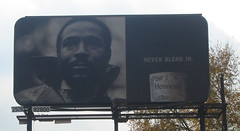
I always imagine a fictional extra verse from, say, "Inner City Blues" about liquor ads. Not sure what's most noteworthy, the irony of the ad given Marvin Gaye's drug addiction and alcoholism, or the irony of the ad given that the image is lifted from one of the most noted pieces of art-as-social-commentary of the rock era.
For the past month I've also passed about a dozen Martha Reeves for City Council signs. Icons of the motown sound. Odd representations. If only Smokey would open a burger chain.
11/09/2005
Slavery documentary
Last night the Michigan Coalition for Human Rights screened the documentary "Slavery: A Global Perspective," a shocking, lo-fi expose of Ivory Coast's cocoa industry (slave labor has a hand in about forty percent of commercially available chocolate, according to the film) and India's carpet industry, two of the major global industries that utilize slave labor. Not sweatshop labor. Forced, unpaid labor performed in large part by children who are lured away from their homes, kidnapped, chained to looms, and beaten brutally. The doc. also exposed the more familiar use of domestic worker-slaves in London, New York, and Washington DC. In 2005, the filmmakers claim, there are about 27 million slaves worldwide, more than at any other point in world history.
Resources:
Free the Slaves
Coalition Against Slavery and Trafficking
Next week's MCHR documentary is Robert Greenwald's "WalMart: The High Cost of Low Price," shown around Metro Detroit. See MCHR for details.
Resources:
Free the Slaves
Coalition Against Slavery and Trafficking
Next week's MCHR documentary is Robert Greenwald's "WalMart: The High Cost of Low Price," shown around Metro Detroit. See MCHR for details.
11/08/2005
links to photo essays
My comp. 106 students are working on photo essays. For those of you with assignments foregrounding visual rhetoric, here are some links from one of my handouts that you might find helpful and/or interesting.
Caring for the Wounded in Iraq
http://content.nejm.org/cgi/content/full/351/24/2476
Canto do Brazil
http://www.hillerphoto.com/brazil/
Stop and Smell the Sakura: A Photo Essy of Japan
http://www.theforeigner-japan.com/photoessays/2004/200402/index.htm
Farewell to Bosnia
http://www.picture-projects.com/bosnia.html
God in the Temples of Government
http://www.humaneventsonline.com/article.php?id=2441
Looking for the Light: A Decade of Living with HIV
http://www.musarium.com/aidsdecade/menu.html
Shattered: NYC after 9/11
http://www.time.com/time/photoessays/shattered/
Sitting Down to Stand Up: The Quiet Defiance of Rosa Parks
http://www.time.com/time/photoessays/rosa_parks/
A Photo Essay on the Great Depression
http://www.english.uiuc.edu/maps/depression/photoessay.htm
Sites with Multiple Photo Essays
Yahoo Photo Essays:
http://dir.yahoo.com/Arts/Visual_Arts/Photography/Photojournalism/Photo_Essays_and_Exhibits/
Time Photo Essays:http://www.time.com/time/photoessays
Caring for the Wounded in Iraq
http://content.nejm.org/cgi/content/full/351/24/2476
Canto do Brazil
http://www.hillerphoto.com/brazil/
Stop and Smell the Sakura: A Photo Essy of Japan
http://www.theforeigner-japan.com/photoessays/2004/200402/index.htm
Farewell to Bosnia
http://www.picture-projects.com/bosnia.html
God in the Temples of Government
http://www.humaneventsonline.com/article.php?id=2441
Looking for the Light: A Decade of Living with HIV
http://www.musarium.com/aidsdecade/menu.html
Shattered: NYC after 9/11
http://www.time.com/time/photoessays/shattered/
Sitting Down to Stand Up: The Quiet Defiance of Rosa Parks
http://www.time.com/time/photoessays/rosa_parks/
A Photo Essay on the Great Depression
http://www.english.uiuc.edu/maps/depression/photoessay.htm
Sites with Multiple Photo Essays
Yahoo Photo Essays:
http://dir.yahoo.com/Arts/Visual_Arts/Photography/Photojournalism/Photo_Essays_and_Exhibits/
Time Photo Essays:http://www.time.com/time/photoessays
11/03/2005
my favorite thing to cook in the fall
Squash Soup
*one butternut squash, peeled and cut into small cubes
*2-3 apples, any kind but preferably tart, cut into cubes with skin still on them
*1 medium onion, peeled and quartered
*4-5 cloves of garlic, peeled
Toss all of the above in a roaster with a couple tablespoons of good olive oil, a pinch of salt, and a couple pinches of chili powder, and bake for 45 minutes at 400 degrees, stirring once or twice. Put the roasted veggies in a blender with about 3-4 cups of vegetable stock and puree well.
Optional...
Blend the following and then use as a stir-in for the soup: about a cup each of walnuts and either parsley or cilantro, a jalapeno pepper or your favorite hot pepper or a generous sprinkle of red pepper flakes, a tablespoon of apple cider vinegar, and enough water to create a pesto-like consistency.
*one butternut squash, peeled and cut into small cubes
*2-3 apples, any kind but preferably tart, cut into cubes with skin still on them
*1 medium onion, peeled and quartered
*4-5 cloves of garlic, peeled
Toss all of the above in a roaster with a couple tablespoons of good olive oil, a pinch of salt, and a couple pinches of chili powder, and bake for 45 minutes at 400 degrees, stirring once or twice. Put the roasted veggies in a blender with about 3-4 cups of vegetable stock and puree well.
Optional...
Blend the following and then use as a stir-in for the soup: about a cup each of walnuts and either parsley or cilantro, a jalapeno pepper or your favorite hot pepper or a generous sprinkle of red pepper flakes, a tablespoon of apple cider vinegar, and enough water to create a pesto-like consistency.
10/31/2005
comments
Somehow my blog account keeps turning off the comments section. I'm not sure how this is happening. Apologies to anyone who may have tried to post a comment. I've turned the comments section back on (and I'll try to make sure it stays on!)--so comment away.
Plan Colombia
Spent Halloween evening learning about some of the frightening effects of the massive amounts of money ($4 billion since 2000) the U.S. sends to Colombia. The Michigan Coalition for Human Rights, a group I recently joined, sponsored a lecture by Colombian activist Jenne Neme. Neme outlined her efforts in an ecumencial resistance group to raise awareness about how U.S. tax dollars--in the name of the war on drugs--are paying for efforts like spraying pesticides on drug fields. An easy soundbite: "we're killing coca plants." Trouble is, the cropdusters can't get close to the fields or they'll be shot down so they release the pesticides from heights that don't allow for much precision. Food crops are also destroyed, to say nothing of the environmental and health concerns. Plus, vast majority (of course) of that $4bil. goes to military spending--the recruitment of child soldiers, the slaughter of untold innocents, including 70 priests and ministers in the last four years alone, etc, etc. Domestically, it's hard to even *imagine* Latin America getting much press. The region is simply off the collective radar. A sad reality. Organized religion in Colombia is trying to exercise some muscle and organize against some of the destruction and violence. I wish the politically engaged religious community in the 'States would flex its own muscle. Aren't those 70 dead priests/ministers, those child soldiers, those decimated food crops worthy of at least as much outrage as what passes for "values" issues in this country?
10/27/2005
photoblogging
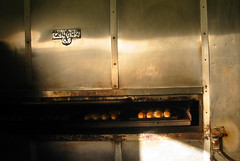
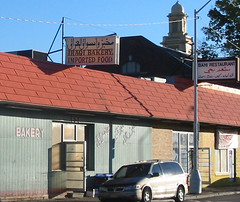
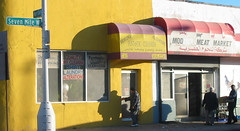
I'm trying to figure out the ins and outs of posting pics (see my shots of the Chaldean district below) using flickr and blogger and am having trouble figuring out how to manipulate images. Flickr has the "blog this" function but that doesn't allow you to put multiple pics in the same post, mess around with size/layout/etc. Any tips? Is there a tutorial that I'm missing?
10/26/2005


rave review
Fans of Detroit rock&roll take note. Metro Times today posted a deservedly glowing review of the Dirtbombs' If You Don't Already Have A Look, surely the best wax to come out of motown this year. If you haven't already had a listen, do so.
10/25/2005
The Real World
"The Real World" may be coming to my backyard, which raises the possibility of a background shot during the credits of me walking Hyatt. I can only assume MTV will call the show "Real World: Detroit" and spark debate over whether the network should use the more accurate "Real World: Royal Oak." Of course Royal Oak is the MTV version (young white people with leisure time) of Detroit, but wouldn't MTV create its own version of Detroit regardless of where they filmed? How different would "Real World: Detroit" be if filmed in Corktown vs. Royal Oak or Ferndale? First off, the neighborhood of the house doesn't figure all that prominently in the show's plotlines. But beyond that, aren't Real World locations generic backdrops? In terms of the show's content, conflicts, and affect, (all of which are constructed indoors) how does the fleeting shot of the Liberty Bell or the beach or the Statue of Liberty matter? What if location *were* a living, breathing entity on the show? Then I'd be tempted to get cable and watch "Real World Detroit."
10/18/2005
identification and non-identification with power
I continue to work on an article on working-class poetics that uses my great-grandfather's anti-FDR writings. Poetics value performance over persuasion; the affective goal is catharsis. To understand the rhetoric that working-class folks use to self-identify, we must contend with poetics--the performance of identity via utterances meant to provoke. Performative utterances like the chapbook of political poetry my great-grandfather published during the Depression revel in irony and contradiction. The ironies and contradictions of working-class identity.
Power lies at the heart of those contradictions. Claiming working-class identity acknowledges lack of power/cultural capital/materiality. Paradoxically, laying claim to being w/c entails touting dignity, value and power of collective identity. The contradiction of w/c identity: a simultaneous and/or alternating non-identification and identification with power.
Poetics facilitates the articulation of these contradictions in a way that a "rhetoric" cannot. Not because of some kind of heart-head binary, but because the performativity of poetics (whether sitcoms about w/c families, FDR poems my grandpa wrote, trash talking in w/c bars) allows for enactments of empowerment, disempowerment.
Here's where I'm going: the theorizing of working-class rhetorics. First step in theorizing such a rhetoric is the collapsing of a rhetoric-poetic binary, a full accounting of the poetry and performance involved with w/c identity. Defining anything called working-class "rhetorics" (in aristotelian sense) is impossible: the terms are contested and divisive to the point of chaos. However a w/c poetics offer contradictory, aesthetically rich, performative enactments of w/c identity.
Power lies at the heart of those contradictions. Claiming working-class identity acknowledges lack of power/cultural capital/materiality. Paradoxically, laying claim to being w/c entails touting dignity, value and power of collective identity. The contradiction of w/c identity: a simultaneous and/or alternating non-identification and identification with power.
Poetics facilitates the articulation of these contradictions in a way that a "rhetoric" cannot. Not because of some kind of heart-head binary, but because the performativity of poetics (whether sitcoms about w/c families, FDR poems my grandpa wrote, trash talking in w/c bars) allows for enactments of empowerment, disempowerment.
Here's where I'm going: the theorizing of working-class rhetorics. First step in theorizing such a rhetoric is the collapsing of a rhetoric-poetic binary, a full accounting of the poetry and performance involved with w/c identity. Defining anything called working-class "rhetorics" (in aristotelian sense) is impossible: the terms are contested and divisive to the point of chaos. However a w/c poetics offer contradictory, aesthetically rich, performative enactments of w/c identity.
10/17/2005
race in Dearborn
From today's Free Press:
Stephanie, also from my Comp. 106 class, writes about Fordson High School in Dearborn. Fordson is the ironic postscript to Hubbard's rasist legacy, enrolling 95% Arab-American students.
Contradiction. Irony. A city with a history rooted in segregation and white supremacy. A city known nationwide for its Arabic communities. I saw images from Toledo this weekend, the race riots, the anarchy, and thought about Dearborn, thought about the fragile peace of communities, thought about the three high-profile cross burnings that took place in Butler County, Ohio, during my three years living there, thought about discussion of race in Comp. 106, where last week a student in the class shared an anecdote of being victimized by a racist epithet not thirty years ago but in recent weeks.
What does a community do with its own racism? How ought a university within that community take a role in confronting both the community's history and the community's present?
Police are trying to learn who was behind racist graffiti that was spray-painted on the home of an African-American family in Dearborn over the weekend.Dearborn as a site of racism has a long and storied history. Sean, a student in my Comp. 106 class, writes about long-time Dearborn Mayor Orville Hubbard and his namesake statue, whose arms stretch over the city, reminding citizens of his staunch segregationist views. In addition to the Hubbard statue outside of city hall, this mythic pic of Hubbard standing on Michigan Avenue suggests the Hubbard mythology of putting his body between Detroit and Dearborn to keep African-Americans in the former and out of the latter. From David Good:
Sometime late Saturday or early Sunday, someone used brown paint to scrawl "Get out" followed by a racial slur. It was then followed with the words "and no love, and all for one," police said.
Despite his record, Hubbard, intriguingly, saw himself as almost a moderate on the race issue, even while giving in to racist invective of the worst sort. "I'm not a racist," he once protested to his assembled department heads, "but I just hate those black bastards." Once, in an apparent effort to show a group of appoinees and a reporter how broadminded he was, he approached a black parking attendant at one of his favorite luncheon spots and, with a flourish, kissed the man on both cheeks. "See," the mayor told his entourage, "I don't hate n-----s."Trashcans around town still tout "Keep Dearborn Clean," the dubious mantra of an ad campaign started by Hubbard himself.
Stephanie, also from my Comp. 106 class, writes about Fordson High School in Dearborn. Fordson is the ironic postscript to Hubbard's rasist legacy, enrolling 95% Arab-American students.
Contradiction. Irony. A city with a history rooted in segregation and white supremacy. A city known nationwide for its Arabic communities. I saw images from Toledo this weekend, the race riots, the anarchy, and thought about Dearborn, thought about the fragile peace of communities, thought about the three high-profile cross burnings that took place in Butler County, Ohio, during my three years living there, thought about discussion of race in Comp. 106, where last week a student in the class shared an anecdote of being victimized by a racist epithet not thirty years ago but in recent weeks.
What does a community do with its own racism? How ought a university within that community take a role in confronting both the community's history and the community's present?
10/07/2005
ad hominem
Great discussion in Composition 99 class last night about logical fallacies. We probably wandered too far off-topic, but students were especially interested in arguing with the notion of ad hominem "attacks" as necessarily being fallacious. Consensus from the class: 'name-calling' per se usually diverts attention from the content of an argument, but most examples of so-called ad hominem arguing we pointed to were legitimate considerations/critiques of credibility.
One student brought up John Edwards' allusions in the VP debate last year to Dick Cheney's daughter being a lesbian. Red herring? Cheap appeal to homophobic voters? Legitimate subject given the GOP's stated desire for a constitutional amendment banning gay marriage? Some students felt the move represented a version of ad hominem argumentation ("your kid's gay!").
Another curious example we discussed: Jack Lessenberry's latest column in the Metro Times. Lessenberry takes on an anachronistic GOP smear campaign against a bill that would have named a post office in California after an alleged communist sympathizer. From his criticisms of one of the reps who spearheaded the campaign:
I appreciate students' skepticism of the fallacies. Textbooks tend to brush off "ad hominem" as a fallacy without complicating the fine line between name calling/attack and critiques of ethos. But I also found curious their overwhelming support for public figures' family lives becoming fair game for critique. We had trouble coming up with examples of political discourse involving statements about an opponent's private life/family/etc. that students felt crossed a line. The traditional-college-aged students in the class were in junior high during the Monica Lewinsky scandal--I wonder how heavy those memories weigh on their current ideas about public discourse.
One student brought up John Edwards' allusions in the VP debate last year to Dick Cheney's daughter being a lesbian. Red herring? Cheap appeal to homophobic voters? Legitimate subject given the GOP's stated desire for a constitutional amendment banning gay marriage? Some students felt the move represented a version of ad hominem argumentation ("your kid's gay!").
Another curious example we discussed: Jack Lessenberry's latest column in the Metro Times. Lessenberry takes on an anachronistic GOP smear campaign against a bill that would have named a post office in California after an alleged communist sympathizer. From his criticisms of one of the reps who spearheaded the campaign:
the nomination excited the passions of one Steven King, a horror novel of a congressman from some backwater town in Iowa.In the context of Lessenberry's sarcastic voice, we talked about the rhetorical effect and specifically the alleged fallaciousness of calling the guy "backwater," pointing out that he never went to college, using a term like "pea brain." Fun stuff and, in a class that meets from 6-9 p.m., students were lively.
True, Steve the Lesser never went to college, but he knows his commies. He owned a construction company before his elevation by the voters, and now mainly spends his time fighting against unions and civil liberties.
“Joe McCarthy was a hero for America,” this pea-brain proclaimed last week.
I appreciate students' skepticism of the fallacies. Textbooks tend to brush off "ad hominem" as a fallacy without complicating the fine line between name calling/attack and critiques of ethos. But I also found curious their overwhelming support for public figures' family lives becoming fair game for critique. We had trouble coming up with examples of political discourse involving statements about an opponent's private life/family/etc. that students felt crossed a line. The traditional-college-aged students in the class were in junior high during the Monica Lewinsky scandal--I wonder how heavy those memories weigh on their current ideas about public discourse.
10/05/2005
Vietnamese in Dearborn
Lunch today at Annam in beautiful downtown Dearborn. My experience with Vietnamese food mostly comes from eating in the homes of friends (see previous two posts), or at mom-and-pop Vietnamese diners, so Annam was a bit jarring. Upscale in both decor and service, and with a menu emphasizing vegetarian "fusion" dishes more than pho, Annam feels like a trendy, west-coast joint. Having said that, though, I opted for the pho (my go-to choice at Vietnamese restaurants): a simple beef broth with flat noodles, thin pieces of beef, and usually served with various sprouts and herbs that one can add at will. Somewhat lacking in the spice department (usually the broth has a touch of fish sauce and the plate of veggies/condiments includes various hot chiles--not so, unfortunately, at Annam), but warm and good. You think chicken soup cures your ills? Then you haven't had a good bowl of pho.
Related note...best lunch--and quickest to boot--that's ten minutes or less from U of M Dearborn: take-out from the New Yasmeen bakery on Warren Avenue. For five or six dollars, you can walk out with a filling combination of a shawarma sandwich and/or a couple kibbees and/or a few mini spinach or meat pies. I can drive up to Warren Ave., get lunch at New Yasmeen's deli counter, and eat on my way back to campus--all in about thirty minutes. They also have all kinds of good sweets, salads, oh yeah, and a mean bowl of jhadra (usually a combo of rice, lentils, and cracked wheat--I've probably got the spelling wrong).
Related note...best lunch--and quickest to boot--that's ten minutes or less from U of M Dearborn: take-out from the New Yasmeen bakery on Warren Avenue. For five or six dollars, you can walk out with a filling combination of a shawarma sandwich and/or a couple kibbees and/or a few mini spinach or meat pies. I can drive up to Warren Ave., get lunch at New Yasmeen's deli counter, and eat on my way back to campus--all in about thirty minutes. They also have all kinds of good sweets, salads, oh yeah, and a mean bowl of jhadra (usually a combo of rice, lentils, and cracked wheat--I've probably got the spelling wrong).
10/04/2005
the great LAX adventure
So Thursday afternoon I leave San Pedro in a jeep with rudimentary directions to one of the biggest and busiest airports in the world. I've arranged for two mini-vans, both of which require a 25-or-over driver with a major credit card, at the Dollar rent-a-car adjacent to LAX. I've also got a list of sixteen relatives, arriving on three different flights on three different airlines at three (slightly) different times. About half of the relatives don't speak English; I don't speak Vietnamese. I need to retrieve a couple drivers, go to Dollar, return to the three terminals, and then get the three vehicles and seventeen people back to San Pedro.
I arrive early, reverse my San Pedro-to-LAX directions and write out three copies, one for each vehicle. I pick up one brother (a displaced University of New Orleans undergrad studying in Oregon for the semester and hence on a flight all his own) but he's under 25. A perfect candidate to drive the jeep. We cruise around the seven terminals waiting for more siblings to land.
A brother-in-law pops out of the terminal. Over 25? Yep. Major credit card and valid driver's license? Not so much.
We keep cruising, three of us now in the jeep. Big group--parents, miscelaneous grandchildren, cousins--comes out of terminal five right on schedule. I explain why they have to stay in terminals a little longer and grab another brother, 25+ and holding a Visa. Four of us cruise to Dollar for vans. Three vans back to first terminal. Relatives. Wedding presents. Suitcases. Hugs all around. One van full.
Next terminal. More relatives. More baggage. More hugs. Another van full. I give written directions to the other two drivers for "just in case we get split up on the highway." A seminarian, a friend of the family at the airport to "help with the arrival" announces that we should wait for him curbside at the terminal while he goes and gets his car from the garage. Security already eyeing the bilingual crowd with conspicuous large boxes, already shooing us toward the exit. I tell seminarian to catch up with us on the 405--you can't miss the parade of two mini-vans and a jeep going slow in the right lane.
Everybody loaded. Jeep, still driven by younger brother, his twin the only passenger, jets out of LAX. So much for the directions being "just in case we get split up." Mini-vans pull out. I'm in the lead. Loud Vietnamese conversations fill the vehicle. Crying grandchild, comforted only by very loud rock and roll on the radio. Mini-van in the rear view. Numerous cell phone conversations with seminarian, trying desperately to catch up to me, though I'm going 40 mph in the right lane. Traffic picks up. Twins call from their cell phone...Q: why aren't you guys at the hotel yet? A: still going 45, trying to get your whole family down there, trying to wait for Fr. Pokey.
Finally, our caravan is three vehicles strong. Baby still crying, conversation still boisterous, I kick it up to 70 mph, an eye constantly in the rear view, and find my way to San Pedro. Check family into six hotel rooms, make room assignments, doll out keycards.
[Three days and one wedding later, groom already honeymooning, time to go back.]
Departure from San Pedro, caravan-style once again. Most of family displaced in Baton Rouge, where finding traditional Vietamese food not as easy as doing so down in New Orleans...so a post-wedding trip to Santa Ana night before departure allowed family to buy boxes and boxes of Asian produce, french bread, and other items they miss being shut out of their adopted city. Hence, vans now full of people AND boxes and boxes of stuff.
The terminals are easy this time. First terminal: passengers unload with respective luggage and groceries. Second terminal: passengers unload with respective luggage and groceries. Third terminal: Oregon-bound brother unloads and Nicole takes over jeep driving duties. Back to Dollar. Vans returned. Groom's older brother, Nicole, and I return rented vehicles. Nicole and I drop final relative at terminal. End of story...
Until cell phone communication later reveals the following airport mishap:
Airport officials: you can only check two packages.
Family: we'll check boxes and carry on our suitcases.
Airport officials: your suitcases look too big.
Family: we'll be fine.
Gate officials: your suitcases are too big.
Family: fine, we'll check them and pay the cost of an extra checked bag.
Gate officials: you have to go back to the ticketing area to check additional bags
Two brothers and one brother-in-law walk back to ticketing area. Airline sells their tickets to stand-by passengers. No more flights to Louisiana. Brothers and brother-in-law must fly to Houston and hitch rides with friends back to temporary homes in Louisiana where their respective wives and Santa Ana Vietnamese produce await.
I arrive early, reverse my San Pedro-to-LAX directions and write out three copies, one for each vehicle. I pick up one brother (a displaced University of New Orleans undergrad studying in Oregon for the semester and hence on a flight all his own) but he's under 25. A perfect candidate to drive the jeep. We cruise around the seven terminals waiting for more siblings to land.
A brother-in-law pops out of the terminal. Over 25? Yep. Major credit card and valid driver's license? Not so much.
We keep cruising, three of us now in the jeep. Big group--parents, miscelaneous grandchildren, cousins--comes out of terminal five right on schedule. I explain why they have to stay in terminals a little longer and grab another brother, 25+ and holding a Visa. Four of us cruise to Dollar for vans. Three vans back to first terminal. Relatives. Wedding presents. Suitcases. Hugs all around. One van full.
Next terminal. More relatives. More baggage. More hugs. Another van full. I give written directions to the other two drivers for "just in case we get split up on the highway." A seminarian, a friend of the family at the airport to "help with the arrival" announces that we should wait for him curbside at the terminal while he goes and gets his car from the garage. Security already eyeing the bilingual crowd with conspicuous large boxes, already shooing us toward the exit. I tell seminarian to catch up with us on the 405--you can't miss the parade of two mini-vans and a jeep going slow in the right lane.
Everybody loaded. Jeep, still driven by younger brother, his twin the only passenger, jets out of LAX. So much for the directions being "just in case we get split up." Mini-vans pull out. I'm in the lead. Loud Vietnamese conversations fill the vehicle. Crying grandchild, comforted only by very loud rock and roll on the radio. Mini-van in the rear view. Numerous cell phone conversations with seminarian, trying desperately to catch up to me, though I'm going 40 mph in the right lane. Traffic picks up. Twins call from their cell phone...Q: why aren't you guys at the hotel yet? A: still going 45, trying to get your whole family down there, trying to wait for Fr. Pokey.
Finally, our caravan is three vehicles strong. Baby still crying, conversation still boisterous, I kick it up to 70 mph, an eye constantly in the rear view, and find my way to San Pedro. Check family into six hotel rooms, make room assignments, doll out keycards.
[Three days and one wedding later, groom already honeymooning, time to go back.]
Departure from San Pedro, caravan-style once again. Most of family displaced in Baton Rouge, where finding traditional Vietamese food not as easy as doing so down in New Orleans...so a post-wedding trip to Santa Ana night before departure allowed family to buy boxes and boxes of Asian produce, french bread, and other items they miss being shut out of their adopted city. Hence, vans now full of people AND boxes and boxes of stuff.
The terminals are easy this time. First terminal: passengers unload with respective luggage and groceries. Second terminal: passengers unload with respective luggage and groceries. Third terminal: Oregon-bound brother unloads and Nicole takes over jeep driving duties. Back to Dollar. Vans returned. Groom's older brother, Nicole, and I return rented vehicles. Nicole and I drop final relative at terminal. End of story...
Until cell phone communication later reveals the following airport mishap:
Airport officials: you can only check two packages.
Family: we'll check boxes and carry on our suitcases.
Airport officials: your suitcases look too big.
Family: we'll be fine.
Gate officials: your suitcases are too big.
Family: fine, we'll check them and pay the cost of an extra checked bag.
Gate officials: you have to go back to the ticketing area to check additional bags
Two brothers and one brother-in-law walk back to ticketing area. Airline sells their tickets to stand-by passengers. No more flights to Louisiana. Brothers and brother-in-law must fly to Houston and hitch rides with friends back to temporary homes in Louisiana where their respective wives and Santa Ana Vietnamese produce await.
code switching
Back from California where I had best-man duties at close friend's wedding. Close friend (CF) was born in Vietnam and raised in a predominantly African-American neighborhood on the eastside of New Orleans. We've been pals since ninth grade and from the start his code switching--combining Vietnamese and African-American vernacular dialect--has fascinated me. Part hip hop and gangsta rap diction and its attendant masculinity, part Asian-American syntax (ubiquitous singular nouns, etc.): "Bitch, I got to do my Physic homework," etc.
CF's younger sisters--in some ways tough, sassy, independent and in other ways traditional and thoroughly old-school--have some really neat speech patterns too. Once during a visit to CF's we were all sitting around when one sister, in high school at the time, got a phone call and took the call in the other room. Her other sister looked at CF, and offered boisterous commentary, all in Vietnamese except the lone English term "booty call."
Best-man duties included driving extended family around L.A. so I had ample time to soak in the sounds of the code switching, the poetry of which really grows on you. CF's parents, who are mostly monolingual and who are currently displaced in Baton Rouge (refugees for the second time in their lives), peppered their conversations with post-Katrina bits of English: "category five," "Rita," etc. Even CF's mom, who I've heard say maybe three words in English over the years, at one point said "FEMA" during a conversation with her sister.
CF's younger sisters--in some ways tough, sassy, independent and in other ways traditional and thoroughly old-school--have some really neat speech patterns too. Once during a visit to CF's we were all sitting around when one sister, in high school at the time, got a phone call and took the call in the other room. Her other sister looked at CF, and offered boisterous commentary, all in Vietnamese except the lone English term "booty call."
Best-man duties included driving extended family around L.A. so I had ample time to soak in the sounds of the code switching, the poetry of which really grows on you. CF's parents, who are mostly monolingual and who are currently displaced in Baton Rouge (refugees for the second time in their lives), peppered their conversations with post-Katrina bits of English: "category five," "Rita," etc. Even CF's mom, who I've heard say maybe three words in English over the years, at one point said "FEMA" during a conversation with her sister.
9/30/2005
live from san pedro, ca.
On location in sunny southern California. No sign of humidity and temps in the mid-80s. Nicole and I eat breakfast outside along the bay, surrounded by moored boats and the sound of waves against the rocks. Post-breakfast stroll reveals starfish, crabs fighting one another, and amoeba-like schools of fish traveling close to the shore. It's no Detroit, but L.A. has its advantages.
9/28/2005
studs terkel: the musical?
Is this as bad as it sounds? A *musical* based on Studs Terkel's classic piece of oral history, Working? Terkel's book came out in 1972 and drew praise from the left as well as the mainstream for its diverse set of commentaries/rants/narratives about what people "do all day and how they feel about what they do." Working-class studies, as an academic discipline, probably would not be possible without Terkel.
But a musical?
But a musical?
9/21/2005
fear of falling, formal correctness, and blogs
Thinking out loud here. Excuse the randomness and the highly questionable connections I'm about to make...
In the newest issue of Teaching English in the Two-Year College, Amy Lynch-Biniek describes the popularity on her campus of the grammar guide Eats, Shoots, & Leaves: The Zero Tolerance Approach to Punctuation, which sat on best-seller lists for months last year. I was interested in her suggestion that one of the causes for the popularity is what Barbara Ehrenreich elsewhere calls "the fear of falling," an insecurity among members of the (shrinking) middle/professional class, an anxiety (a justified one at that) that they might fall out of their comfortable positions. Lynch-Biniek suggests the cultural obsession over "correctness" in writing (she argues that--at least on standardized tests--comma errors trump ineffectiveness in terms of what damns a piece of writing) reflects this anxiety. Grammar guide as self-help book. Grammar guide as means to (maintain or achieve) social position.
In my own research, I've critiqued ways that open-admissions colleges institutionalized (via curriculum, obviously, but also in representations of college mission and particularly in its communications with working-class community members) this use of language as class marker and "achievement."
But I'm thinking about the present moment, the burgeoning popularity of blogs, for example, and moments where the culture maybe chipping away at a middle-class sense of formal-correctness-above-all. I know the party line is that blogs, like any other textual phenomenon, build their own conventions which are just as rule-bound as any other. But I'm not so sure. Doesn't blogging, at the very least, break down notions of middle-class decorum inherent in what books like Eats, Shoots, and Leaves.
The grammar guide revels in its ha-ha titular pun, which is a warning about the lack of "clarity" that arises from a punctuation mishap. But don't blogs revel in something quite different...a reveling in language that's messier than the "1) learn the rules, 2) become part of the initiated crowd, 3) make fun of those on the outside of the club" assumptions of grammarians? Blogs revel in language play that doesn't necessarily require the initiation process? Join in the reindeer (language) games and take part in appropriation, error-making, tentativeness, randomness, and incoherence.
And yet, blogging requires access, so we get a new version of elitism and exclusion.
In the newest issue of Teaching English in the Two-Year College, Amy Lynch-Biniek describes the popularity on her campus of the grammar guide Eats, Shoots, & Leaves: The Zero Tolerance Approach to Punctuation, which sat on best-seller lists for months last year. I was interested in her suggestion that one of the causes for the popularity is what Barbara Ehrenreich elsewhere calls "the fear of falling," an insecurity among members of the (shrinking) middle/professional class, an anxiety (a justified one at that) that they might fall out of their comfortable positions. Lynch-Biniek suggests the cultural obsession over "correctness" in writing (she argues that--at least on standardized tests--comma errors trump ineffectiveness in terms of what damns a piece of writing) reflects this anxiety. Grammar guide as self-help book. Grammar guide as means to (maintain or achieve) social position.
In my own research, I've critiqued ways that open-admissions colleges institutionalized (via curriculum, obviously, but also in representations of college mission and particularly in its communications with working-class community members) this use of language as class marker and "achievement."
But I'm thinking about the present moment, the burgeoning popularity of blogs, for example, and moments where the culture maybe chipping away at a middle-class sense of formal-correctness-above-all. I know the party line is that blogs, like any other textual phenomenon, build their own conventions which are just as rule-bound as any other. But I'm not so sure. Doesn't blogging, at the very least, break down notions of middle-class decorum inherent in what books like Eats, Shoots, and Leaves.
The grammar guide revels in its ha-ha titular pun, which is a warning about the lack of "clarity" that arises from a punctuation mishap. But don't blogs revel in something quite different...a reveling in language that's messier than the "1) learn the rules, 2) become part of the initiated crowd, 3) make fun of those on the outside of the club" assumptions of grammarians? Blogs revel in language play that doesn't necessarily require the initiation process? Join in the reindeer (language) games and take part in appropriation, error-making, tentativeness, randomness, and incoherence.
And yet, blogging requires access, so we get a new version of elitism and exclusion.
9/20/2005
working-class rhetorics vs. working-class poetics
In addition to farming a plot of land in Mantua, Ohio, my great-grandfather spent the Great Depression writing sarcastic poems about FDR. He published a chapbook called "The New Deal" that collected eight of his ditties, each a deliberative meditation on rural, working-class libertarianism.
All partisan, sectarian content. Political discourse. Quintessential deliberate rhetoric, tackling specific, context-bound, civic concerns.
And yet I'm fascinated by grandpa's use of poetry as not only a means for engaging in civic discourse, but also as a means to articulate his own class status. I see The New Deal as a statement of working-class identity.
Is a "working-class rhetoric" even possible? Our culture doesn't have a vocabulary for having non-fiction discussions about class status. We lack terms with agreed-upon meanings. Statements about class (especially working-class) status are politically divisive, perpetually contested. And yet here's a book of poetry that serves a rhetorical function and a self-defining function.
Julie Lindquist, in her ethnography of a working-class bar in Chicago, found that among her respondents class stood out as a "felt identity." Lindquist writes, "they are unable to name themselves as a sociopolitical entity…[and] have no conventional language in which to articulate a shared political predicament." Her thesis involves the notion that political debate at the bar becomes a performance of class identity, a substitute for a meta-cognitive language for articulating class status.
I think poetry functions in a similar vein for my grandpa. A performance of his working-class identity, a stand-in for a critical vocabulary for saying 'this is who I am.' I'm thinking poetics (and maybe by poetics I mean "performance") allows for this in a way that "rhetorics" can't.
So I'm toying with the notion that "working-class rhetorics" are impossible, whereas "working-class poetics" instead provides for opportunities for self identification, identity construction, and political discourse.
The Grounded Ear
We have a President Roosevelt,
the thing that makes me madder,
Is how craftily he sneaked around
And climbed up Teddy's ladder.
If you politicians would succeed,
Yes? Well then, here's the moral!
He rode up to our White House chair
Astride a whiskey barrel...
To his country stuck in banker mud
His order pedagogic,
"Lift yourselves by boot straps,"
Just simply is not logic.
All partisan, sectarian content. Political discourse. Quintessential deliberate rhetoric, tackling specific, context-bound, civic concerns.
And yet I'm fascinated by grandpa's use of poetry as not only a means for engaging in civic discourse, but also as a means to articulate his own class status. I see The New Deal as a statement of working-class identity.
Is a "working-class rhetoric" even possible? Our culture doesn't have a vocabulary for having non-fiction discussions about class status. We lack terms with agreed-upon meanings. Statements about class (especially working-class) status are politically divisive, perpetually contested. And yet here's a book of poetry that serves a rhetorical function and a self-defining function.
Julie Lindquist, in her ethnography of a working-class bar in Chicago, found that among her respondents class stood out as a "felt identity." Lindquist writes, "they are unable to name themselves as a sociopolitical entity…[and] have no conventional language in which to articulate a shared political predicament." Her thesis involves the notion that political debate at the bar becomes a performance of class identity, a substitute for a meta-cognitive language for articulating class status.
I think poetry functions in a similar vein for my grandpa. A performance of his working-class identity, a stand-in for a critical vocabulary for saying 'this is who I am.' I'm thinking poetics (and maybe by poetics I mean "performance") allows for this in a way that "rhetorics" can't.
So I'm toying with the notion that "working-class rhetorics" are impossible, whereas "working-class poetics" instead provides for opportunities for self identification, identity construction, and political discourse.
9/14/2005
Bloc Party show last night
Still getting accustomed to my new job and finding a productive and humane work schedule, difficult tasks with four consecutive weekends with out-of-town commitments. More frequent blogging in the very near future...I guarantee.
In the meantime, a few thoughts on last night's Bloc Party show at the Royal Oak Music Theater. The band came out and performed a lean, fast-paced, Buzzocks-like set. No more than thirty-five minutes, but nearly the whole crowd was shakin' it (and that included college kids as well as older, music-geek types). Amazing energy level, more punk than how they come off on their CD. They flew through the better part of their record, with nearly every track paced notably faster. Even with the speedy, thin pace, the band maintained the dance vibe that earns them Gang of Four comparisons in the media. Oddly, they left the stage and returned with a slowed-down encore that was a bit anti-climactic. But they're a young band and pacing might be something they work on as they build a larger catalogue of material.
The Kills opened the show with their usual loud and suggestive approach to blues-punk. I saw them headline a show in Cinci. last year and the full-length set really allowed them to create a kind of narrative (one involving the duo acting out a love-hate relationship that seemed to involve climbing on amps and using fret boards to simulate firing rifles) within the scope of their performace. Last night they had to shorten the set to play the opening act roll. They rocked out (ears still ringing a bit) but I missed the Captain Beefheart cover ("Dropout Boogie") and their breakout single "Cat Claw" last night, when they concentrated on material from their newer album No Wow.
Good time, and home by 11:15...my kind (read: geezer) of show.
In the meantime, a few thoughts on last night's Bloc Party show at the Royal Oak Music Theater. The band came out and performed a lean, fast-paced, Buzzocks-like set. No more than thirty-five minutes, but nearly the whole crowd was shakin' it (and that included college kids as well as older, music-geek types). Amazing energy level, more punk than how they come off on their CD. They flew through the better part of their record, with nearly every track paced notably faster. Even with the speedy, thin pace, the band maintained the dance vibe that earns them Gang of Four comparisons in the media. Oddly, they left the stage and returned with a slowed-down encore that was a bit anti-climactic. But they're a young band and pacing might be something they work on as they build a larger catalogue of material.
The Kills opened the show with their usual loud and suggestive approach to blues-punk. I saw them headline a show in Cinci. last year and the full-length set really allowed them to create a kind of narrative (one involving the duo acting out a love-hate relationship that seemed to involve climbing on amps and using fret boards to simulate firing rifles) within the scope of their performace. Last night they had to shorten the set to play the opening act roll. They rocked out (ears still ringing a bit) but I missed the Captain Beefheart cover ("Dropout Boogie") and their breakout single "Cat Claw" last night, when they concentrated on material from their newer album No Wow.
Good time, and home by 11:15...my kind (read: geezer) of show.
9/08/2005
class of '92
Alright, just taught my first class of the semester and ought to blog students and all of the exciting projects of the semester, but I'll pick up on the thread (here and here), and have a bit of fun while I eat my yogurt.
Here's the deal: go to Music Outfitters and get the list of the Top 100 songs from the year of your high school graduation. Paste them into your blog and identify those that you like or dislike. I've bolded the ones I like and italicized those I disliked. I've left alone those that I don't remember. Yeah, this is way more important right now than working...
Top 100 hits of 1992:
1. End Of The Road, Boyz II Men
The year Nirvana breaks, and my senior class (along with every other
senior class) chooses THIS schmaltz as its song.
2. Baby Got Back, Sir Mix A-lot
One word: awesome
3. Jump, Kris Kross
Of backwards clothing fame.
4. Save The Best For Last, Vanessa Williams
5. Baby-Baby-Baby, TLC
6. Tears In Heaven, Eric Clapton
7. My Lovin' (You're Never Gonna Get It), En Vogue
8. Under The Bridge, Red Hot Chili Peppers
9. All 4 Love, Color Me Badd
10. Just Another Day, Jon Secada
11. I Love Your Smile, Shanice
12. To Be With You, Mr. Big
embarassing, but I found this catchy at the time.
13. I'm Too Sexy, Right Said Fred
14. Black Or White, Michael Jackson
15. Achy Breaky Heart, Billy Ray Cyrus 16.
16. I'll Be There, Mariah Carey
17. November Rain, Guns N' Roses
18. Life Is A Highway, Tom Cochrane
19. Remember The Time, Michael Jackson
20. Finally, CeCe Peniston
21. This Used To Be My Playground, Madonna
22. Sometimes Love Just Ain't Enough, Patty Smyth
23. Can't Let Go, Mariah Carey
24. Jump Around, House Of Pain
25. Diamonds and Pearls, Prince and The N.P.G.
26. Don't Let The Sun Go Down On Me, George Michael and Elton John
27. Masterpiece, Atlantic Starr
28. If You Asked Me To, Celine Dion
29. Giving Him Something He Can Feel, En Vogue
30. Live and Learn, Joe Public
31. Come and Talk To Me, Jodeci
32. Smells Like Teen Spirit, Nirvana
33. Humpin' Around, Bobby Brown
34. Damn I Wish I Was Your Lover, Sophie B. Hawkins
35. Tell Me What You Want Me To Do, Teven Campbell
36. Ain't 2 Proud 2 Beg, TLC
37. It's So Hard To Say Goodbye To Yesterday, Boyz II Men
38. Move This, Technotronic
39. Bohemian Rhapsody, Queen
40. Tennessee, Arrested Development
41. The Best Things In Life Are Free, Luther Vandross and Janet Jackson
42. Make It Happen, Mariah Carey
43. The One, Elton John
44. Set Adrift On Memory Bliss, P.M. Dawn
45. Stay, Shakespear's Sister
46. 2 Legit 2 Quit, Hammer
47. Please Don't Go, K.W.S.
48. Breakin' My Heart (Pretty Brown Eyes), Mint Condition
49. Wishing On A Star, Cover Girls
50. She's Playing Hard To Get, Hi-Five
51. I'd Die Without You, P.M. Dawn
52. Good For Me, Amy Grant
53. All I Want, Toad The Wet Sprocket
54. When A Man Loves A Woman, Michael Bolton
55. I Can't Dance, Genesis
56. Hazard, Richard Marx
57. Mysterious Ways, U2
58. Too Funky, George Michael
59. How Do You Talk To An Angel, Heights
60. One, U2
61. Keep On Walkin', CeCe Peniston
62. Hold On My Heart, Genesis
63. The Way I Feel About You, Karyn White
64. Beauty and The Beast, Calms Dion and Peabo Bryson
65. Warm It Up, Kris Kross
66. In The Closet, Michael Jackson
67. People Everyday, Arrested Development
68. No Son Of Nine, Genesis
69. Wildside, Marky Mark and The Funky Bunch
70. Do I Have To Say The Words?, Bryan Adams
71. Friday I'm In Love, Cure
72. Everything About You, Ugly Kid Joe
73. Blowing Kisses In The Wind, Paula Abdul
74. Thought I'd Died and Gone To Heaven, Bryan Adams
75. Rhythm Is A Dancer, Snap
76. Addams Groove, Hammer
77. Missing You Now, Michael Bolton
78. Back To The Hotel, N2Deep
79. Everything Changes, Kathy Troccoli
80. Have You Ever Needed Somone So Bad, Def Leppard
81. Take This Heart, Richard Marx
82. When I Look Into Your Eyes, Firehouse
83. I Wanna Love You, Jade
84. Uhh Ahh, Boyz II Men
85. Real Love, Mary J. Blige
86. Justified and Ancient, The KLF
87. Slow Motion, Color Me Badd
88. What About Your Friends, TLC
89. Thinkin' Back, Color Me Badd
90. Would I Lie To You?, Charles and Eddie
91. That's What Love Is For, Amy Grant
92. Keep Coming Back, Richard Marx
93. Free Your Mind, En Vogue
94. Keep It Comin', Keith Sweat
95. Just Take My Heart, Mr. Big
96. I Will Remember You, Amy Grant
97. We Got A Love Thang, CeCe Peniston
98. Let's Get Rocked, Def Leppard
99. They Want EFX, Das EFX
100. I Can't Make You Love Me, Bonnie Raitt
Here's the deal: go to Music Outfitters and get the list of the Top 100 songs from the year of your high school graduation. Paste them into your blog and identify those that you like or dislike. I've bolded the ones I like and italicized those I disliked. I've left alone those that I don't remember. Yeah, this is way more important right now than working...
Top 100 hits of 1992:
1. End Of The Road, Boyz II Men
The year Nirvana breaks, and my senior class (along with every other
senior class) chooses THIS schmaltz as its song.
2. Baby Got Back, Sir Mix A-lot
One word: awesome
3. Jump, Kris Kross
Of backwards clothing fame.
4. Save The Best For Last, Vanessa Williams
5. Baby-Baby-Baby, TLC
6. Tears In Heaven, Eric Clapton
7. My Lovin' (You're Never Gonna Get It), En Vogue
8. Under The Bridge, Red Hot Chili Peppers
9. All 4 Love, Color Me Badd
10. Just Another Day, Jon Secada
11. I Love Your Smile, Shanice
12. To Be With You, Mr. Big
embarassing, but I found this catchy at the time.
13. I'm Too Sexy, Right Said Fred
14. Black Or White, Michael Jackson
15. Achy Breaky Heart, Billy Ray Cyrus 16.
16. I'll Be There, Mariah Carey
17. November Rain, Guns N' Roses
18. Life Is A Highway, Tom Cochrane
19. Remember The Time, Michael Jackson
20. Finally, CeCe Peniston
21. This Used To Be My Playground, Madonna
22. Sometimes Love Just Ain't Enough, Patty Smyth
23. Can't Let Go, Mariah Carey
24. Jump Around, House Of Pain
25. Diamonds and Pearls, Prince and The N.P.G.
26. Don't Let The Sun Go Down On Me, George Michael and Elton John
27. Masterpiece, Atlantic Starr
28. If You Asked Me To, Celine Dion
29. Giving Him Something He Can Feel, En Vogue
30. Live and Learn, Joe Public
31. Come and Talk To Me, Jodeci
32. Smells Like Teen Spirit, Nirvana
33. Humpin' Around, Bobby Brown
34. Damn I Wish I Was Your Lover, Sophie B. Hawkins
35. Tell Me What You Want Me To Do, Teven Campbell
36. Ain't 2 Proud 2 Beg, TLC
37. It's So Hard To Say Goodbye To Yesterday, Boyz II Men
38. Move This, Technotronic
39. Bohemian Rhapsody, Queen
40. Tennessee, Arrested Development
41. The Best Things In Life Are Free, Luther Vandross and Janet Jackson
42. Make It Happen, Mariah Carey
43. The One, Elton John
44. Set Adrift On Memory Bliss, P.M. Dawn
45. Stay, Shakespear's Sister
46. 2 Legit 2 Quit, Hammer
47. Please Don't Go, K.W.S.
48. Breakin' My Heart (Pretty Brown Eyes), Mint Condition
49. Wishing On A Star, Cover Girls
50. She's Playing Hard To Get, Hi-Five
51. I'd Die Without You, P.M. Dawn
52. Good For Me, Amy Grant
53. All I Want, Toad The Wet Sprocket
54. When A Man Loves A Woman, Michael Bolton
55. I Can't Dance, Genesis
56. Hazard, Richard Marx
57. Mysterious Ways, U2
58. Too Funky, George Michael
59. How Do You Talk To An Angel, Heights
60. One, U2
61. Keep On Walkin', CeCe Peniston
62. Hold On My Heart, Genesis
63. The Way I Feel About You, Karyn White
64. Beauty and The Beast, Calms Dion and Peabo Bryson
65. Warm It Up, Kris Kross
66. In The Closet, Michael Jackson
67. People Everyday, Arrested Development
68. No Son Of Nine, Genesis
69. Wildside, Marky Mark and The Funky Bunch
70. Do I Have To Say The Words?, Bryan Adams
71. Friday I'm In Love, Cure
72. Everything About You, Ugly Kid Joe
73. Blowing Kisses In The Wind, Paula Abdul
74. Thought I'd Died and Gone To Heaven, Bryan Adams
75. Rhythm Is A Dancer, Snap
76. Addams Groove, Hammer
77. Missing You Now, Michael Bolton
78. Back To The Hotel, N2Deep
79. Everything Changes, Kathy Troccoli
80. Have You Ever Needed Somone So Bad, Def Leppard
81. Take This Heart, Richard Marx
82. When I Look Into Your Eyes, Firehouse
83. I Wanna Love You, Jade
84. Uhh Ahh, Boyz II Men
85. Real Love, Mary J. Blige
86. Justified and Ancient, The KLF
87. Slow Motion, Color Me Badd
88. What About Your Friends, TLC
89. Thinkin' Back, Color Me Badd
90. Would I Lie To You?, Charles and Eddie
91. That's What Love Is For, Amy Grant
92. Keep Coming Back, Richard Marx
93. Free Your Mind, En Vogue
94. Keep It Comin', Keith Sweat
95. Just Take My Heart, Mr. Big
96. I Will Remember You, Amy Grant
97. We Got A Love Thang, CeCe Peniston
98. Let's Get Rocked, Def Leppard
99. They Want EFX, Das EFX
100. I Can't Make You Love Me, Bonnie Raitt
9/07/2005
Non-Academic Stuff I Read During Summer Vacation #9
I guess since I start teaching tomorrow morning (UM-Dearborn started classes today but I've got a Tues/Thurs teaching schedule), my summer vacation is coming to a close. So here's one last installment of my run-down of this summer's reading-material-only-tangentially-related-to-rhetoric...
Philip Roth's great novel The Plot Against America is in part allegory, and a brilliant one at that, a story that mirrors the regressive policies of the current neo-con regime. But Roth goes beyond polemic, beyond partisanship, and creates a nostalgic and vivid dystopia.
A speculative historical novel, Roth's book imagines a 1940s U.S. in which Charles Lindbergh defeats FDR's re-election bid and builds diplomatic ties with Nazi Germany, institutes anti-semitic public policy at home, and effectively keeps the U.S. out of WWII. The story centers around a Jewish family in New Jersey, named "Roth," and most especially the Roth's youngstest child, "Philip."
Roth creates a dystopic world with as much chilling detail as Margaret Atwood's best novels. And like the scariest dystopias, Roth's world looks awfully familiar. I'll avoid giving examples, as I don't want to give anything away. Rest assured that the fictional Lindbergh's demagogue, the-world-is-black-and-white rhetoric uses the same tropes as the rhetoric of George W. Bush (put America first!). Great piece of work.
One of the ways Roth goes beyond simplistic polemic is by turning the tables on current right-left distinctions. In Roth's world, the left advocates U.S. entry into foriegn war while the right opposes such action. This creates more than a little ambivalence in the reader, and Roth uses this switch to ironic effect.
Roth's meandering style is in full effect here. Roth writes,
Philip Roth's great novel The Plot Against America is in part allegory, and a brilliant one at that, a story that mirrors the regressive policies of the current neo-con regime. But Roth goes beyond polemic, beyond partisanship, and creates a nostalgic and vivid dystopia.
A speculative historical novel, Roth's book imagines a 1940s U.S. in which Charles Lindbergh defeats FDR's re-election bid and builds diplomatic ties with Nazi Germany, institutes anti-semitic public policy at home, and effectively keeps the U.S. out of WWII. The story centers around a Jewish family in New Jersey, named "Roth," and most especially the Roth's youngstest child, "Philip."
Roth creates a dystopic world with as much chilling detail as Margaret Atwood's best novels. And like the scariest dystopias, Roth's world looks awfully familiar. I'll avoid giving examples, as I don't want to give anything away. Rest assured that the fictional Lindbergh's demagogue, the-world-is-black-and-white rhetoric uses the same tropes as the rhetoric of George W. Bush (put America first!). Great piece of work.
One of the ways Roth goes beyond simplistic polemic is by turning the tables on current right-left distinctions. In Roth's world, the left advocates U.S. entry into foriegn war while the right opposes such action. This creates more than a little ambivalence in the reader, and Roth uses this switch to ironic effect.
Roth's meandering style is in full effect here. Roth writes,
It went without saying that Mr. Mawhinney was a Christian, a long-standing member of the great overpowering majority that fought the Revolution and founded the nation and conquered the wilderness and subjugated the Indian and enslaved the Negro, one of the good, clean, hard-working Christian millions who settled the frontier, tilled the farms, built the cities, governed the states, sat in Congress, occupied the White House, amassed the wealth, possessed the land, owned the steel mills and the ball clubs and the railroads and the banks, even owned and oversaw the language, one of those unassailable Nordic and Anglo-Saxon Protestants who ran America and would always run it--generals, dignitaries, magnates, tycoons, the men who laid down the law and called the shots and read the riot act when they chose to--while my father, of course, was only a Jew.Holy macaroni, what a sentence. And what a voice.
9/02/2005
the mouse on Bourbon Street
New Orleans, LA., 2000. Enjoying tasty fried oysters in the French Quarter at a less-than-four-star establishment, while a mouse scurries across the floor along the restaurant's rear wall. Customers--bourbon-sipping lawyers on lunchbreaks, college-kid tourists, seafood lovers of every stripe, Nicole and I--remain oblivious to the mouse, sipping beers and raw oysters, talking over jazz licks and noisy strangers, happy in the big easy. Nicole in the restaurant's ladies room, startled by either the same mouse or one of his friends, jumps, bumping into a stall door. Woman in the stall, opens the door, sees Nicole but not the mouse, looks Nicole up and down and says: "I'm not interested." God bless New Orleans.
8/19/2005
Day Labor in Virginia and Literacy Crisis On Listerv
Interesting story on NPR this morning about the community of Herndon, Virginia, debating the funding of a day-labor center that some there feel is encouraging illegal immigration. Local right-wing radio, apparently, buzzes with callers complaining about how "unsightly" are the people of color who gather to wait for work at the center. One critic of the worker center, concerned about the aesthetic effect of the center, comments, "It's time for all nationalities to learn to live like Americans. This means learn how to speak English, learn how to have good hygiene, and learn how to use appliances correctly in your homes." Same old xenophobia from the right...same thing said of Italians and Greeks and Poles a century ago (they're dirty, don't share our values, and will pollute the democratic ideals of the U.S., bla, bla, bla).
Striking how much of the criticism of this worker center is about how people of color look, which is, I guess, different. And by extension abhorrent.
Meantime, on a national e-mail listerv for teachers of writing, there rages intense discussion over all that the new Tommy Lee reality show reveals about the illiteracy of college students. They don't read, apparently. Smart criticism of the conversation has already gone on. Of course the issue is not that college students don't read--it's that they don't read the stuff that English teachers want them to read. They're not taking part in the cultures that English teachers most value.
What's the connection between these two stories? Aesthetics and belletrism, of course. Day laborers and Tommy Lee's television sidekicks lack what a community deems to be of high cultural value, whether that deficit involves standing around outside being brown-skinned, or not knowing how to use an appliance properly (where does that notion even come from?), or not speaking the "right" way, or not reading the right books, or choosing to listen to Motley Crue, or whatever. Both are also cases of a community expressing fear and loathing for that which is different. Yikes, they're brown. Oh jeepers, they're dirty. HELP ME...they're getting their news from blogs and yahoo instead of home delivery of the NYTimes. Ohmygod they haven't read as many "good" novels as me. It's about homogenization and the desire to make everyone the same, to obliterate class differences.
Striking how much of the criticism of this worker center is about how people of color look, which is, I guess, different. And by extension abhorrent.
Meantime, on a national e-mail listerv for teachers of writing, there rages intense discussion over all that the new Tommy Lee reality show reveals about the illiteracy of college students. They don't read, apparently. Smart criticism of the conversation has already gone on. Of course the issue is not that college students don't read--it's that they don't read the stuff that English teachers want them to read. They're not taking part in the cultures that English teachers most value.
What's the connection between these two stories? Aesthetics and belletrism, of course. Day laborers and Tommy Lee's television sidekicks lack what a community deems to be of high cultural value, whether that deficit involves standing around outside being brown-skinned, or not knowing how to use an appliance properly (where does that notion even come from?), or not speaking the "right" way, or not reading the right books, or choosing to listen to Motley Crue, or whatever. Both are also cases of a community expressing fear and loathing for that which is different. Yikes, they're brown. Oh jeepers, they're dirty. HELP ME...they're getting their news from blogs and yahoo instead of home delivery of the NYTimes. Ohmygod they haven't read as many "good" novels as me. It's about homogenization and the desire to make everyone the same, to obliterate class differences.
8/17/2005
new vinyl finds
A post-YMCA stop at Goodwill and a crisp new dollar bill yielded:
* Harry Belafonte Sings the Blues. Great 1958 collection of bluesy nuggets sung by H.B. Highlights include a rendition of "God Bless the Child" as well as Ray Charles' "A Fool for You." Plus, on the sleeve a great essay by Nat Hentoff, later of the Village Voice, addressing how Belafonte draws aesthetically on Ray Charles.
* Oingo Boingo--Only a Lad. Ska-dance-pop-synth-novelty-punk band, led by Danny Elfman before he scored more movies than Randy Newman. From "Capitalism": "There's nothing wrong with making some profit / If you ask me I'll say it's just fine / There's nothing wrong with wanting to live nice / I'm so tired of hearing you whine / about the revolution."
* Bing Crosby--Hey Jude/Hey Bing! Horrible title, and a shaky concept (Crosby singing 60s pop songs) to boot, but worth it for his version of "Little Green Apples." I've got a record by Kate Smith--same exact concept--that's better. But Bing, as the liner notes indicate, is "a gas." A nice precursor to that creepy duet he later did with David Bowie.
* Harry Belafonte Sings the Blues. Great 1958 collection of bluesy nuggets sung by H.B. Highlights include a rendition of "God Bless the Child" as well as Ray Charles' "A Fool for You." Plus, on the sleeve a great essay by Nat Hentoff, later of the Village Voice, addressing how Belafonte draws aesthetically on Ray Charles.
* Oingo Boingo--Only a Lad. Ska-dance-pop-synth-novelty-punk band, led by Danny Elfman before he scored more movies than Randy Newman. From "Capitalism": "There's nothing wrong with making some profit / If you ask me I'll say it's just fine / There's nothing wrong with wanting to live nice / I'm so tired of hearing you whine / about the revolution."
* Bing Crosby--Hey Jude/Hey Bing! Horrible title, and a shaky concept (Crosby singing 60s pop songs) to boot, but worth it for his version of "Little Green Apples." I've got a record by Kate Smith--same exact concept--that's better. But Bing, as the liner notes indicate, is "a gas." A nice precursor to that creepy duet he later did with David Bowie.
8/09/2005
tonight I'm cleaning out my closet
(Apologies to Eminem for the subject heading)
I spent two days last week going through files in my MUH office, doing some weeding and rearranging of papers, classroom handouts (some from as far back as my first year in graduate school: 1996), drafts of articles, drafts of diss chapters with Tilly Warnock's just-barely-legible questions scrawled in the margins of every single page (won't part with those), syllabi, seminar papers and notes from every single seminar and practicum I took at both Youngstown State and Arizona, student evaluations, yellowing print-outs of journal articles. Nine years worth of paper. Filled twelve boxes with books. Bubble-wrapped framed diplomas and Diego Rivera prints. Yesterday, I took all of it to a storage room in my building, where they'll sit for the next two weeks, awaiting the movers, awaiting the U of Michigan Dearborn, my new home.
Today's computer file day. Got to make some back-up discs of a boatload of files, save some back-up files to my hard disc space (which I'm told I can access 60 days after my departure), then delete all the personal files off of my (err, the state of Ohio's) computer. Today, I realize, is my last day at Miami University. And while for the most part, I can't wait to start fresh, I'm also a little blue. Three good years...my first academic job.
I'm thankful not to be leaving on a bad note of any sort. Miami's a great place in most respects, both the Oxford and Hamilton campuses, full of good people doing good work. Dearborn's a better fit for me--lighter teaching load, less toggling between what was becoming two jobs (one in Oxford, one in Hamilton), closer proximity to family and close friends, resources in working-class rhetorics for my writing and research, and a more pluralistic and diverse community. Glad to be making the move, but it's still a blue day.
Off to finish packing...
I spent two days last week going through files in my MUH office, doing some weeding and rearranging of papers, classroom handouts (some from as far back as my first year in graduate school: 1996), drafts of articles, drafts of diss chapters with Tilly Warnock's just-barely-legible questions scrawled in the margins of every single page (won't part with those), syllabi, seminar papers and notes from every single seminar and practicum I took at both Youngstown State and Arizona, student evaluations, yellowing print-outs of journal articles. Nine years worth of paper. Filled twelve boxes with books. Bubble-wrapped framed diplomas and Diego Rivera prints. Yesterday, I took all of it to a storage room in my building, where they'll sit for the next two weeks, awaiting the movers, awaiting the U of Michigan Dearborn, my new home.
Today's computer file day. Got to make some back-up discs of a boatload of files, save some back-up files to my hard disc space (which I'm told I can access 60 days after my departure), then delete all the personal files off of my (err, the state of Ohio's) computer. Today, I realize, is my last day at Miami University. And while for the most part, I can't wait to start fresh, I'm also a little blue. Three good years...my first academic job.
I'm thankful not to be leaving on a bad note of any sort. Miami's a great place in most respects, both the Oxford and Hamilton campuses, full of good people doing good work. Dearborn's a better fit for me--lighter teaching load, less toggling between what was becoming two jobs (one in Oxford, one in Hamilton), closer proximity to family and close friends, resources in working-class rhetorics for my writing and research, and a more pluralistic and diverse community. Glad to be making the move, but it's still a blue day.
Off to finish packing...
8/08/2005
Ibrahim
Sad news, the death of Cuban singer Ibrahim Ferrer. Ferrer stands out as one of the masters of the son, the uptempo folk song that grew trendy in the late 90s after the release of the Buena Vista Social Club film. Listen to "Bruca Manigua" or "Marieta" and you can't help but smile...you probably can't help but dance a bit, too.
8/03/2005
comments
It's been brought to my attention that my blog wasn't accepting comments. Sorry about that--not sure how that happened. I've turned on the comment switch. Comment away.
I'm taking a break from the writing to cook this afternoon (as I said in last post, won't have that luxury in a few weeks). A friend gave us some unprocessed whole wheat flour from a local mill. Made a dough with olive oil and dried basil. It's raising right now. The toppings are ready to go: spinach, slices of tomatoes, roasted garlic (in the oven right now), marinated mushrooms, and four-count-em-four types of cheese: ricotta, feta, provolone, and kaseri.
I'm taking a break from the writing to cook this afternoon (as I said in last post, won't have that luxury in a few weeks). A friend gave us some unprocessed whole wheat flour from a local mill. Made a dough with olive oil and dried basil. It's raising right now. The toppings are ready to go: spinach, slices of tomatoes, roasted garlic (in the oven right now), marinated mushrooms, and four-count-em-four types of cheese: ricotta, feta, provolone, and kaseri.
Non-Academic Stuff I Read During Summer Vacation #8
Each year, right around the beginning of August, my dad--a teacher for thirty-five years--used to start coming in from his garden with a wistful look on his face, knowing his days in the garden were numbered. That's kind of how I am with pleasure reading. While school's in session, I make little time for reading novels, opting instead to focus on drafts of student work and keep up with scholarship...both 'reading pleasures' in and of themselves, don't get me wrong, but not the same as pouring through a stack of novels from the library, which I take great pleasure in doing during the summer. And I've enjoyed blogging some of my summer fun reading. But the days are numbered.
If you've been reading this series, you know Elmore Leonard's a favorite of mine. Nicole and I just finished his short story collection When the Women Come Out to Dance. I was somewhat disappointed, as the stories lacked the pulpy rhythm that Leonard sustains so well in his full-length novels. Leonard seems to be playing with genre here, and he works hard to develop thematic elements more eplicitly than in his novels, which are always driven forward by plot (and, of course, Leonard's noir-with-a-cheeky-sense-of-humor-like narration). His short stories are all *about* something--at times a bit moralistic, and this isn't what I expect from Leonard. But it's interesting how he uses the genre of the short story to explore marginal characters--wronged wives (one who seemingly has burned down her rich husband's mansion, one an ex-stripper fearful of her abusive spouse), an African-American army vet. in the old west. And Leonard fans like me will get a kick out of stories centering around familiar Leonard characters like Karen Sisco, and even one centering on the grandson of the protagonist, Carl Webster, from The Hot Kid.
Not his best, and not terribly consistent, but an engaging set.
If you've been reading this series, you know Elmore Leonard's a favorite of mine. Nicole and I just finished his short story collection When the Women Come Out to Dance. I was somewhat disappointed, as the stories lacked the pulpy rhythm that Leonard sustains so well in his full-length novels. Leonard seems to be playing with genre here, and he works hard to develop thematic elements more eplicitly than in his novels, which are always driven forward by plot (and, of course, Leonard's noir-with-a-cheeky-sense-of-humor-like narration). His short stories are all *about* something--at times a bit moralistic, and this isn't what I expect from Leonard. But it's interesting how he uses the genre of the short story to explore marginal characters--wronged wives (one who seemingly has burned down her rich husband's mansion, one an ex-stripper fearful of her abusive spouse), an African-American army vet. in the old west. And Leonard fans like me will get a kick out of stories centering around familiar Leonard characters like Karen Sisco, and even one centering on the grandson of the protagonist, Carl Webster, from The Hot Kid.
Not his best, and not terribly consistent, but an engaging set.
8/02/2005
The Dirtbombs
I've been working quite a bit on the Oxford campus as of late (several grad students' oral exams, research in the library, working with this year's MAT class as they finish their Teacher-as-Researcher projects), which has given me commute time in the car to enjoy the latest release from Detroit's own Dirtbombs. If You Don't Already Have a Look is a massive, 52-song set comprised of a disc of originals and a disc of covers, and the songs run the gamut from one-minute punk rave-ups a la The Minutemen to the garage-noise-art they're most known for to funk-soul remakes of Stevie Wonder ("Maybe Your Baby"), the Stones ("No Expectations), and bands you've never heard of (the rest of disc 2). The diversity is a blast--no surprise if you know their full-length records, one of which is a soul record, one of which is a punk record, etc.--and justifies the two-disc format. Oh, and the songs for the most part come from their 45s, which frontman Mick Collins explains in the liner notes is a format he prefers and hence places his best songs there. He ain't kidding. Good stuff, and a reminder of the great music that fills the town I'll call home in three short weeks. Side note re: Detroit music...I see upcoming shows from Sleater-Kinney and The Gossip slated for the motor city--both bands that regularly skip the 'Nati. Welcome back to motown!
8/01/2005
Murderball
Best film I've seen all year. "Murderball," a documentary about wheelchair rugby, shows the sport as an exciting, ultra-competitive, sometimes violent contest. Nicole and I want to find a venue that hosts matches. Part of the appeal lies in the unfamiliarity of the sport and viewers of the film get to learn much about the machinations, the equipment, and of course the players of the sport. The human interest element of the film never slips into sentimentality or pity, relying instead of a more genuine pathos--one that stems from multi-dimensional representation. We get to see these guys being jerks, and also being good citizens/semi-celebrities. We see a coach being a lousy dad, and also a caring dad. But make no mistake, there's also plenty to compell. A recently disabled motorcross enthusiast, at first depressed but later excited to learn about quad rugby. A tenuous and strained friendship between a guy thrown from a pick-up who sustains a spinal injury and the drunken driver/best friend who was driving the truck. I'll say no more. Highly, highly recommended. If there's any justice, this is going to be the year when a documentary receives a best picture nod.
Non-Academic Stuff I Read During Summer Vacation #7
Eric Goodman's Child of my Right Hand. Goodman, a colleague of mine (for about two more weeks) at Miami, does something extraordinary with the narration of this novel, shifting into a faux third-person objectivity for the bulk of the story in order to play with his protagonist's own struggles with his existence as a detached scientist. That protagonist professes the history of science at a fictional Ohio college that clearly draws on Miami for inspiration, and is also struggling with how both he and the conservative college town receive his out-of-the-closet son Simon. The narrator begins two new scholarly projects, one looking at the "gay gene" and its intellectual antecedents, and the other telling Simon's story (which the protagonist/Goodman do with a paradoxical sentimentality and scientific gaze). Simon becomes a compelling, funny, real, imperfect, infinitely likable character in Goodman's hands.
But what interested me most were the not-so-subtle critiques of SW Ohio imbedded in the narrative: the cross burnings, the hate crimes, the rampant anti-intellectualism, the loathing of public institutions. I picked up the book after hearing buzz from teachers in the Ohio Writing Project, ambivalent over the novel's representations of area schools (which don't smell like roses in the book). The book doesn't break any new ground regarding the familiar town-gown divide, which Miami exemplifies, but it's a sensitive and raw account of how lefty profs in these parts often feel, and holds a mirror up to local communities (AND the family culture of higher education) in all kinds of interesting ways. If I were staying at Miami, I'd love to use the book in undergraduate classes. The appeal might be limited for readers outside of college towns, but this is also a truthful look at all kinds of aspects of family life. Check it out...
But what interested me most were the not-so-subtle critiques of SW Ohio imbedded in the narrative: the cross burnings, the hate crimes, the rampant anti-intellectualism, the loathing of public institutions. I picked up the book after hearing buzz from teachers in the Ohio Writing Project, ambivalent over the novel's representations of area schools (which don't smell like roses in the book). The book doesn't break any new ground regarding the familiar town-gown divide, which Miami exemplifies, but it's a sensitive and raw account of how lefty profs in these parts often feel, and holds a mirror up to local communities (AND the family culture of higher education) in all kinds of interesting ways. If I were staying at Miami, I'd love to use the book in undergraduate classes. The appeal might be limited for readers outside of college towns, but this is also a truthful look at all kinds of aspects of family life. Check it out...
7/26/2005
scattered thoughts from the road
I've been a rather lazy blogger for the past week or so. Spent four days in Youngstown, and then four more in Detroit. The two constants: spending time with family and enjoying the finest Arabic food the midwestern U.S. has to offer. Fifteen miles or so east of Youngstown, Mary's serves up middle-eastern favorites to working-class residents of New Castle, Pennsylvania, on their lunchbreaks. Everything on the menu pleases, but I recommend the marinated chicken. I also recommend going with as big a group as possible so you can sample lots of different dishes. Owned and operated by a quirky Syrian family, including a patriarch circulating among customers, munching on a humongous cucumber. Inspired, my folks and I went home and rolled a huge batch of stuffed grape leaves.
And, of course, while in Detroit, choose from the dozens of Arabic diners on Warren Avenue (two short miles from my new job!)...Cedarland is clearly the best, in my not-so-humple opinion, but check out other recommendations in the above linked story, including Al-Ameer's, site of my first date with Nicole. Here's another interesting article that captures the non-academic (specifically culinary) reasons why I can't wait to start work next month. Don't get me wrong, the job provides challenging teaching opportunities and close proximity to resources in working-class culture and rhetorics, but a good shawarma sandwich was another prime motivation for the move.
While not eating dolmas, we managed to find a house in greater motown. Small but cute, and walking distance to downtown Royal Oak, where Bloc Party is playing a show with the Kills opening. September 13...I'm there. Anyway, I wanted to live in Detroit proper, and the Royal Oak thing is giving me a bit of liberal guilt, but in the end Detroit 1) ended up being a bit of a hike to N's new job, 2) has really high city taxes that sort of nullify the cheaper housing prices, and 3) scared us with stories of cutting back on various public services like fire ("the local station shut down, so wait fifteen extra minutes for a truck from two neighborhoods over"), police, etc. At least--and this is the voice of me rationalizing--R.O. offers greater racial diversity and cultural possibilities than the average s-s-s-s-suburb (see, I can say it). Loads of places to grab a cup of coffee and read, plus the Main Art Theatre, a tasty gelato place, general motown atmosphere, and did I mention a Bloc Party show in like six weeks?! All in walking distance.
Alright, back to Youngstown (hey, I said this would be scattered). While in Y-town, my buddy Lew and I drove up to Cleveland for some pasta e fagioli in Little Italy, and then an Indians game at Jacob's Field. And then, driving from Youngstown to Hamilton, I experienced a stretch of highway north of Columbus where three a.m. stations were carrying Rush Limbaugh's radio program. Yes, the drive gets boring and, yes, I like to track such things. I didn't realize he still had a show, and out of masochistic curiosity managed to listen for about ten minutes. He had GOP Senator Rick Santorum on defending himself against critiques of an editorial Santorum wrote in 2002, in which he argued that the liberal ethos of Boston created an environment that fostered the Catholic Church's abuse scandal. Santorum wrote:
And, of course, while in Detroit, choose from the dozens of Arabic diners on Warren Avenue (two short miles from my new job!)...Cedarland is clearly the best, in my not-so-humple opinion, but check out other recommendations in the above linked story, including Al-Ameer's, site of my first date with Nicole. Here's another interesting article that captures the non-academic (specifically culinary) reasons why I can't wait to start work next month. Don't get me wrong, the job provides challenging teaching opportunities and close proximity to resources in working-class culture and rhetorics, but a good shawarma sandwich was another prime motivation for the move.
While not eating dolmas, we managed to find a house in greater motown. Small but cute, and walking distance to downtown Royal Oak, where Bloc Party is playing a show with the Kills opening. September 13...I'm there. Anyway, I wanted to live in Detroit proper, and the Royal Oak thing is giving me a bit of liberal guilt, but in the end Detroit 1) ended up being a bit of a hike to N's new job, 2) has really high city taxes that sort of nullify the cheaper housing prices, and 3) scared us with stories of cutting back on various public services like fire ("the local station shut down, so wait fifteen extra minutes for a truck from two neighborhoods over"), police, etc. At least--and this is the voice of me rationalizing--R.O. offers greater racial diversity and cultural possibilities than the average s-s-s-s-suburb (see, I can say it). Loads of places to grab a cup of coffee and read, plus the Main Art Theatre, a tasty gelato place, general motown atmosphere, and did I mention a Bloc Party show in like six weeks?! All in walking distance.
Alright, back to Youngstown (hey, I said this would be scattered). While in Y-town, my buddy Lew and I drove up to Cleveland for some pasta e fagioli in Little Italy, and then an Indians game at Jacob's Field. And then, driving from Youngstown to Hamilton, I experienced a stretch of highway north of Columbus where three a.m. stations were carrying Rush Limbaugh's radio program. Yes, the drive gets boring and, yes, I like to track such things. I didn't realize he still had a show, and out of masochistic curiosity managed to listen for about ten minutes. He had GOP Senator Rick Santorum on defending himself against critiques of an editorial Santorum wrote in 2002, in which he argued that the liberal ethos of Boston created an environment that fostered the Catholic Church's abuse scandal. Santorum wrote:
[I]t is no surprise that Boston, a seat of academic, political and cultural liberalism in America, lies at the center of the storm.Santorum falls short of claiming direct causation between 'liberal identity' and 'pedophile' but on Limbaugh's show stood by his claim of correlation. I was in dissertation mode three years ago when Santorum published his screed and missed any attention it may have garnered, but--as I heard the story last week--couldn't help but think about the religious right's claims that gay people caused September 11. It's Ted Kennedy's fault that Boston priests abused children? Really? And Santorum's claims are NOT completely out-of-step with sentiment I've heard over and over in SW Ohio: the country will be less moral with a liberal in the white house. Never mind that the number of abortions decreased during the two Clinton terms and increased again during the past five years. I know good and smart people who occupy all points on the political spectrum, but I optimistically see a time in future decades when our culture looks back with shame on the current regime's alignment with hatefulness, vengefulness, intolerance, and disregard for rights and liberties. Just as I hope we progress to a place where Ashcroft is remembered for the Joseph McCarthy he truly is, I also hope we get to a place where the Rick Santorums and Pat Buchanans are remembered as the Charles Coughlins that they truly are: using religion as a mask for regressive and self-serving political ideology.
7/16/2005
Charlie and the Chocolate Factory
After seeing the re-make last night, Nicole and I christened a new term for creepy: "Johnny Depp Wonka." If you see a guy hanging out in an alley wearing a trench coat, you might comment to your mates, "Whoa, that's kind of Johnny Depp Wonka." If you're talking about your old college roommate, the phone rings, and it's him/her, you could say, "I was just talking about you...how Johnny Depp Wonka that you would call today."
We were having a conversation in the car about the two Wonkas. Not the two films, but the two cinematic versions of the character. In the original, Gene Wilder Wonka (GWW) had his creepy moments. Sure, everybody talks about that boat ride--obviously inspired by repeated listenings of Pink Floyd's "The Piper at the Gates of Dawn"--as being the pinnacle of GWW's freakiness. But for me, GWW creeps me out the most during the frame where he's got this vacant look on his face, silent, staring through the cogs of the Everlasting Gobstopper machine. Also when he gets that same look on his face and half-heartedly protests Violet's chewing of the gum that ends up turning her into a human blueberry: "No, little girl, you musn't."
(spoiler alert...don't read on if you don't wish to know anything about the new version)
But Johnny Depp Wonka is a different animal altogether. First of all, completely unlikable. A misanthrope. And, most strikingly, a deep aversion to traditional family life and familial structures defines Johnny Depp Wonka. In early scenes, he's visibly bothered by the parent-child relationships--and *not merely* because of the lousy parenting skills on disply (though that's certainly part of his aversion). Not only is he disgusted that Veruca's dad spoils her, he's disgusted that the two are connected to one another. In several scenes (and Johnny Depp brilliantly plays up these moments), Johnny Depp Wonka avoids physical contact with the kids or their parents. He's repelled by the very notion of nuclear family.
Late in the film (stop reading now if you don't want anything spoiled), Wonka tries to lure Charlie to leave his parents behind and come live with him at the factory. Until Charlie declines, it never occurs to him that Charlie would rather stay with his family. He looks at Charlie's parents and grandparents in disgust, partly because of their abject poverty, but mostly because of the absurdity of the parent-child bond. Sunken cheeks, bleached-out skin, costume, visible insecurity. The Michael Jackson comparisons are obvious (an abused child who grows into an adult constructing his own larger-than-life playworld that he invites children--but not their parents--into), but I swear Depp looks, talks, and acts more like the lovechild of the Food Network's Rachel Ray and The White Stripes's Jack White.
In short, the creepiness of the Wonka character is at a fever pitch. And on one level, the film could be seen as a meditation on the life of Michael Jackson.
Visually, the sequences inside the chocolate factory are absolutely stunning. As striking and different as anything Tim Burton has done. The oompa loompas are campy performance-vamps, whose musical numbers are part broadway, part Kraftwerk. This is the coolest musical work of Danny Elfman's career; he comes full circle from his days with Oingo Boingo (several of the Oompa Loompa songs really could be Oingo Boingo, or even Devo, songs!). And Freddie Highmore is a knock-out as Charlie. What a great actor...this makes me want to rent Neverland just to see this kid's performance. Many kid actors are clearly just on the screen because of how cute they are. Highmore looks like a real kid. For all of Depp's highjinks, Highmore keeps pace and is often the most talented actor on the screen. And there's a priceless scene with squirrles that I would have loved even more if I were still 10 years old. Many little kids (and/or maybe their parents), though, will probably NOT like the scene.
The only mis-step, in my opinion, is Johnny Depp Wonka's backstory. I liked how creepy he is in the present and the Freudian narrative was already there without actually narrating it explicitly. This version is more faithful to Dahl's novel, which as a kid I loved as much as I did the Gene Wilder film (still have the grey hardcover edition I read four or five times). This is what family movies should look like.
We were having a conversation in the car about the two Wonkas. Not the two films, but the two cinematic versions of the character. In the original, Gene Wilder Wonka (GWW) had his creepy moments. Sure, everybody talks about that boat ride--obviously inspired by repeated listenings of Pink Floyd's "The Piper at the Gates of Dawn"--as being the pinnacle of GWW's freakiness. But for me, GWW creeps me out the most during the frame where he's got this vacant look on his face, silent, staring through the cogs of the Everlasting Gobstopper machine. Also when he gets that same look on his face and half-heartedly protests Violet's chewing of the gum that ends up turning her into a human blueberry: "No, little girl, you musn't."
(spoiler alert...don't read on if you don't wish to know anything about the new version)
But Johnny Depp Wonka is a different animal altogether. First of all, completely unlikable. A misanthrope. And, most strikingly, a deep aversion to traditional family life and familial structures defines Johnny Depp Wonka. In early scenes, he's visibly bothered by the parent-child relationships--and *not merely* because of the lousy parenting skills on disply (though that's certainly part of his aversion). Not only is he disgusted that Veruca's dad spoils her, he's disgusted that the two are connected to one another. In several scenes (and Johnny Depp brilliantly plays up these moments), Johnny Depp Wonka avoids physical contact with the kids or their parents. He's repelled by the very notion of nuclear family.
Late in the film (stop reading now if you don't want anything spoiled), Wonka tries to lure Charlie to leave his parents behind and come live with him at the factory. Until Charlie declines, it never occurs to him that Charlie would rather stay with his family. He looks at Charlie's parents and grandparents in disgust, partly because of their abject poverty, but mostly because of the absurdity of the parent-child bond. Sunken cheeks, bleached-out skin, costume, visible insecurity. The Michael Jackson comparisons are obvious (an abused child who grows into an adult constructing his own larger-than-life playworld that he invites children--but not their parents--into), but I swear Depp looks, talks, and acts more like the lovechild of the Food Network's Rachel Ray and The White Stripes's Jack White.
In short, the creepiness of the Wonka character is at a fever pitch. And on one level, the film could be seen as a meditation on the life of Michael Jackson.
Visually, the sequences inside the chocolate factory are absolutely stunning. As striking and different as anything Tim Burton has done. The oompa loompas are campy performance-vamps, whose musical numbers are part broadway, part Kraftwerk. This is the coolest musical work of Danny Elfman's career; he comes full circle from his days with Oingo Boingo (several of the Oompa Loompa songs really could be Oingo Boingo, or even Devo, songs!). And Freddie Highmore is a knock-out as Charlie. What a great actor...this makes me want to rent Neverland just to see this kid's performance. Many kid actors are clearly just on the screen because of how cute they are. Highmore looks like a real kid. For all of Depp's highjinks, Highmore keeps pace and is often the most talented actor on the screen. And there's a priceless scene with squirrles that I would have loved even more if I were still 10 years old. Many little kids (and/or maybe their parents), though, will probably NOT like the scene.
The only mis-step, in my opinion, is Johnny Depp Wonka's backstory. I liked how creepy he is in the present and the Freudian narrative was already there without actually narrating it explicitly. This version is more faithful to Dahl's novel, which as a kid I loved as much as I did the Gene Wilder film (still have the grey hardcover edition I read four or five times). This is what family movies should look like.
7/15/2005
new summer lifestyle; new summer tunes
Got done teaching my summer class last week, and I find myself with a little more room to breathe. Write for an hour first thing each day, followed by a visit to the YMCA, followed by errands and chores, followed by some work on the two very different articles I'm working on right now (one a comparative critique of the two state-of-the-university addresses given by Miami's president and the Miami-Hamilton campus's director, looking at how the two differ in their constructions of economies of higher ed, the other a piece about a chapbook of poems my great-grandfather, a farmer, published during the Depression). Both articles are rooted in similar kinds of (con)textual analysis, and I'm re-reading Sonja Foss's awesome work on rhetorical criticism, while thinking of ways to incorporate Lukacs on history and class consciousness, which I use in virtually everything I write.
So I'm taking time for new tunes, too, while cruising around Butler County (only one more month in Ohio!) in the ole Taurus. Recommended: Kanye West's "Diamonds from Sierra Leone" with the cool James Bond sample. Gotta be the best song of 2005. Also liking: Sleater-Kinney's "Entertain," Missy Elliott's "Lose Control," The Bad Plus's cover of "Smells Like Teen Spirit," and "Chewing Gum" by Annie). Everybody make time for good summer music. That fall semester's starting before you know it.
So I'm taking time for new tunes, too, while cruising around Butler County (only one more month in Ohio!) in the ole Taurus. Recommended: Kanye West's "Diamonds from Sierra Leone" with the cool James Bond sample. Gotta be the best song of 2005. Also liking: Sleater-Kinney's "Entertain," Missy Elliott's "Lose Control," The Bad Plus's cover of "Smells Like Teen Spirit," and "Chewing Gum" by Annie). Everybody make time for good summer music. That fall semester's starting before you know it.
7/14/2005
and you thought people were critical of you...
Poor Roger Ebert. Maybe the best-known film critic in the world, and folks won't cut him a break. In the latest installment of Movie Answer Man (Ebert's q-and-a session on his website), one Michael L. Stoianoff, of Anchorage, Alaska, challenges Ebert:
The animated feature "Madagascar" has two illogical scenes where the male lion gets kicked from the front between his back legs and doubles over like a man kicked in the testicles.Everybody's a critic.
Problem: A male lion, like all cats, has his testicles located on his back side, and there is no way they could be kicked by standing in front of the lion, who is "rampant" on his hind legs. I suspect that you noticed this error, but were too politically correct, or lacked the cojones, to point this out in your review of the movie.
7/13/2005
teaching as replication
Last week I finished up my second summer co-teaching a graduate course called 'The Teaching of Writing' for my local Writing Project site. The Writing Project is an initiative that reaches out to K-12 language arts teachers, providing continuing education and graduate credit and supporting best practices in the teaching of writing. The key to Writing Project philosophy is the notion that teachers of writing should be writers. Hence, the course is one part writing pedagogy and two parts writing workshop. Easily one of the most rewarding teaching experiences of my nine years in the classroom.
Obviously I'm on board with the whole teachers-as-writers component of the program. I'm struck by how expressivist the Project is. I don't disagree per se with the Elbow-informed nature of instruction. Expressivism (emphasis on writing-as-self-discovery) is not necessarily what guides my teaching of first-year college students, but for the Writing Project audience (teachers coming to recognize how their own experiences with language might shape how they teach), journal writing and memory-to-insight pieces are remarkably productive.
Still, I wonder if the project limits what it means to be "a writer." I worry that the teachers in my class left the workshop with a monolithic idea of "writer" (person who discovers authentic voice by writing poems and narratives in a journal), instead of seeing a "writer" as one of various types of multivalent agents moving in and out of various discourse communities. I mean, I spent time during the four-week talking about rhetoric and civic engagement and affect and so forth, but the primary emphasis was clearly on expressivism.
Since class got out last week, I've been thinking about how Writing Project alum tend to hope above all else that their students will find their voices and recognize the value of (again, a particular version of...) the writing life. Not necessarily a bad thing--and this line of thinking leads to some great teachers (I wish I had English teachers as a kid who loved language as much as these dedicated pedagogues). But the rub, for me, is that replication is the goal. Write about yourself and your life experiences, just like me. But this is no less true of other pedagogies. Become proficient in ideological critique, just like me. Understand writing as a rhetorical act, just like me. Engage social issues through public debate fora, just like me. Teaching as replication.
Obviously I'm on board with the whole teachers-as-writers component of the program. I'm struck by how expressivist the Project is. I don't disagree per se with the Elbow-informed nature of instruction. Expressivism (emphasis on writing-as-self-discovery) is not necessarily what guides my teaching of first-year college students, but for the Writing Project audience (teachers coming to recognize how their own experiences with language might shape how they teach), journal writing and memory-to-insight pieces are remarkably productive.
Still, I wonder if the project limits what it means to be "a writer." I worry that the teachers in my class left the workshop with a monolithic idea of "writer" (person who discovers authentic voice by writing poems and narratives in a journal), instead of seeing a "writer" as one of various types of multivalent agents moving in and out of various discourse communities. I mean, I spent time during the four-week talking about rhetoric and civic engagement and affect and so forth, but the primary emphasis was clearly on expressivism.
Since class got out last week, I've been thinking about how Writing Project alum tend to hope above all else that their students will find their voices and recognize the value of (again, a particular version of...) the writing life. Not necessarily a bad thing--and this line of thinking leads to some great teachers (I wish I had English teachers as a kid who loved language as much as these dedicated pedagogues). But the rub, for me, is that replication is the goal. Write about yourself and your life experiences, just like me. But this is no less true of other pedagogies. Become proficient in ideological critique, just like me. Understand writing as a rhetorical act, just like me. Engage social issues through public debate fora, just like me. Teaching as replication.
Wednesday miscelany
Working my way through Reading Lolita in Tehran. Normally I'm not big on the Oprah-sanctioned booklist, but Nicole picked this up at the library and I thought I'd have a look. In six weeks I begin teaching at a university that serves a significant Muslim population and thought the book might prove insightful. But I'm finding more connections with reflecting on teaching in *SW Ohio* for the past three years. It's a slow read, but I'll certainly blog more on this when I finish the book.
Really Rovey
Last year, heavily involved in the local Kerry-Edwards campaign team, I blogged on an almost daily basis about national and local politics. Disheartened and a bit scared after the election, I mostly switched gears and drove elsewhere on this blog. But the Karl Rove business is pulling me back in...
Anybody at all interested in knowing more about the man who is the senior advisor to Bushie on domestic matters should read Bush's Brain, an account of Rove's influence on the president. No matter what your politics, the fundamental truth here is that Karl Rove is not a leader, he's a political operative. Not a politician himself, but rather a strategist. As such he's spent his career trying to win. He should not be in the West Wing.
I'll avoid the litany of Karl Rove transgressions over the years (read the book--it's as shocking as it is fascinating)--transgressions that date back to his days as a ruthless College Republican--and just offer the reminder that Rove orchestrated the smear campaign against John McCain in 2000 (polling in the deep South about whether folks would support a Republican vet with illegitmate black children, an untrue "hypothetical" that played on a most insidious racism) that probably stole McCain's momentum. He's bad news. I can't believe the level at which the president and press secretary are floundering as they try to manage this crisis. Nor can I believe the general public ignoring the possibility that Rove may have endangered two lives--all for political retribution.
Anybody at all interested in knowing more about the man who is the senior advisor to Bushie on domestic matters should read Bush's Brain, an account of Rove's influence on the president. No matter what your politics, the fundamental truth here is that Karl Rove is not a leader, he's a political operative. Not a politician himself, but rather a strategist. As such he's spent his career trying to win. He should not be in the West Wing.
I'll avoid the litany of Karl Rove transgressions over the years (read the book--it's as shocking as it is fascinating)--transgressions that date back to his days as a ruthless College Republican--and just offer the reminder that Rove orchestrated the smear campaign against John McCain in 2000 (polling in the deep South about whether folks would support a Republican vet with illegitmate black children, an untrue "hypothetical" that played on a most insidious racism) that probably stole McCain's momentum. He's bad news. I can't believe the level at which the president and press secretary are floundering as they try to manage this crisis. Nor can I believe the general public ignoring the possibility that Rove may have endangered two lives--all for political retribution.
7/04/2005
Non-Academic Stuff I Read During Summer Vacation #6
What better way to celebrate Fourth of July weekend than enjoying the newest novel from the best living fiction writer in the U.S. of A.? Elmore Leonard provides a logical link between his early work (pretty traditional Westerns) and later work (the crime stories, most of which take place in contemporary Detroit) in the brand-spanking-new book The Hot Kid. Quirky criminals and equally quirky cops pursue their respective, beloved crafts and generally tease each other in the universe of The Hot Kid, but Leonard's setting just happens to be the plains of Oklahoma during the 20s and 30s. This might be my favorite Leonard novel.
Leonard uses two narrative hooks that work particularly well. First, he paints two protagonists with similar trajectories: both sons of Okies who hit it big in the oil boom of the early 20th Century who had life-altering experiences at fifteen years of age--experiences that leave each boy with an affinity for shooting people. Carlos becomes a famous lawman and Jack becomes an infamous criminal. In terms of the plot, they are foils. In terms of character, they both serve as reflections on the violent, masculine culture in which they come of age. The other narrative hook I loved was the pulpy 'true crime' reporter, Tony, who follows the adventures of Jack and Carlos and frequently writes about their exploits. In the midst of a gun battle, Tony will pull out his reporter's notebook and readers see what he's scribbling. I love the image of a writer in the middle of such chaos capturing the scene, and I love seeing action unfold via Tony's scribblings.
But most of all, this is just a great story of gun molls, shoot-outs, gambling and drinking, and prohibition-era criminals. God bless America!
Leonard uses two narrative hooks that work particularly well. First, he paints two protagonists with similar trajectories: both sons of Okies who hit it big in the oil boom of the early 20th Century who had life-altering experiences at fifteen years of age--experiences that leave each boy with an affinity for shooting people. Carlos becomes a famous lawman and Jack becomes an infamous criminal. In terms of the plot, they are foils. In terms of character, they both serve as reflections on the violent, masculine culture in which they come of age. The other narrative hook I loved was the pulpy 'true crime' reporter, Tony, who follows the adventures of Jack and Carlos and frequently writes about their exploits. In the midst of a gun battle, Tony will pull out his reporter's notebook and readers see what he's scribbling. I love the image of a writer in the middle of such chaos capturing the scene, and I love seeing action unfold via Tony's scribblings.
But most of all, this is just a great story of gun molls, shoot-outs, gambling and drinking, and prohibition-era criminals. God bless America!
6/29/2005
Non-Academic Stuff I Read During Summer Vacation #5
Alright, second entry on my Chuck Klosterman kick. Between lugging boxes to our temporary apartment-home in Hamilton (we sold our house--yeah!), I read Klosterman's 2003 essay collection Sex, Drugs, and Cocoa Puffs and found the volume infinitely more interesting than Klosterman's more self-indulgent, overly confessional follow-up, Killing Yourself to Live (see my previous summer reading entry).
'Sex, Drugs, and Cocoa Puffs' allows Klosterman to explore his obsessions: The Real World, Saved by the Bell, Billy Joel, the 1980s Celtics-Lakers rivalry, mining each for cultural significance. What I love about his collection is the having-a-conversation-in-a-bar tone he adopts. This m.o. not only affects Klosterman's tone of voice, but also his attitude and approach to the subject matter. He knows his analyses are half-baked (albeit developed in vociferous detail) and invites his readers to point out just how half-baked his theories often are, and develop their own counter-theories. An example of what I mean...for Klosterman, Billy Joel is the only popstar in the rock and roll era who's *great* but not *cool*. He uses these categories with a winking, wicked sense of humor, all the while standing by the utter logic of his own taxonomy. But Klosterman wants to run into someone who can prove otherwise, dares his readers to prove otherwise. Tough to do--he's thought his theories through for hours and hours and hours.
This collection is lots and lots of fun. You can't help but laugh out loud once or twice per chapter. And Klosterman's got some smart things to say about what he unapologetically calls "low culture." Best thing I've read this summer.
'Sex, Drugs, and Cocoa Puffs' allows Klosterman to explore his obsessions: The Real World, Saved by the Bell, Billy Joel, the 1980s Celtics-Lakers rivalry, mining each for cultural significance. What I love about his collection is the having-a-conversation-in-a-bar tone he adopts. This m.o. not only affects Klosterman's tone of voice, but also his attitude and approach to the subject matter. He knows his analyses are half-baked (albeit developed in vociferous detail) and invites his readers to point out just how half-baked his theories often are, and develop their own counter-theories. An example of what I mean...for Klosterman, Billy Joel is the only popstar in the rock and roll era who's *great* but not *cool*. He uses these categories with a winking, wicked sense of humor, all the while standing by the utter logic of his own taxonomy. But Klosterman wants to run into someone who can prove otherwise, dares his readers to prove otherwise. Tough to do--he's thought his theories through for hours and hours and hours.
This collection is lots and lots of fun. You can't help but laugh out loud once or twice per chapter. And Klosterman's got some smart things to say about what he unapologetically calls "low culture." Best thing I've read this summer.
On The Road
[More stuff from the 'writing with my students this summer' file. Also very rough drafty.]
The road from Tucson to New Orleans pretends the north does not exist. In Summer, 1999, a month before my wedding, I drove that road. Alone in my Ford Ranger pick-up, royal blue, I made my way across Interstate 10. Browns, grays. Saguaro cactus, tumbleweed. After the lights of Tucson fade, a dry expanse. Cars and trucks on 10 are salty pumpkin seeds, dryingon a cookie sheet in a low oven.
Semis cut through the one-hundred-and-ten degrees as Arizona becomes New Mexico. Still no cities. Over-priced gas. The radio scan button on continuous loop becase of no F.M. stations until El Paso. Finally a city. I-10 sits on al elevated plain through town, overlooking a valley, border at the bottom. Unadorned chainlink fence separates El Paso, USA, from Ciudad Juarez, Mexico.
A roadside stand. Three tacos and a bottle of water. Back on the road, a station from Juarez plays mariachi music, the only genre loud and brash enough to cut the heat. Trumpets, violins, a guittaron. Guantanamera.
Eastbound for hours and hours. Still not halfway through Texas. No fast-food joints. Ghost town gas stations with names I’ve never heard. No chains or franchises here. Barbecue brisket for dinner at a convenience store that sells live bait even though there’s no water for miles. Brisket comes on a styrofoam plate dripping with a maroon-colored sauce, part spicy, part sweet, all Texas. Speckles of peppercorns map that sauce and the tangy scent gets into your sinuses before the first, sitting-on-the-tailgate bite.
The sun is setting but the digital thermometer advertising a local feedstore still registers in the triple digits. I’ve driven nearly one-thousand miles since my 5:00 a.m. Tucson departure but I know I’ve got another hundred in me. Another hundred before I find a sign that simply says “Hotel.” No name except “Hotel.” It’s dusty. No cars in the lot. Not as bad as a place in Tucson called the “No Tell Mo-Tel,” with flexible hourly and weekly rates. But bad. I wake the proprietor with the night buzzer and pay with cash. Fill a pocket with Saltine packets from the counter.
Next morning I realize that West Texas somewhere, somehow, at some point became East-Central Texas. What’s the difference? One word: humidity. I’m on the road at 10:00 a.m. and now I’m sweating. And there’s some—not a lot—but some grass along the interstate.
More trucks. More higway. Day two miles click off at a slower clip. It’s a law. But I did well over half the trip on day one. Cruise control. Still water in ditches. The southwest is behind me, the bayou in front. Truck-stop salad and ice cream for lunch. I pace a semi with Louisiana plates for at least three hours, thankful the moist sun’s not as bright as the Tucson sun.
I find a radio station playing hip hop. Good stuff, too: Wu-Tang Clan, Tupac, an old Digable Planets song, some Spanish-language rap I’ve never heard before. I imagine Texas kids, living hours away from Dallas or Houston or Baton Rouge, worlds away from L.A. or Detroit or Brooklyn listening to gangsta rap in trucks, bedrooms, basements.
Welcome to Louisiana. Bridges over swamps where I look for alligators. The bayous form raodways like in Venice and primitive fishing boats dot the murky waters. Cloistered communities. Creole families whose language, food, religious, lifestyle mixes four or five eighteenth century cultures into one jumbalaya.
I’m hungry but I push through Baton Rouge where every car sports an LSU bumper sticker or license plate holder or both. Long humid stretch from Baton Rouge to New Orleans, but I can already taste beignets and muddy black coffee from the French Quarter. Already I’m bumping into drunk businessmen, spilling their hurricanes and slurring their “excuse me”s. I’m already smelling musky incense from Santeria shops. I can hear zydeco folk songs. All on that last stretch of I-10.
I’m only fifteen minutes from Versailles, the Eastside Vietnamese quarter, my final destination, when I see the ‘New Orleans City Limit’ sign but I exit 10 anyway. Two days in the car. A shower and bed await in Versailles. But I exit I-10 for one final round of freeway food. Oyster po’boy, dressed: hard French roll, soft in the middle, lots of salty oysters, deep fried, lettuce, tomato, pickle, mayo. Goodbye, Tucson. Hello, N’awlins.
The road from Tucson to New Orleans pretends the north does not exist. In Summer, 1999, a month before my wedding, I drove that road. Alone in my Ford Ranger pick-up, royal blue, I made my way across Interstate 10. Browns, grays. Saguaro cactus, tumbleweed. After the lights of Tucson fade, a dry expanse. Cars and trucks on 10 are salty pumpkin seeds, dryingon a cookie sheet in a low oven.
Semis cut through the one-hundred-and-ten degrees as Arizona becomes New Mexico. Still no cities. Over-priced gas. The radio scan button on continuous loop becase of no F.M. stations until El Paso. Finally a city. I-10 sits on al elevated plain through town, overlooking a valley, border at the bottom. Unadorned chainlink fence separates El Paso, USA, from Ciudad Juarez, Mexico.
A roadside stand. Three tacos and a bottle of water. Back on the road, a station from Juarez plays mariachi music, the only genre loud and brash enough to cut the heat. Trumpets, violins, a guittaron. Guantanamera.
Eastbound for hours and hours. Still not halfway through Texas. No fast-food joints. Ghost town gas stations with names I’ve never heard. No chains or franchises here. Barbecue brisket for dinner at a convenience store that sells live bait even though there’s no water for miles. Brisket comes on a styrofoam plate dripping with a maroon-colored sauce, part spicy, part sweet, all Texas. Speckles of peppercorns map that sauce and the tangy scent gets into your sinuses before the first, sitting-on-the-tailgate bite.
The sun is setting but the digital thermometer advertising a local feedstore still registers in the triple digits. I’ve driven nearly one-thousand miles since my 5:00 a.m. Tucson departure but I know I’ve got another hundred in me. Another hundred before I find a sign that simply says “Hotel.” No name except “Hotel.” It’s dusty. No cars in the lot. Not as bad as a place in Tucson called the “No Tell Mo-Tel,” with flexible hourly and weekly rates. But bad. I wake the proprietor with the night buzzer and pay with cash. Fill a pocket with Saltine packets from the counter.
Next morning I realize that West Texas somewhere, somehow, at some point became East-Central Texas. What’s the difference? One word: humidity. I’m on the road at 10:00 a.m. and now I’m sweating. And there’s some—not a lot—but some grass along the interstate.
More trucks. More higway. Day two miles click off at a slower clip. It’s a law. But I did well over half the trip on day one. Cruise control. Still water in ditches. The southwest is behind me, the bayou in front. Truck-stop salad and ice cream for lunch. I pace a semi with Louisiana plates for at least three hours, thankful the moist sun’s not as bright as the Tucson sun.
I find a radio station playing hip hop. Good stuff, too: Wu-Tang Clan, Tupac, an old Digable Planets song, some Spanish-language rap I’ve never heard before. I imagine Texas kids, living hours away from Dallas or Houston or Baton Rouge, worlds away from L.A. or Detroit or Brooklyn listening to gangsta rap in trucks, bedrooms, basements.
Welcome to Louisiana. Bridges over swamps where I look for alligators. The bayous form raodways like in Venice and primitive fishing boats dot the murky waters. Cloistered communities. Creole families whose language, food, religious, lifestyle mixes four or five eighteenth century cultures into one jumbalaya.
I’m hungry but I push through Baton Rouge where every car sports an LSU bumper sticker or license plate holder or both. Long humid stretch from Baton Rouge to New Orleans, but I can already taste beignets and muddy black coffee from the French Quarter. Already I’m bumping into drunk businessmen, spilling their hurricanes and slurring their “excuse me”s. I’m already smelling musky incense from Santeria shops. I can hear zydeco folk songs. All on that last stretch of I-10.
I’m only fifteen minutes from Versailles, the Eastside Vietnamese quarter, my final destination, when I see the ‘New Orleans City Limit’ sign but I exit 10 anyway. Two days in the car. A shower and bed await in Versailles. But I exit I-10 for one final round of freeway food. Oyster po’boy, dressed: hard French roll, soft in the middle, lots of salty oysters, deep fried, lettuce, tomato, pickle, mayo. Goodbye, Tucson. Hello, N’awlins.
Subscribe to:
Posts (Atom)