Steven Spielberg's Munich distinguishes itself as one of the most arresting films of the year. Munich chronicles a series of assasinations (with all of their intrique and all of their blood) of Palestinian terrorists connected to the killing of Israelis at the 1972 Olympics. We glimpse the killings in excruciating detail, but we also glimpse how the assasinations destroy the men rigging the bombs and pulling the triggers. The film is about revenge and the ethics and justifications of taking human life. What I found most remarkable about Munich is the way the film respects and values theme over plot. Viewers remain on the edge of their seats, not merely wondering whether the little girl will perish in the blast, but also wondering the extent to which her death will impact the righteousness of the vengeance-seeking agents. Will they still feel justified? Will I still feel secure in my own moral and political stance regarding the notion of returning violence with more violence?
Eric Bana leads a stellar cast, playing Avner, a former bodyguard to Israeli Prime Minister Golda Meir and the son of an Israeli hero who is recruited to lead the mission. Avner, a dedicated husband, must leave behind his very pregnant wife and become patriarch--albeit a tentative one--to a family of agents. Bana brings a great deal of gravity to a role that challenges him to display ambivalence, cunning, amorality, pride, patriotism, and finally anguish. Bana surely deserves an Oscar nomination for this performance.
I'm struck by words Golda Meir speaks to Avner while recruiting him for the mission: Now is not the time for peace. Later, peace. When? The historical accuracy of the film will be debated a great deal. Good, we should all check facts, consider conflicting accounts, and learn more about the middle east. But Munich is not a history but rather a morality tale about righteous indignation, retribution, and the ways that nations justify killing. Certainly Spielberg's film is a meditation on the post-9/11 American mindset, and the action the Israelis take against the Olympic terrorists prompts us to consider our own counter-action against 9/11 terrorists. Look at the film and consider Avner at the film's end: haunted, hollow, homeless. Then consider our own national righteousness. Where are we headed? At what point are we no longer justified and righteous?
12/29/2005

12/14/2005
Counter-Statement (reading notes)
Re-reading sections of Burke's Counter-Statement today--incorporating various notions of practical art into article on working-class poetics--and am struck by several lines:
"An author who lives most of his life in his head must perform his transgressions on paper."
“Poets, deciding that the world needs or does not need woman suffrage, or the forty-hour week, or being interested in how some one starts a traction company in Idaho, write accordingly.”
Art and poetry as rhetorical. Burke revises poetics into rhetoric with elements of compromise, symbol-as-generative force, transformation, and revision (revision as Platonic emotion enters material world via "paper").
"In information, the matter is intrinsically interesting. And by intrinsically interesting I do not necessarily mean intrinsically valuable, as witness the instrinsic interest of backyard gossip or the most casual newspaper items. In art, at least the art of the great ages...the matter is interesting by means of an extrinsic use, a function."
Burke elsewhere in the text rejects "proletarian attitude" that art must "deal with life" or be "useful," seeing productive possibilities of abstraction. "The literature of the imagination may prepare the minds in a more general fashion." Thus Burke does not seek to define an extant genre or body of work or discrete set of texts or utterances as working class, but rather opens up the entire realm of poetics as having that kind of potentiality, a potentiality rooted in consciousness of various ilk.
"An author who lives most of his life in his head must perform his transgressions on paper."
“Poets, deciding that the world needs or does not need woman suffrage, or the forty-hour week, or being interested in how some one starts a traction company in Idaho, write accordingly.”
Art and poetry as rhetorical. Burke revises poetics into rhetoric with elements of compromise, symbol-as-generative force, transformation, and revision (revision as Platonic emotion enters material world via "paper").
"In information, the matter is intrinsically interesting. And by intrinsically interesting I do not necessarily mean intrinsically valuable, as witness the instrinsic interest of backyard gossip or the most casual newspaper items. In art, at least the art of the great ages...the matter is interesting by means of an extrinsic use, a function."
Burke elsewhere in the text rejects "proletarian attitude" that art must "deal with life" or be "useful," seeing productive possibilities of abstraction. "The literature of the imagination may prepare the minds in a more general fashion." Thus Burke does not seek to define an extant genre or body of work or discrete set of texts or utterances as working class, but rather opens up the entire realm of poetics as having that kind of potentiality, a potentiality rooted in consciousness of various ilk.
bad news around the "D"
When I was an undergrad at U of Detroit, Focus:HOPE enjoyed the status of local icon. A multi-purpose civil rights outpost, the organization provided a slew of food distribution, job training, and community education services. With a philosophy rooted in catholic social justice teaching, Focus:HOPE went beyond 'charity' and always emphasized 'justice.' Through the university, I went on several volunteer trips to Focus:HOPE's main campus on Oakman Boulevard, near the University, mostly packaging food and, once, helping out at their daycare facility. The flagship program was the manufacturing operation, a full-service (and profitable) production line that built auto parts for the Big Three, while providing industrial training, degree programs, and good jobs to community members. I took several social ethics and social justice courses at U of D with the late Fr. Art McGovern, who had a close relationship with Focus:HOPE and frequently foregrounded and illustrated theoretical issues (historical praxis, consumerism, underemployment) by talking about Focus:HOPE's programs.
With sadness, I heard on the local NPR station this a.m. that, due to Michigan's struggling auto industry, Focus:HOPE will stop making auto parts and begin doing r&d work for the pentagon. The Detroit Free Press confirms, reporting that the organization "will end a 12-year venture making auto parts and shift into research and development work for the U.S. Department of Defense." I can't help but see this shift as a betrayal of the group's long-standing committment to justice issues. Contracting with a D.O.D. engaged in pre-emptive military action--an explicit violation of just-war theory--and a D.O.D. contemplating the legitimacy of torture. The Freep goes on to say that Focus:HOPE COO Keith "Cooley declined to discuss much of the defense-related work except to say that it does not involve weapons systems, but rather various types of manufacturing procedures and products for equipment needed by the government." I admire Focus:HOPE very much and this quote from Cooley leads me to believe that the group is trying to keep its hands clean. I desperately want to give them the benefit of the doubt until more discussion emerges.
--
Recently re-elected Detroit Mayor Kwame Kilpatrick has never been very popular with city employees, many of whom have been threatened with layoff since his tenure began. In addition to the alarming news about Focus:HOPE, this morning's papers also included reports that Mayor Kilpatrick will fire 414 city workers as part of his latest too-little-too-late plan to lessen the city's massive deficit. That plan also involves closing the Detroit Historical Museum and various other cultural and recreational centers around town. The kicker is that this plan won't even begin to address the deficit. Four-hundred-plus more unemployed Detroiters in exchange for a drop-in-the-bucket.
--
Finally, as Jeff reports--and rightly laments--WDET has abandoned its weekday free-form music programming. You could hear indie rock alongside jazz alongside Detroit's storied local garage rock bands alongside electronic alongside classic blues. The station has mostly replaced that daytime programming with NPR shows that most Metro Detroiters can already hear on the station out of Ann Arbor. What a rip-off. Although it's good to see that Democracy Now--which interested lefties could already listen to for free on the web--has a place in the new line-up. Looks like the web really is the only place to hear free-form radio now. Thank goodness for woxy.com and wfmu.org.
--
To get off the negative tip for a moment, cool story in today's Metro Times about Detroit bloggers. Even inspired me to (finally) update my links.
With sadness, I heard on the local NPR station this a.m. that, due to Michigan's struggling auto industry, Focus:HOPE will stop making auto parts and begin doing r&d work for the pentagon. The Detroit Free Press confirms, reporting that the organization "will end a 12-year venture making auto parts and shift into research and development work for the U.S. Department of Defense." I can't help but see this shift as a betrayal of the group's long-standing committment to justice issues. Contracting with a D.O.D. engaged in pre-emptive military action--an explicit violation of just-war theory--and a D.O.D. contemplating the legitimacy of torture. The Freep goes on to say that Focus:HOPE COO Keith "Cooley declined to discuss much of the defense-related work except to say that it does not involve weapons systems, but rather various types of manufacturing procedures and products for equipment needed by the government." I admire Focus:HOPE very much and this quote from Cooley leads me to believe that the group is trying to keep its hands clean. I desperately want to give them the benefit of the doubt until more discussion emerges.
--
Recently re-elected Detroit Mayor Kwame Kilpatrick has never been very popular with city employees, many of whom have been threatened with layoff since his tenure began. In addition to the alarming news about Focus:HOPE, this morning's papers also included reports that Mayor Kilpatrick will fire 414 city workers as part of his latest too-little-too-late plan to lessen the city's massive deficit. That plan also involves closing the Detroit Historical Museum and various other cultural and recreational centers around town. The kicker is that this plan won't even begin to address the deficit. Four-hundred-plus more unemployed Detroiters in exchange for a drop-in-the-bucket.
--
Finally, as Jeff reports--and rightly laments--WDET has abandoned its weekday free-form music programming. You could hear indie rock alongside jazz alongside Detroit's storied local garage rock bands alongside electronic alongside classic blues. The station has mostly replaced that daytime programming with NPR shows that most Metro Detroiters can already hear on the station out of Ann Arbor. What a rip-off. Although it's good to see that Democracy Now--which interested lefties could already listen to for free on the web--has a place in the new line-up. Looks like the web really is the only place to hear free-form radio now. Thank goodness for woxy.com and wfmu.org.
--
To get off the negative tip for a moment, cool story in today's Metro Times about Detroit bloggers. Even inspired me to (finally) update my links.
12/13/2005
Lost: Deliberate Caricatures?
So I'm addicted to the tv series Lost and have been since last winter break. Critics seem to praise the show and explain its commercial success based on two related factors: 1) the writing, and 2) the characters. I don't necessarily disagree, but I wonder why--if the show's popularity stems from these two factors--the series traffics in such blatant stereotypes. Aren't these kind of broad, stereotypical depictions usually indicative of lazy writing and/or the substitution of caricatures for real characters?
First and foremost, Rose. Here is an African-American woman given almost "mammy" like traits: humble, faithful, maternal, de-sexualized, stripped of dangerous allure, and physically large. She's the only non-pregnant female character from season one not regularly shown on the beach in a bikini. She also removes herself from the island's decision-making processes. Instead, she's depicted in various servile activities, notably doing laundry.
Second, Sun. An Asian woman with expertise in alternative medicines.
Third, Sawyer and Kate. Two southern whites with working-class roots. Oh yeah, they're also the products of dysfunctional and/or violent home lives. One (Sawyer) is also a racist, and the writers of the show allow terms like "redneck" and "hick" to be used as identity markers for him.
Lastly, the most extreme caricature, the most dangerous stereotype. Sayeed. Arab man and expert in torture.
Of course, elsewhere we get traits that are less-than-original. The doctor loves golf. The rock star has a drug problem. Etc, etc, etc. Are these caricatures deliberate? Many of the conspiracy theories about the show's and the island's secrets involve the notion that the characters are reckoning with/for past sins. But does that change things?
Like I said, what interests me about these stereotypes is that they don't prevent commercial and critical praise for aspects of the show (the great writing, the interesting characters) that would seem to be nullified by the stereotypes themselves.
First and foremost, Rose. Here is an African-American woman given almost "mammy" like traits: humble, faithful, maternal, de-sexualized, stripped of dangerous allure, and physically large. She's the only non-pregnant female character from season one not regularly shown on the beach in a bikini. She also removes herself from the island's decision-making processes. Instead, she's depicted in various servile activities, notably doing laundry.
Second, Sun. An Asian woman with expertise in alternative medicines.
Third, Sawyer and Kate. Two southern whites with working-class roots. Oh yeah, they're also the products of dysfunctional and/or violent home lives. One (Sawyer) is also a racist, and the writers of the show allow terms like "redneck" and "hick" to be used as identity markers for him.
Lastly, the most extreme caricature, the most dangerous stereotype. Sayeed. Arab man and expert in torture.
Of course, elsewhere we get traits that are less-than-original. The doctor loves golf. The rock star has a drug problem. Etc, etc, etc. Are these caricatures deliberate? Many of the conspiracy theories about the show's and the island's secrets involve the notion that the characters are reckoning with/for past sins. But does that change things?
Like I said, what interests me about these stereotypes is that they don't prevent commercial and critical praise for aspects of the show (the great writing, the interesting characters) that would seem to be nullified by the stereotypes themselves.
12/09/2005
best music of the year
the second annual top ten list of my favorite music of the past year...
10. The Kills--No Wow.
I got to see these guys twice this past year, once in Cinci. and once in Royal Oak, and they, err, killed both times. Har. Their second album, recorded in two weeks in Benton Harbor, Michigan, has a remarkable consistency. Thanks to the drum machines and electronic flourishes that complement the band's punky guitar sound, the Kills sound a bit like Suicide or Joy Division, but with a closer eye on catchy melodies. Their debut two years ago had some good songs ("Cat Claw" and "Fried My Little Brains"), but No Wow please from start to finish, lacking even a single weak link. They even pull off a ballad of sorts, with the bitter, country-ish "Rodeo Town," which wound up being my favorite tune on the album.
9. Death Cab for Cutie--"When Soul Meets Body"
When I lived in Ohio, the local indie station used to play a lot of Death Cab and I could never really get into their whole sad-sack vibe, though I appreciated them lyrically. And for the past three years, I've had a boatload of students who would absolutely rave about everything they (along with Bright Eyes) released. This, the lead-off single from their newest record, finally caught my attention though. Beautiful melody, very Beach Boys-ish.
8. Kanye West--"Diamonds from Sierra Leone"
Another brilliant single from the preppy, Bush-bashing hip hop star Kanye West. To funny, catchy, and provocative effect, Kanye samples the Shirley Bassey-sung theme to the James Bond movie Diamonds are Forever. The lyrics are mostly nonsense. One verse recounts Alicia Keys trying to talk Kanye down from his bitterness after failing to win a Grammy. Elsewhere he offers some generic boasting. Elsewhere a non-sequitur about a stripper and her overweight pal. Lyrically rather goofy, but, again, that's not the point. It's all about the awesome sample, which barely edges out "Gold Digger" as Kanye's coolest track.
7. Missy Elliot--"Lose Control"
Missy Elliot has created a bizarre, accessible, left-field, and poppy run of singles in the past five years or so. And "Lose Control" sounds every bit as slamming as "Work It" or "Get Ur Freak On." Fast, fun, funky. What's not to love here?
6. New Pornographers--Twin Cinema
The New Pornographers don’t really do anything new musically. They take a little 60s power pop, toss in a little 70s power pop, and integrate singer Neko Case’s brand of alt-country and 21st century indie rock. The result is a sound that keeps listeners interested, as each song brings in a different style, a different genre, a different influence. This album is FULL of catchy melodies, a very good CD for your commute home from work. Music to unwind by. Music to make you tap the steering wheel and forget about the jerk at the next desk. The fast, upbeat songs work best: "Sing Me Spanish Techno," "The Bleeding Heart Show," and the title track are three standouts.
5. Hard Lessons--Gasoline
This Detroit three-piece references timeless soul and '60s r&b, foregrounding a Hammond organ and a co-ed pair of lead singers who belt out punked-up love songs. They'd go over big at (what I imagine based on "Animal House" to be the atmosphere of) an early '60s frat party. "Feedback Loop" echoes the riff of The Stooges' "1969," and serves as a kind-of Bo Diddley-sound-a-like centerpiece for the album. And that anthem's flanked by garage rock anthems like "Feel Alright" and bluegrass-y ballads like "All Over This Town." How come they're not touring the country (or at least Metro Detroit) with the Detroit Cobras?
4. Coldplay--"Talk"
Alright, it's easy to rag on Coldplay. Too easy. Yes, they're way too earnest. Yes, they crib Unforgettable Fire-era U2 with their pseudo-Christian, arena-friendly, politically moderate optimism. But they also write good songs, and this is the standout of their X&Y record from this past year. I love the image of a conversation as an artifact: "I'm so scared about the future and I want to talk to you/I wanna talk to you/You can take a picture of something you see/In the future, where will I be?" Human interaction becomes a kind-of technology. No wonder the song samples "Computer Love" by Kraftwerk, a band whose entire aesthetic broke down the human-machine duality.
3. Bloc Party
Hyperactive art rock from a gang of four multi-culti British kids. Politically charged dance music with lyrics about poverty, empire-building, and the price of gasoline. The first four tracks ("Like Eating Glass," "Helicopter," "Positive Tension," and "Banquet") are outstanding. Talk about a strong debut.
2. M.I.A.--"Galang"
Electronic meets hip hop meets girl power meets grime meets dub meets reggae meets world music meets pop. This is in part a late-90s collage of sorts: Missy Elliot's debut/Spice Girls/Elastica, all filtered through a very 21st century, very cool radical Sri Lankan named "MIA." Pretty damn groovy, no? This got lots of (well-earned) internet buzz last Spring and, while I never heard the whole record, I enjoyed this upbeat single very much. One of the catchiest songs of the year. A kind of companion--in terms of politics, internet buzz, and genre co-opting--to the Bloc Party record.
1. Dirtbombs--If You Don't Already Have a Look
Hands down, best record of the year. This two-record compilation has something for everyone. Like the eclectic New Pornographers record, it's an LP for the I-Pod age. Speed-metal rockers. Ballads. Dance tracks. A Yoko Ono cover. It's become cliche, but I'll repeat the sentiment that listening to the Dirtbombs is like thumbing through a good record collection. Eclecticism at its finest. Each Dirtbombs studio album adopts a different genre--garage rock, soul, pop--but this compilation, since it spans the last eight years or so, is messier, jumping all over the musical map. I like the version of Lou Rawls' "Natural Man" and the straight-ahead-rock originals "Stuck Under My Shoe" and "The Sharpest Claws." Peruse the whopping 52 songs (this makes Sandanista look like an EP) yourself and find your own favorites.
---------------
***a few selections that didn't make the cut, with commentary***
White Stripes--Get Behind Me Satan
It's an enjoyable piece of work, but sort of uneven compared to their other records. A little too much marimba and xylophone. "My Doorbell" has that friendly White Stripes hook and "Blue Orchid" repeats the LedZep-ish "Seven Nation Army" vibe, and it's musically an interesting progression from their mega-popular mid-period, but this just isn't up there with De Stijl and White Blood Cells.
Clap Your Hands Say Yeah
Talking Heads for the new milennium. Or at least Arcade Fire for 2005. This almost made the top ten. I like the twee whimsy, the tracks that include calliope and run the vocals through what sounds like an echo chamber. Like Belle&Sebastian, CYHSY sometimes makes you feel like a little kid whistling along to a folk song. At times the lyrics get bogged down in over-the-top abstraction, but this surely is one of the most interesting releases of the year.
Annie--"Chewing Gum," and Sleater-Kinney, "Entertain"
Two more great singles well worth downloading. Like so much of this year's best music, Annie is fun and never pretentious. If you're going to make a bubblegum-pop song, why not call it "Chewing Gum." Sleater-Kinney keep it simple (wailing guitar, and vocals too match), and pound out a track that would have felt at home on their Call the Doctor record.
10. The Kills--No Wow.
I got to see these guys twice this past year, once in Cinci. and once in Royal Oak, and they, err, killed both times. Har. Their second album, recorded in two weeks in Benton Harbor, Michigan, has a remarkable consistency. Thanks to the drum machines and electronic flourishes that complement the band's punky guitar sound, the Kills sound a bit like Suicide or Joy Division, but with a closer eye on catchy melodies. Their debut two years ago had some good songs ("Cat Claw" and "Fried My Little Brains"), but No Wow please from start to finish, lacking even a single weak link. They even pull off a ballad of sorts, with the bitter, country-ish "Rodeo Town," which wound up being my favorite tune on the album.
9. Death Cab for Cutie--"When Soul Meets Body"
When I lived in Ohio, the local indie station used to play a lot of Death Cab and I could never really get into their whole sad-sack vibe, though I appreciated them lyrically. And for the past three years, I've had a boatload of students who would absolutely rave about everything they (along with Bright Eyes) released. This, the lead-off single from their newest record, finally caught my attention though. Beautiful melody, very Beach Boys-ish.
8. Kanye West--"Diamonds from Sierra Leone"
Another brilliant single from the preppy, Bush-bashing hip hop star Kanye West. To funny, catchy, and provocative effect, Kanye samples the Shirley Bassey-sung theme to the James Bond movie Diamonds are Forever. The lyrics are mostly nonsense. One verse recounts Alicia Keys trying to talk Kanye down from his bitterness after failing to win a Grammy. Elsewhere he offers some generic boasting. Elsewhere a non-sequitur about a stripper and her overweight pal. Lyrically rather goofy, but, again, that's not the point. It's all about the awesome sample, which barely edges out "Gold Digger" as Kanye's coolest track.
7. Missy Elliot--"Lose Control"
Missy Elliot has created a bizarre, accessible, left-field, and poppy run of singles in the past five years or so. And "Lose Control" sounds every bit as slamming as "Work It" or "Get Ur Freak On." Fast, fun, funky. What's not to love here?
6. New Pornographers--Twin Cinema
The New Pornographers don’t really do anything new musically. They take a little 60s power pop, toss in a little 70s power pop, and integrate singer Neko Case’s brand of alt-country and 21st century indie rock. The result is a sound that keeps listeners interested, as each song brings in a different style, a different genre, a different influence. This album is FULL of catchy melodies, a very good CD for your commute home from work. Music to unwind by. Music to make you tap the steering wheel and forget about the jerk at the next desk. The fast, upbeat songs work best: "Sing Me Spanish Techno," "The Bleeding Heart Show," and the title track are three standouts.
5. Hard Lessons--Gasoline
This Detroit three-piece references timeless soul and '60s r&b, foregrounding a Hammond organ and a co-ed pair of lead singers who belt out punked-up love songs. They'd go over big at (what I imagine based on "Animal House" to be the atmosphere of) an early '60s frat party. "Feedback Loop" echoes the riff of The Stooges' "1969," and serves as a kind-of Bo Diddley-sound-a-like centerpiece for the album. And that anthem's flanked by garage rock anthems like "Feel Alright" and bluegrass-y ballads like "All Over This Town." How come they're not touring the country (or at least Metro Detroit) with the Detroit Cobras?
4. Coldplay--"Talk"
Alright, it's easy to rag on Coldplay. Too easy. Yes, they're way too earnest. Yes, they crib Unforgettable Fire-era U2 with their pseudo-Christian, arena-friendly, politically moderate optimism. But they also write good songs, and this is the standout of their X&Y record from this past year. I love the image of a conversation as an artifact: "I'm so scared about the future and I want to talk to you/I wanna talk to you/You can take a picture of something you see/In the future, where will I be?" Human interaction becomes a kind-of technology. No wonder the song samples "Computer Love" by Kraftwerk, a band whose entire aesthetic broke down the human-machine duality.
3. Bloc Party
Hyperactive art rock from a gang of four multi-culti British kids. Politically charged dance music with lyrics about poverty, empire-building, and the price of gasoline. The first four tracks ("Like Eating Glass," "Helicopter," "Positive Tension," and "Banquet") are outstanding. Talk about a strong debut.
2. M.I.A.--"Galang"
Electronic meets hip hop meets girl power meets grime meets dub meets reggae meets world music meets pop. This is in part a late-90s collage of sorts: Missy Elliot's debut/Spice Girls/Elastica, all filtered through a very 21st century, very cool radical Sri Lankan named "MIA." Pretty damn groovy, no? This got lots of (well-earned) internet buzz last Spring and, while I never heard the whole record, I enjoyed this upbeat single very much. One of the catchiest songs of the year. A kind of companion--in terms of politics, internet buzz, and genre co-opting--to the Bloc Party record.
1. Dirtbombs--If You Don't Already Have a Look
Hands down, best record of the year. This two-record compilation has something for everyone. Like the eclectic New Pornographers record, it's an LP for the I-Pod age. Speed-metal rockers. Ballads. Dance tracks. A Yoko Ono cover. It's become cliche, but I'll repeat the sentiment that listening to the Dirtbombs is like thumbing through a good record collection. Eclecticism at its finest. Each Dirtbombs studio album adopts a different genre--garage rock, soul, pop--but this compilation, since it spans the last eight years or so, is messier, jumping all over the musical map. I like the version of Lou Rawls' "Natural Man" and the straight-ahead-rock originals "Stuck Under My Shoe" and "The Sharpest Claws." Peruse the whopping 52 songs (this makes Sandanista look like an EP) yourself and find your own favorites.
---------------
***a few selections that didn't make the cut, with commentary***
White Stripes--Get Behind Me Satan
It's an enjoyable piece of work, but sort of uneven compared to their other records. A little too much marimba and xylophone. "My Doorbell" has that friendly White Stripes hook and "Blue Orchid" repeats the LedZep-ish "Seven Nation Army" vibe, and it's musically an interesting progression from their mega-popular mid-period, but this just isn't up there with De Stijl and White Blood Cells.
Clap Your Hands Say Yeah
Talking Heads for the new milennium. Or at least Arcade Fire for 2005. This almost made the top ten. I like the twee whimsy, the tracks that include calliope and run the vocals through what sounds like an echo chamber. Like Belle&Sebastian, CYHSY sometimes makes you feel like a little kid whistling along to a folk song. At times the lyrics get bogged down in over-the-top abstraction, but this surely is one of the most interesting releases of the year.
Annie--"Chewing Gum," and Sleater-Kinney, "Entertain"
Two more great singles well worth downloading. Like so much of this year's best music, Annie is fun and never pretentious. If you're going to make a bubblegum-pop song, why not call it "Chewing Gum." Sleater-Kinney keep it simple (wailing guitar, and vocals too match), and pound out a track that would have felt at home on their Call the Doctor record.
12/01/2005
Detroit memoir
Paul Clemens came to campus today to talk about his book Made in Detroit: A South of 8-Mile Memoir. Clemens writes about growing up as a white, working-class, ethnic, Catholic on Detroit's east side. The book starts out with a story in which the 16-year-old Clemens is awakened by his mother so that he can chase after his father, who is chasing after the guys who just shot out the windows of the family car. I've only read the first chapter (just picked up the book yesterday), so I'll say more about the text when I finish, but let me relate some early impressions.
Today Clemens suggested the worst thing a writer can do is try to make himself look good. He cited quips from both Orwell and Eliot that said the best autobiographical writing gives you the sense that the writer's a bit of a dirtball. (I'm paraphrasing here.)
Aristotelian notions of ethos run directly counter to this suggestion. Clemens argued for a counter-intuitive, self-deprecating version of ethos, a dirtball ethos even, one where cred comes from crud. Clemens establishes ethos via *identity markers* moreso than knowledge, diction and other linguistic features, or even experience. For Clemens, being Catholic and being white both give him a kind of insight into Detroit. Clemens wears his Catholicism as a marker certifying his non-wasp essence. He spoke about going off to university elsewhere in the state and feeling less connection to white protestants there than he did to his African-American neighbors. His sense of humor, his values and attitues, his counter-intuitive sense of self.
Similarly, he calls his first chapter "Right to Go Left," a reference to the "Michigan left turn," that classic feature of Detroit streets which requires drivers who reach busy intersections who wish to head to the left to make a right-hand turn followed by a U-Turn on the intersecting road. Right to go left. Running to stand still. That counter-intuition, for Clemens, represents Detroit (driving the streets making Michigan lefts), Catholicism (kneeling, going to St. Jude's--the patron of lost causes), his humor (non-pc), his ethos (flaws, warts, etc.). Even his whiteness, ironically, marks his Detroit identity and Detroit ethos, as a minority within city limits where he grew up.
More later, when I finish the book. Incidentally, the other book I'm in the middle of is another Detroit memoir, Erma Henderson's Down through the Years, by a prominent former member of the Detroit City Council. A Comp. 106 student profiled Henderson in an early paper this term and then lent me the book after our discussion of her paper. More on E.H.'s very different version of Detroit working-class ethos later, too.
Today Clemens suggested the worst thing a writer can do is try to make himself look good. He cited quips from both Orwell and Eliot that said the best autobiographical writing gives you the sense that the writer's a bit of a dirtball. (I'm paraphrasing here.)
Aristotelian notions of ethos run directly counter to this suggestion. Clemens argued for a counter-intuitive, self-deprecating version of ethos, a dirtball ethos even, one where cred comes from crud. Clemens establishes ethos via *identity markers* moreso than knowledge, diction and other linguistic features, or even experience. For Clemens, being Catholic and being white both give him a kind of insight into Detroit. Clemens wears his Catholicism as a marker certifying his non-wasp essence. He spoke about going off to university elsewhere in the state and feeling less connection to white protestants there than he did to his African-American neighbors. His sense of humor, his values and attitues, his counter-intuitive sense of self.
Similarly, he calls his first chapter "Right to Go Left," a reference to the "Michigan left turn," that classic feature of Detroit streets which requires drivers who reach busy intersections who wish to head to the left to make a right-hand turn followed by a U-Turn on the intersecting road. Right to go left. Running to stand still. That counter-intuition, for Clemens, represents Detroit (driving the streets making Michigan lefts), Catholicism (kneeling, going to St. Jude's--the patron of lost causes), his humor (non-pc), his ethos (flaws, warts, etc.). Even his whiteness, ironically, marks his Detroit identity and Detroit ethos, as a minority within city limits where he grew up.
More later, when I finish the book. Incidentally, the other book I'm in the middle of is another Detroit memoir, Erma Henderson's Down through the Years, by a prominent former member of the Detroit City Council. A Comp. 106 student profiled Henderson in an early paper this term and then lent me the book after our discussion of her paper. More on E.H.'s very different version of Detroit working-class ethos later, too.
11/28/2005
greasy kid stuff
Another Thanksgiving in O'Fallon, Illinois. Very little writing, very little grading of student papers, and very little anxiety over tenurewritingdeadlinesuniversitypolitics. And I was thankful for *the absence* of that trio of real-world realities.
Since our O'Fallon pals have three small children--younger even than my siblings-in-law and most of my nieces and nephews--we immersed ourselves in kid culture. A little Go Fish, a little Dinosaur Dominos, a little bit of cruising around to look at the Christmas lights illuminating suburbia. And a weekend double-feature of "Harry Potter and the Goblet of Fire" (the best HP film so far) and "Chicken Little" (Q: is it possible to be "extremely mediocre"? A: yes).
I knew Thanksgiving had to be a real, albeit short, break. The winter hiatus will be a whirlwind, thanks to a January 1 deadline on the book manuscript (not to mention a self-imposed new year deadline on the working-class poetics article), interviews with job candidates, and a new syllabus to finish.
Since our O'Fallon pals have three small children--younger even than my siblings-in-law and most of my nieces and nephews--we immersed ourselves in kid culture. A little Go Fish, a little Dinosaur Dominos, a little bit of cruising around to look at the Christmas lights illuminating suburbia. And a weekend double-feature of "Harry Potter and the Goblet of Fire" (the best HP film so far) and "Chicken Little" (Q: is it possible to be "extremely mediocre"? A: yes).
I knew Thanksgiving had to be a real, albeit short, break. The winter hiatus will be a whirlwind, thanks to a January 1 deadline on the book manuscript (not to mention a self-imposed new year deadline on the working-class poetics article), interviews with job candidates, and a new syllabus to finish.
11/22/2005
tuesday round-up
- It must be the end of November. I'm starting to get that burned-out feeling.
- Thanksgiving. The long weekend couldn't have come at a better time. Tomorrow a.m. we're off to O'Fallon, IL. to visit old pals from Tucson, who now live in suburban St. Louis. I'll do the cooking on turkey day. I love cooking, and I'm pretty good at it, but being responsible for Thanksgiving food always freaks me out.
- Saw the Johnny Cash film Walk the Line over the weekend. How could a film about Cash fail to please? Full of affecting moments: singing "Cocaine Blues" to prisoners at Folsom, watching a violent filmstrip about Folsom while still in the military and identifying with the hard-timers, singing "It Ain't Me Babe" as a duet with June Carter while his wife sits in the frontrow and being too strung out and confused to know who he's singing those words to, etc. etc. The pic uses rags-to-riches and salvation-via-the-love-of-a-good-woman and even VH1 trappings and tropes and probably neglects Cash's religious conversions and ambivalences, but comes out a winner anyway due to the unbelievable music and the performances of the two leads.
- Best Johnny Cash song ever: "One Piece at a Time," about an auto worker who devises a plan to steal a Cadillac: "I'd sneak it out of there in a lunchbox in my hand. Now gettin' caught meant getting fired, but I figured I'd have it all by the time I retired. I'd have me a car worth at least a hundred grand." Song did NOT appear in the film, sadly.
- Current writing projects: three entries ("Community Colleges," "Higher Education," and Vo-Tech Education") for Greenwood's Class in America encyclopedia; revisions to the introduction of New Rhetorics of Working-Class Consciousness, now--at last!--under contract with Pitt; article on working-class poetics and my grandpa's writings; a reflective piece about teaching the rhetorics of class for a special pedagogy issue of Living Forge; next term's syllabi.
- UM Dearborn's hiring a writing program director. Not too late to apply.
- Tonight's the last in MCHR's film series. 7:00, St. John's Church at 11-Mile and Woodward. Tonight's film: "Oil Factor: Behind the War on Terror," narrated by Ed Asner. Followed by what's sure to be a heated discussion.
more photoessays
I posted a few weeks back some links to photoessays that my Comp. 106 students had been working with online. I wanted to follow up that post by linking to a sampling of my students' Detroit photoessays, many of which are intriguing, rhetorically and visually. I need to do more reading on visual rhetorics (recommended sources anyone?), and perhaps think about a paper on photo essays for the Detroit edition of the Computers and Writing conference.
Anyhow, from the Comp. 106 group, here are some good reads (most of these are still works-in-progress):
The Game is Over
Tombstones
Open Space
American Baby
Out and About in Ferndale
These photo essays all use blogger as a canvas. Other students are using Power Point. I noticed that students were more engaged than usual when we did various workshopping and peer reviewing activities. I think that engagement had a lot to do with the visual component of the project. Next time I'd like to use the Photo Essay assignment earlier in the term, so the visual can become (early on) a heuristic for other writing and blogging that the students do.
Anyhow, from the Comp. 106 group, here are some good reads (most of these are still works-in-progress):
The Game is Over
Tombstones
Open Space
American Baby
Out and About in Ferndale
These photo essays all use blogger as a canvas. Other students are using Power Point. I noticed that students were more engaged than usual when we did various workshopping and peer reviewing activities. I think that engagement had a lot to do with the visual component of the project. Next time I'd like to use the Photo Essay assignment earlier in the term, so the visual can become (early on) a heuristic for other writing and blogging that the students do.
11/18/2005
Bait and Switch
I finally finished Barbara Ehrenreich's Bait and Switch, a somewhat tedious look at unemployed corporate America. Ehrenreich goes undercover, as she did in the superior but flawed Nickle and Dimed, this time to study the lifestyles of a white-collar workforce rightly fretting over increasing job insecurity. Essentially, Ehrenreich repeats the Nickle and Dimed experiment--to document her attempt to survive in low-wage jobs--this time with higher-prestige corporate jobs. Maybe because of the rehashed premise, Bait and Switch often reads like a movie sequel. Nickle and Dimed made waves in 2001 and had some revelatory moments, like the ruthless treatment Ehrenreich endures during her tenure as a waitress who is not allowed to rest for even a moment. Ethically, though, Nickle and Dimed was often on shaky ground, treating the real-life low-wage workers in the book like circus performers. And, as my students often pointed out (I taught the book for several years), Ehrenreich let her classism (ewwww, look at all the mayonaise and red meat they're eating...look at them sitting in church like fools) undermine her credibility.
In Bait and Switch, undercover Ehrenreich can't actually GET a corporate job, so she documents white-collar unemployment. She points out that 44% of the unemployed are from middle-class, "professional" and/or corporate lines of work. In the book she describes corporate job searches, networking events (with their frequent religious agendas), career coaches, internet pseduo-businesses meant to aid the job search, and the desperation of those using these services. Overwhelmingly (and not at all surprisingly), these job search services use a rhetoric of individualism and blame-the-victim that divert attention from the context of corporate unemployment (greed, downsizing, etc.). It's a familiar narrative and Ehrenreich offers few new insights, and fewer solutions to the problem.
How should folks concerned about these issues organize? How might the unemployed middle class and working class take common cause to fight the systemic abuses Ehrenreich describes? These questions, or other productive/proactive queries, aren't pursued in the book.
In fact, I kept thinking as I read Bait and Switch that the book underscores the limits of rhetorical analysis, or rather that the book uses a limited version of rhetorical analysis. What I mean is that there's no praxis, only a critique of language with no identified implications. Ehrenreich shows the uses of terms like "self adaptation" and "in transitions," obvious euphemisms, but doesn't reveal much about the constitutive value of the terms. Put another way, she doesn't do much with the "so what" question. Like the new Wal Mart film I blogged the other day, Bait and Switch doesn't do much to reach beyond the like-minded.
In Bait and Switch, undercover Ehrenreich can't actually GET a corporate job, so she documents white-collar unemployment. She points out that 44% of the unemployed are from middle-class, "professional" and/or corporate lines of work. In the book she describes corporate job searches, networking events (with their frequent religious agendas), career coaches, internet pseduo-businesses meant to aid the job search, and the desperation of those using these services. Overwhelmingly (and not at all surprisingly), these job search services use a rhetoric of individualism and blame-the-victim that divert attention from the context of corporate unemployment (greed, downsizing, etc.). It's a familiar narrative and Ehrenreich offers few new insights, and fewer solutions to the problem.
How should folks concerned about these issues organize? How might the unemployed middle class and working class take common cause to fight the systemic abuses Ehrenreich describes? These questions, or other productive/proactive queries, aren't pursued in the book.
In fact, I kept thinking as I read Bait and Switch that the book underscores the limits of rhetorical analysis, or rather that the book uses a limited version of rhetorical analysis. What I mean is that there's no praxis, only a critique of language with no identified implications. Ehrenreich shows the uses of terms like "self adaptation" and "in transitions," obvious euphemisms, but doesn't reveal much about the constitutive value of the terms. Put another way, she doesn't do much with the "so what" question. Like the new Wal Mart film I blogged the other day, Bait and Switch doesn't do much to reach beyond the like-minded.
11/16/2005
Wal Mart: The High Cost of Low Price
Last night, the MCHR screnned Robert Greenwald's new documentary "Wal Mart: The High Cost of Low Price," an uneven, long, but sometimes-compelling critique of the big-box behemoth. Greenwald made the outstanding Outfoxed film, an expose of Fox News, so I guess I expected more from his new offering. On the brightside, the film attracted over two-hundred people, and sitting in a church basement with that many people who give a damn tends to leave you feeling almost hopeful.
First off, saying something new and rhetorically effective about Wal Mart is tough. The Walton family's destruction of mom-and-pop stores, monopoly-like control over the retail market, union busting, refusal to give employees health care, and reliance on sweatshop labor to produce their cheap items are all familiar problems. And, as a high-profile lefty cause, invoking Wal Mart's problems prompts either nods from those who find their practices problematic or eye-rolling from those who don't. Hence, the challenge for Greenwald is two-fold: 1) reach beyond the already like-minded, and 2) tell us something we don't already know.
Here's what really worked in the film. Greenwald exposes Wal Mart stores, especially those out west, actively ENCOURAGING employees to go on public assistance, creating fliers telling low-wage employees to collect welfare, that the aid comes from their own tax dollars and they should obtain health care and other needs via public assistance. Greenwald juxtaposes this campaign with statistics about the huge number of Wal Mart employees who are indeed on public aid and the amount of tax dollars ($1.6 billion) that last year went to welfare for Wal Mart employees. That equation didn't surprise me one stitch, but it seemed like a great moment for convincing moderates and even fiscal conservatives that something is amiss.
Tax dollars essentially subsidize the largest and richest corporation in the world. Billions--literally--roll into the Wal Mart empire, but they can't offer health care or living wages to their employees, who in turn collect welfare, funded by tax payers instead of the billion-dollar industry that makes its fortunes on the backs of its health care-deprived employees.
Here's where the film lost that savvy. Later segments in the film focused on crime in Wal Mart parking lots. Now, I recognize the ethical obligation of the corporation to provide some safety for employees and customers, and I recognize the problematics the film point out about Wal Mart using its security cameras to bust union organizers instead of violent criminals...but I couldn't help imagining the reaction of corporate apologists and right-wingers (none of whom, to my knowledge, were at last night's screening) rolling their eyes and saying: "sure, it's the evil company's fault that someone got attacked outside its store." I'm not sure Greenwald anticipates this counter-critique. Talking to several MCHR members afterward, we also questioned the use of a rape victim's testimony during this segment of the film. The testimony was graphic and bordered on exploitative.
Next week's Tuesday night film, the last in the series, is "Oil Factor: Behind the War on Terror," with a post-film discussion led by Detroit Bishop Thomas Gumbleton. Bishop Gumbleton, as well as the film's subject matter, ought to attract another big crowd.
First off, saying something new and rhetorically effective about Wal Mart is tough. The Walton family's destruction of mom-and-pop stores, monopoly-like control over the retail market, union busting, refusal to give employees health care, and reliance on sweatshop labor to produce their cheap items are all familiar problems. And, as a high-profile lefty cause, invoking Wal Mart's problems prompts either nods from those who find their practices problematic or eye-rolling from those who don't. Hence, the challenge for Greenwald is two-fold: 1) reach beyond the already like-minded, and 2) tell us something we don't already know.
Here's what really worked in the film. Greenwald exposes Wal Mart stores, especially those out west, actively ENCOURAGING employees to go on public assistance, creating fliers telling low-wage employees to collect welfare, that the aid comes from their own tax dollars and they should obtain health care and other needs via public assistance. Greenwald juxtaposes this campaign with statistics about the huge number of Wal Mart employees who are indeed on public aid and the amount of tax dollars ($1.6 billion) that last year went to welfare for Wal Mart employees. That equation didn't surprise me one stitch, but it seemed like a great moment for convincing moderates and even fiscal conservatives that something is amiss.
Tax dollars essentially subsidize the largest and richest corporation in the world. Billions--literally--roll into the Wal Mart empire, but they can't offer health care or living wages to their employees, who in turn collect welfare, funded by tax payers instead of the billion-dollar industry that makes its fortunes on the backs of its health care-deprived employees.
Here's where the film lost that savvy. Later segments in the film focused on crime in Wal Mart parking lots. Now, I recognize the ethical obligation of the corporation to provide some safety for employees and customers, and I recognize the problematics the film point out about Wal Mart using its security cameras to bust union organizers instead of violent criminals...but I couldn't help imagining the reaction of corporate apologists and right-wingers (none of whom, to my knowledge, were at last night's screening) rolling their eyes and saying: "sure, it's the evil company's fault that someone got attacked outside its store." I'm not sure Greenwald anticipates this counter-critique. Talking to several MCHR members afterward, we also questioned the use of a rape victim's testimony during this segment of the film. The testimony was graphic and bordered on exploitative.
Next week's Tuesday night film, the last in the series, is "Oil Factor: Behind the War on Terror," with a post-film discussion led by Detroit Bishop Thomas Gumbleton. Bishop Gumbleton, as well as the film's subject matter, ought to attract another big crowd.
Six Degrees of Geoffrey Fieger, or Wednesday Free Association
\scintilla\ n. 1. a minute amount; an iota or trace. 2. A spark; a flash
Geoffrey Fieger:
For readers living outside of Detroit, here's the skinny. Fieger, a well-known (more on this later) local attorney, allegedly conspired to blackmail Michigan Attorney General Mike Cox, threatening to reveal Cox's extra-marital affair if Cox didn't abandon an investigation into some shady campaign donations of Fieger's. Last week Cox and his wife came forward, admitted the affair, and alleged the blackmail. Fieger denied everything. Yesterday, the prosecutor's office announced it was "100% confident" that Fieger and his henchmen had committed blackmail, but didn't have enough evidence to go forward with charges. Juicy stuff, especially for a public hungry for intrigue now that Detroit's ugly mayoral race--a race full of scandal, innuendo, and personal attack--is over.
Here's where the skinny gets phatter. Fieger, Cox, and Prosecutor David Gorcyca all have political histories with one another. Fieger had vied for the A.G. job the year Cox took office and planned to to challenge Cox at the end of his term. They've been flinging partisan mud at one another for years. Gorcyca and Fieger are also political rivals, having spent the late 80s and early 90s fighting one another in the courtroom and in the media over suicide doctor Jack Kevourkian, whom Fieger defended and Gorcyca repeatedly attempted to prosecute. A messy web of motives, rivalries, rhetoric, scandal, and now-destroyed (presumably...but who knows?) political careers.
Here's one reason why it's probably a good thing that I went into teaching instead of journalism, which was my plan during several of my undergraduate years. When the press covers Fieger (as they often do--he's been at the center of various investigations into ethics violations over the years), inevitably his identifying tag line is something like "the prominent local attorney who defended Jack Kevourkian" or "Jack 'Dr. Death' Kevourkian's former lawyer and spokesperson"). If I were covering a Fieger story, I'd probably identify him with something like this: "the brother of Doug Fieger, who fronted 70s L.A. rock band The Knack, whose hit "My Sharona" is one of George W. Bush's favorite songs." Or: "whose brother wrote the song "My Sharona," which was covered by The Chipmunks on their seminal "Chipmunk Punk" record." And that just wouldn't be good journalism, unlike the always-stellar reporting of the Detroit media.
Here's my all-time favorite moment in Detroit media. One summer night in 1997 I was watching a local late edition of the news--the affiliate will remain nameless--and the newscaster--she'll remain nameless too--was covering the following stories: the death of Princess Diana and an Aretha Frankling concert. Maybe you can see where this is going. The transition went a little something like this: "The Princess of Wales may be dead, but the Queen of Soul is alive and kicking." Priceless.
So one year prior to that, I spent the summer (the summer after I graduated from college) as an intern in the office of the press secretary to Detroit Mayor Dennis Archer--writing press releases, helping to plan press conferences, etc. Frequently, I'd pass Geoffrey Fieger in the halls of the City-County Building. Once, he nodded at me and said "G'Morning." A friend recently told me that while waiting in line for an ATM, Fieger drove up to the bank, cut in front of three people and, when given dirty looks for cutting, acknowledged the crowd by saying "Yes, I am Geoffrey Fieger. Good to see you all."
I don't know how I lived away from this city for nine years! Sure is good to be back.
Geoffrey Fieger:
Fieger does his part for Metro Detroit's twelfth graders by breaking out quite the SAT word during his press conference yesterday. "Scintilla." I must write a poem using the word "scintilla." To call Fieger's rhetoric over-the-top smacks of understatement. In fact, the previous sentence smacks of understatement. He even broke out the "Have you no sense of decency sir, at long last?" line, apparently fancying himself the victim of McCarthy-esque witch hunt.Not a word of what Mr. Cox told you last week was true;
not a word. There was never a scintilla of evidence that I
had committed a crime. And yet, for the past week, my wife,
and those who care about me, have spent many a sleepless
night and fear-filled days because of Mr. Cox’s reckless and
For readers living outside of Detroit, here's the skinny. Fieger, a well-known (more on this later) local attorney, allegedly conspired to blackmail Michigan Attorney General Mike Cox, threatening to reveal Cox's extra-marital affair if Cox didn't abandon an investigation into some shady campaign donations of Fieger's. Last week Cox and his wife came forward, admitted the affair, and alleged the blackmail. Fieger denied everything. Yesterday, the prosecutor's office announced it was "100% confident" that Fieger and his henchmen had committed blackmail, but didn't have enough evidence to go forward with charges. Juicy stuff, especially for a public hungry for intrigue now that Detroit's ugly mayoral race--a race full of scandal, innuendo, and personal attack--is over.
Here's where the skinny gets phatter. Fieger, Cox, and Prosecutor David Gorcyca all have political histories with one another. Fieger had vied for the A.G. job the year Cox took office and planned to to challenge Cox at the end of his term. They've been flinging partisan mud at one another for years. Gorcyca and Fieger are also political rivals, having spent the late 80s and early 90s fighting one another in the courtroom and in the media over suicide doctor Jack Kevourkian, whom Fieger defended and Gorcyca repeatedly attempted to prosecute. A messy web of motives, rivalries, rhetoric, scandal, and now-destroyed (presumably...but who knows?) political careers.
Here's one reason why it's probably a good thing that I went into teaching instead of journalism, which was my plan during several of my undergraduate years. When the press covers Fieger (as they often do--he's been at the center of various investigations into ethics violations over the years), inevitably his identifying tag line is something like "the prominent local attorney who defended Jack Kevourkian" or "Jack 'Dr. Death' Kevourkian's former lawyer and spokesperson"). If I were covering a Fieger story, I'd probably identify him with something like this: "the brother of Doug Fieger, who fronted 70s L.A. rock band The Knack, whose hit "My Sharona" is one of George W. Bush's favorite songs." Or: "whose brother wrote the song "My Sharona," which was covered by The Chipmunks on their seminal "Chipmunk Punk" record." And that just wouldn't be good journalism, unlike the always-stellar reporting of the Detroit media.
Here's my all-time favorite moment in Detroit media. One summer night in 1997 I was watching a local late edition of the news--the affiliate will remain nameless--and the newscaster--she'll remain nameless too--was covering the following stories: the death of Princess Diana and an Aretha Frankling concert. Maybe you can see where this is going. The transition went a little something like this: "The Princess of Wales may be dead, but the Queen of Soul is alive and kicking." Priceless.
So one year prior to that, I spent the summer (the summer after I graduated from college) as an intern in the office of the press secretary to Detroit Mayor Dennis Archer--writing press releases, helping to plan press conferences, etc. Frequently, I'd pass Geoffrey Fieger in the halls of the City-County Building. Once, he nodded at me and said "G'Morning." A friend recently told me that while waiting in line for an ATM, Fieger drove up to the bank, cut in front of three people and, when given dirty looks for cutting, acknowledged the crowd by saying "Yes, I am Geoffrey Fieger. Good to see you all."
I don't know how I lived away from this city for nine years! Sure is good to be back.
11/10/2005
What's Going On?
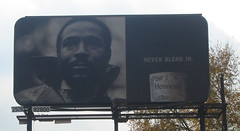
Marvin Gaye. I pass this image each morning on my way to school. Visible along the Southfield, just north of Warren Avenue.
I always imagine a fictional extra verse from, say, "Inner City Blues" about liquor ads. Not sure what's most noteworthy, the irony of the ad given Marvin Gaye's drug addiction and alcoholism, or the irony of the ad given that the image is lifted from one of the most noted pieces of art-as-social-commentary of the rock era.
For the past month I've also passed about a dozen Martha Reeves for City Council signs. Icons of the motown sound. Odd representations. If only Smokey would open a burger chain.
I always imagine a fictional extra verse from, say, "Inner City Blues" about liquor ads. Not sure what's most noteworthy, the irony of the ad given Marvin Gaye's drug addiction and alcoholism, or the irony of the ad given that the image is lifted from one of the most noted pieces of art-as-social-commentary of the rock era.
For the past month I've also passed about a dozen Martha Reeves for City Council signs. Icons of the motown sound. Odd representations. If only Smokey would open a burger chain.
11/09/2005
Slavery documentary
Last night the Michigan Coalition for Human Rights screened the documentary "Slavery: A Global Perspective," a shocking, lo-fi expose of Ivory Coast's cocoa industry (slave labor has a hand in about forty percent of commercially available chocolate, according to the film) and India's carpet industry, two of the major global industries that utilize slave labor. Not sweatshop labor. Forced, unpaid labor performed in large part by children who are lured away from their homes, kidnapped, chained to looms, and beaten brutally. The doc. also exposed the more familiar use of domestic worker-slaves in London, New York, and Washington DC. In 2005, the filmmakers claim, there are about 27 million slaves worldwide, more than at any other point in world history.
Resources:
Free the Slaves
Coalition Against Slavery and Trafficking
Next week's MCHR documentary is Robert Greenwald's "WalMart: The High Cost of Low Price," shown around Metro Detroit. See MCHR for details.
Resources:
Free the Slaves
Coalition Against Slavery and Trafficking
Next week's MCHR documentary is Robert Greenwald's "WalMart: The High Cost of Low Price," shown around Metro Detroit. See MCHR for details.
11/08/2005
links to photo essays
My comp. 106 students are working on photo essays. For those of you with assignments foregrounding visual rhetoric, here are some links from one of my handouts that you might find helpful and/or interesting.
Caring for the Wounded in Iraq
http://content.nejm.org/cgi/content/full/351/24/2476
Canto do Brazil
http://www.hillerphoto.com/brazil/
Stop and Smell the Sakura: A Photo Essy of Japan
http://www.theforeigner-japan.com/photoessays/2004/200402/index.htm
Farewell to Bosnia
http://www.picture-projects.com/bosnia.html
God in the Temples of Government
http://www.humaneventsonline.com/article.php?id=2441
Looking for the Light: A Decade of Living with HIV
http://www.musarium.com/aidsdecade/menu.html
Shattered: NYC after 9/11
http://www.time.com/time/photoessays/shattered/
Sitting Down to Stand Up: The Quiet Defiance of Rosa Parks
http://www.time.com/time/photoessays/rosa_parks/
A Photo Essay on the Great Depression
http://www.english.uiuc.edu/maps/depression/photoessay.htm
Sites with Multiple Photo Essays
Yahoo Photo Essays:
http://dir.yahoo.com/Arts/Visual_Arts/Photography/Photojournalism/Photo_Essays_and_Exhibits/
Time Photo Essays:http://www.time.com/time/photoessays
Caring for the Wounded in Iraq
http://content.nejm.org/cgi/content/full/351/24/2476
Canto do Brazil
http://www.hillerphoto.com/brazil/
Stop and Smell the Sakura: A Photo Essy of Japan
http://www.theforeigner-japan.com/photoessays/2004/200402/index.htm
Farewell to Bosnia
http://www.picture-projects.com/bosnia.html
God in the Temples of Government
http://www.humaneventsonline.com/article.php?id=2441
Looking for the Light: A Decade of Living with HIV
http://www.musarium.com/aidsdecade/menu.html
Shattered: NYC after 9/11
http://www.time.com/time/photoessays/shattered/
Sitting Down to Stand Up: The Quiet Defiance of Rosa Parks
http://www.time.com/time/photoessays/rosa_parks/
A Photo Essay on the Great Depression
http://www.english.uiuc.edu/maps/depression/photoessay.htm
Sites with Multiple Photo Essays
Yahoo Photo Essays:
http://dir.yahoo.com/Arts/Visual_Arts/Photography/Photojournalism/Photo_Essays_and_Exhibits/
Time Photo Essays:http://www.time.com/time/photoessays
11/03/2005
my favorite thing to cook in the fall
Squash Soup
*one butternut squash, peeled and cut into small cubes
*2-3 apples, any kind but preferably tart, cut into cubes with skin still on them
*1 medium onion, peeled and quartered
*4-5 cloves of garlic, peeled
Toss all of the above in a roaster with a couple tablespoons of good olive oil, a pinch of salt, and a couple pinches of chili powder, and bake for 45 minutes at 400 degrees, stirring once or twice. Put the roasted veggies in a blender with about 3-4 cups of vegetable stock and puree well.
Optional...
Blend the following and then use as a stir-in for the soup: about a cup each of walnuts and either parsley or cilantro, a jalapeno pepper or your favorite hot pepper or a generous sprinkle of red pepper flakes, a tablespoon of apple cider vinegar, and enough water to create a pesto-like consistency.
*one butternut squash, peeled and cut into small cubes
*2-3 apples, any kind but preferably tart, cut into cubes with skin still on them
*1 medium onion, peeled and quartered
*4-5 cloves of garlic, peeled
Toss all of the above in a roaster with a couple tablespoons of good olive oil, a pinch of salt, and a couple pinches of chili powder, and bake for 45 minutes at 400 degrees, stirring once or twice. Put the roasted veggies in a blender with about 3-4 cups of vegetable stock and puree well.
Optional...
Blend the following and then use as a stir-in for the soup: about a cup each of walnuts and either parsley or cilantro, a jalapeno pepper or your favorite hot pepper or a generous sprinkle of red pepper flakes, a tablespoon of apple cider vinegar, and enough water to create a pesto-like consistency.
10/31/2005
comments
Somehow my blog account keeps turning off the comments section. I'm not sure how this is happening. Apologies to anyone who may have tried to post a comment. I've turned the comments section back on (and I'll try to make sure it stays on!)--so comment away.
Plan Colombia
Spent Halloween evening learning about some of the frightening effects of the massive amounts of money ($4 billion since 2000) the U.S. sends to Colombia. The Michigan Coalition for Human Rights, a group I recently joined, sponsored a lecture by Colombian activist Jenne Neme. Neme outlined her efforts in an ecumencial resistance group to raise awareness about how U.S. tax dollars--in the name of the war on drugs--are paying for efforts like spraying pesticides on drug fields. An easy soundbite: "we're killing coca plants." Trouble is, the cropdusters can't get close to the fields or they'll be shot down so they release the pesticides from heights that don't allow for much precision. Food crops are also destroyed, to say nothing of the environmental and health concerns. Plus, vast majority (of course) of that $4bil. goes to military spending--the recruitment of child soldiers, the slaughter of untold innocents, including 70 priests and ministers in the last four years alone, etc, etc. Domestically, it's hard to even *imagine* Latin America getting much press. The region is simply off the collective radar. A sad reality. Organized religion in Colombia is trying to exercise some muscle and organize against some of the destruction and violence. I wish the politically engaged religious community in the 'States would flex its own muscle. Aren't those 70 dead priests/ministers, those child soldiers, those decimated food crops worthy of at least as much outrage as what passes for "values" issues in this country?
10/27/2005
photoblogging
I'm trying to figure out the ins and outs of posting pics (see my shots of the Chaldean district below) using flickr and blogger and am having trouble figuring out how to manipulate images. Flickr has the "blog this" function but that doesn't allow you to put multiple pics in the same post, mess around with size/layout/etc. Any tips? Is there a tutorial that I'm missing?
10/26/2005

Subscribe to:
Posts (Atom)