2/08/2007
out of shape

2/01/2007
Sometimes, just sometimes, mainstream culture makes room for something completely unexpected. And youtube lets us remember those moments. Here's Patti Smith covering "You Light Up My Life." But wait, there's more. She's performing on a children's show. But wait, there's more. After her performance, the announcer says, "Coming up, we have Count Dracula and Adam Rich." Huh? Are they together?
The "D"

Detroit: shiny, sleek, and metallic. This is the Convention and Visitors Bureau's new logo, meant to attract 20-somethings to the D. The image references cars, certainly, with the sheen that looks something like a newly built engine, but the five words go beyond autos into other realms: culture, gaming, music, sports.
I like the catch-all of the word "culture." From "cars" to "culture," the concrete to the abstract. And then back to the concrete, if not exactly material, realms with "gaming" (Greektown Casino!), "music" (The White Stripes! Aretha!) and "sports" (Tigers! Red Wings!).
A connection: the scene in "Roger and Me" in which Michael Moore confronts the bureaucrat from Flint's CVB for suggesting that a lint roller or an auto amusement park can replace the industrial age's biggest industry.
1/31/2007
Rumor has it that The Police are going to reform and tour the world this year. They'll probably charge a fortune for tickets and play mostly their big singles from the 80s.
Here's hoping they at least leave the synthesizers back at Sting's mansion. Remember the new version of "Don't Stand So Close to Me?" they put on their greatest hits record in 1986? Ouch.
Instead, how about exploiting the simplicity of the three-piece rock band? Those early songs like "Landlord" and "Nothing's Achieving" showed that musicianship and punk ethos weren't mutually exclusive.
They were like the british version of Television: literary allusions and difficult chord progressions juxtaposed with ripped t-shirts and two-minute songs.
Personally, a reunion of The Smiths would excite me a whole lot more, but nonetheless I'll probably end up getting my nostlgia fix via this tour.
1/30/2007
visiting writers
This afternoon Steve Climer was visiting writer in my creative writing class (thanks for coming Steve!). Talking about his own fiction, he really championed the idea of divorcing the creative process from deliberate or forced emphasis on rhetorical elements like theme. He's all about telling a character's story without getting lost in other matters. We looked at a story of Steve's called "High Lonesome Road," a neat southern gothic tale about a little boy who is a victim of racism until a surreal encounter with the ghosts of a group of civil war soldiers and the woman who cooks for them.
Some of what Steve said echoed things I've emphasized during the past few weeks, but he used a different lingo and described these processes with ideas that sometimes ran counter to my own. The language and the concepts bounced around and I think students left the room thinking they had to find their own lingo, their own set of writerly values. Not a bad day.
1/28/2007
visual rhetoric
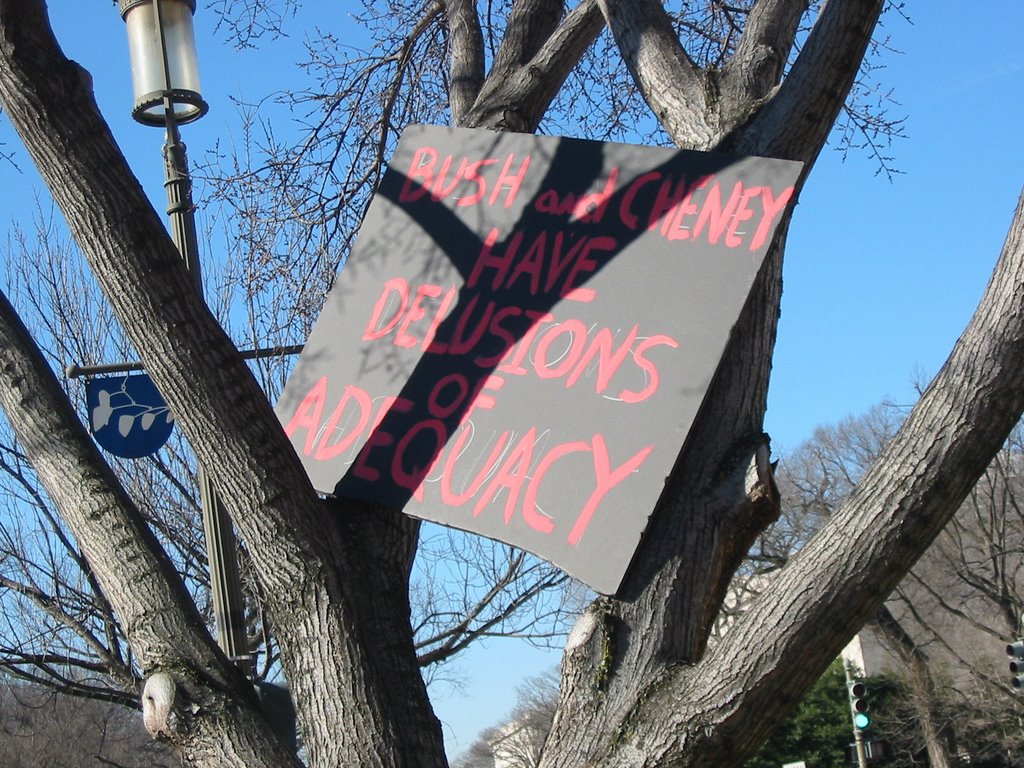

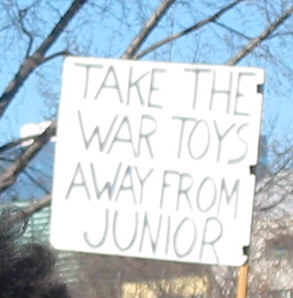
Yesterday's protest in D.C. and the subsequent all-night bus ride have left me exhausted, but I wanted to represent here some of the visuals on display on capital hill and the mall. Press coverage of the event has been particularly weak, with lowball estimates of attendance and too much emphasis on Sean Penn's presence. Okay, exciting that Jeff Spicoli is here, but how about the hundreds of thousands of everyday veterans, grandmothers, and college students from across the country?
Anyway, some visual rhetoric:



1/24/2007
violence
del Toro also referenced in the interview his Christian upbringing in Mexico--the grandmother who performed makeshift exorcisms on him when he refused to stop drawing pictures of monsters, the bottle caps he wore in his shoes as corporal mortification. (He suggests that his affinity for Alfred Hitchcock grows from their both being fat, Catholic, and repressed.) I got the sense that del Toro sees this element of his background as being "violent" on various levels. The violence done to him by family members. The violence of religious justifications for attempting to squelch his artistic vision. I kept thinking of that scene with Ofelia refusing Pan's orders to spill the blood of an innocent in contrast to the biblical scene of Abraham's *willingness* to spill Isaac's blood, that biblical moment that provided endless ethical debate back in ninth grade religion class. A vision that seems to justify violence. And a vision that condemns violence.
I've got no conclusions. No insights. Just two visions that are inescapable. Clearly del Toro is a provocative and insightful commentator. I just wish he had clearer answers to the problematics he introduces.
1/21/2007
revision
And you find yourself WAY over the journal's word limit. Some 2,500 words over. Cut out this particular tangent. Edit for brevity. Eliminate a couple endnotes that now seem off topic. Cut out another tangent. Almost there...
I always bristle when students say things like "I don't understand what you want me to do on this paper." It's your paper. Make decisions. Have some ownership over your ideas. Don't do what I want you to do.
But then I find myself following advice of reviewers, making changes they suggest, losing ownership, asking those same questions that student ask: "What do you want me to do?," and wanting to be finished.
1/20/2007
pan's labyrinth
Pan's Labyrinth in many ways hops from genre to genre. At times a sadistic horror film, as Capitan Vidal uses any means available to find the traitors in his house. At times a comic book come to life, complete with bizarre creatures and villains and of course the heroine Ofelia. What an original vision.
1/17/2007
One of the great 1960s rockers has lost his home to a fire. The man who legally changed his name to "?" and who has long claimed to be a martian also lost four of his dogs and most of the belongings that were in the house outside Clio, Michigan.
Born Rudy Martinez, ? led The Mysterians out of a garage in Flint, Michigan, and into frat houses, school dances, and rock and roll infamy. Along with bands like The Sonics and the 13th Floor Elevators, ? and the Mysterians are often credited with inventing punk rock. At least four or five years before The Stooges, the band foregrounded Brash simplicity. And an ear for great pop music. Who can resist the organ line in "96 Tears"?
1/16/2007
going once, going twice...
Visiting Youngstown this past weekend, we went to two auctions and I realized that one of the things I miss about Ohio (either of the two opposite sides of the state where I've spent time living) is the auction.
Auctions and the people who attend them for fun and profit exist in a parallel universe. There's a class dynamic, as attendees lean toward working class. Both sub/urban working class and rural working class. There's also a broader cultural dynamic that relates to class but transcends class. Auction-goers resist many of the whims and fads of mass culture. They seem to fetishize objects and artifacts just as intensely, or moreso, but the objects and artifacts of attention vear further from the mainstream. Milk bottles. Pottery from occupied Japan. Sheet music from 1970s singer-songwriters.
I don't mean to draw some kind of broad and inaccurate dichotomy. Certainly many (most?) auction-goers collect antiquities by day and then go home and watch Lost or listen to music on an i-pod. (And certainly Yuppies attend auctions, although there are fewer and fewer middle-class folks in Youngstown or Hamilton.)
But I get the sense that many auction afficionados resist at least some elements of the mainstream. Dick Hebdidge writes that "subordinate groups...express obliquely, in style" a challenge to hegemony. Folks at auctions, to use Hebdidge's language, have style. They are subculture. Rooted in kitsch and retro, their cultural practices threaten the mainstream. For example, buying a crate of records for five bucks doesn't feed the economy the way dropping $50 at Best Buy does.
But is there political praxis? Certainly, and sadly, reactionary politics has a presence. Confederate flag bumper stickers (and this is Youngstown, hundreds of miles north of the Mason-Dixon), for example. I get the sense that auction-goers may be dissatisfied with the current trajectory of free-market capitalism ("Buy American" bumper stickers, too). Buying goods at an auction may or may not be a legitimate resistance to that trajectory. There's a sense at the auction that stuff from the mall is tainted by free trade, sullied by globalism. Maybe old stuff at an auction expresses a nostalgia, not only for a previous lifestyle (listening to music on vinyl, eating off a set of china from the '20s) but also for earlier, happier moments on capitalism's timeline (roaring 20s, baby boom, etc.).
1/15/2007
MLK
We made 1,200 turkey and cheese sandwiches for prisoners in lock-up around Detroit. The police buy the sandwiches from CCSS each day to feed prisoners, helping to subsidize the various services Cass provides. Ever make hundreds and hundreds of sandwiches all at once? Here's an effective technique: cover table with stacks of two pieces of bread; add turkey and cheese to each stack; pile five or six sandwiches on top of one another and then bring the bottom slice to the top of that tall stack. That last step, which saves the time time involved in moving one piece of bread to the top of each sandwich, almost blew our minds. Very slick. Hats off to 'Shorty' at CCSS for developing this method.
1/09/2007
those technology gremlins
1/08/2007
momofuku ando
The slightly more expensive Asian brands, while no healthier, taste a bit better. "Mama Noodles" were a staple when I was in the high school seminary. About half the student body consisted of kids from Vietnam who hated the American food served at the school--it was pretty bad--and filled their lockers with cases and cases of Mama noodles. I can remember when food in the cafeteria got particularly awful (inexplicably, the hot dogs were green), kids would pay up to a buck for a package of Mama noodles. Enterprising seminarians stocked lockers full of Mama noodles and Marlboro Lights and made a killing, in fact.
1/07/2007
"...so this is the new year..."
Classes start tomorrow. In the fall I was spoiled with a course release but this term it's back to three classes (two sections of composition and one section of creative writing) which still leaves plenty of time to write. 2 days of teaching+1 day of meetings and paper grading+2 days of writing = a good work life.
Blogging has been sporadic and unfocused over the break but effective tomorrow I'm back. I'm revising an article for jac (the old "revise and resubmit") on intersectional identity politics and getting started in earnest on a "response essay" for an edited collection on social movement rhetoric some friends from grad school are doing. The latter is a conclusion of sorts for their book that puts the essays in conversation with one another and offers some Springer-esque final thoughts. Oh, and the "Who Says?" book comes out in a few weeks. So, much academic stuff to blog about.
Cliche to whine about break coming to a close, and kind of ridiculous since most of my friends netted only two or three days off work, so instead I'll say that the time away from campus was enjoyable. I wrote most of a short story that needs a lotta work but that I'm happy with so far (thanks to Caribou Coffee for the beverages and atmosphere), spent much time with family, did loads of cooking, and saw a whole slew of films. "Volver" was beautiful and ought to earn Penelope Cruz an Oscar nod. Thanks to Netflix--I'm new to Netflix but I've gotten my money's worth as of late--I enjoyed at home "Wordplay" (slow at times but fun), "Little Miss Sunshine" (very, very well-written, and great to see Alan Arkin in a comedic role again), "Palindromes" (odd, provocative, not Todd Solondz's best work, but interesting), and "No Direction Home" (worth it for all the priceless performance footage alone, and for all the miscelaneous characters who show up long enough to claim Dylan stole records from them).
1/03/2007
Tillie Olsen
Many know Olsen's great short story "I Stand Here Ironing," a lulling work of fiction in which a working-class woman reflects on the circumstances surrounding her imperfect mothering and hopes her daughter might somehow thrive. Few, unfortunately, have read the rest of Olsen's compelling, often sobering, body of work. Yonnondio, her only novel and a work of grim realism, recounts the suffering of the Holbrook family attempting to survive the Great Depression. In the novel Olsen doesn't hesitate to represent all forms of abuse and dehumanization as by-products of injustice. "I Want You Women Up North to Know," a topical poem about sweatshop labor, begins with the emphatic
The poem closes with the radical threat:i want you women up north to know
I want you women up north to see
how those dainty children's dresses you buy
at macy's, wannamakers, gimbels, marshall fields,
are dyed in blood, are stitched in wasting flesh,
down in San Antonio, "where sunshine spends the winter."
the obsequious smile, the salesladies trill
"exquisite work, madame, exquisite pleats"
vanish into a bloated face, ordering more dresses,
gouging the wages down,
dissolve into maria, ambrosa, catalina,
stitching these dresses from dawn to night,
in blood, in wasting flesh.
Women up north, I want you to know,
I tell you this can't last forever.I swear it won't.
I met Olsen in 1997 when she spoke at Youngstown State's Working-Class Studies Conference. She visited a graduate seminar at YSU devoted to her work and I was lucky enough to be a student in that class. In tears she recounted a story of being arrested for civil disobedience and separated at the jailhouse from her husband. In cells on two different floors, they sang to one another through heating ducts. I shook Olsen's hand after the class and she told me to never leave home without a copy of the U.N. Declaration of Human Rights and to never stop demanding the rights and freedoms the document outlines. Shaky with old age even a decade ago, her voice as she gave that advice was unwavering and defiant. The same voice as the voice of the closing lines of her poem.
12/28/2006
the best of 2006
10. SSM A kind of a Detroit supergroup, featuring members of various motown indie bands including The Sights. Their debut album features psychedelic keyboards, space-age concept lyrics a la George Clinton, and the requisite two-minute garage rock songs. Well worth a listen.
9. Pipettes, "Pull Shapes" & Beyonce, "Irreplacable" Two of the catchiest pop singles of the year. The Pipettes pay homage to '60s girl groups and Beyonce offers the funniest break-up song you've heard in ages ("...everything you own is in a box to the left..."). Girl power in full effect.
8. Yeah Yeah Yeahs, "Gold Lion" Another great single from NYC punk outfit the YYYs. Female-fronted punk band in the tradition of The Slits and X-Ray Spex in the sense that YYYs combine an art rock aesthetic with rock-single simplicity. Like "Maps" a couple years ago, this YYYs track doesn't sound like anything else out there. A stand-out track from a band with a voice.
7. Yo La Tengo -- I Am Not Afraid of You and I Will Beat Your Ass One of their strongest records yet, thanks to an eclectic mix of pop ("Beanbag Chair") and fuzz ("Pass the Hatchet, I Think I'm Goodkind"). Smart, earnest lyrics and the guitar virtuosity of Ira Kaplan. Bonus points for putting on a great show in Ann Arbor a few months back. These guys are a couple decades into their career and keep releasing great rock and roll.
6. Arctic Monkeys, "I Bet You Look Good On the Dancefloor" Little Steven's radio show kept this single on heavy rotation last summer, and for good reason. Catchy dance number. Zero pretention. A perfect summer song.
5. Belle & Sebastian, "The Blues are Still Blue" & The Envelopes, "It Is the Law" Two of the best alt-rock songs of the past twelve months. Belle & Sebastian, a Scottish twee-pop collective, is one of my favorite bands and though their newest album is somewhat uneven, "The Blues are Still Blue," a glammy T.Rex-ish creation, is their best song since "Lazy Line Painter Jane" a decade ago. Like other bands on this list (B&S, Yo La Tengo, Hard Lessons), The Envelopes have a great male-female/shared-vocal dynamic. "It Is the Law" showcases the disparate elements (airy keyboards, dueling rock guitars, pretty vocals) that give the bands its odd oomph.
4. New York Dolls -- One Day It Will Please Us to Remember Even This A remarkable record. Not just a reunion souvenir but rather a re-invention of one of the greatest rock bands of all times. Could have been disappointing, as the 'Dolls are (in)famously without most of their founding members, including the great Johnny Thunders. But this album revisits the bluesy, raunchy sound the 'Dolls created in the early 70s and adds emotive lyrics that implicitly reflect the losses that the surviving 'Dolls have weathered. But those lyrics maintain the campy sense of humor of the band. Like their classic debut album, full of stand-out tracks. Give a listen to "Dance Like a Monkey" and "Dancing on the Lip of a Volcano." Bonus points for headlining a great show in Detroit with Chesterfield Kings and Supersuckers and The Charms--all bands they inspired.
3. Bob Dylan -- Modern Times Best full-length album of the year, hands down. With "Workingman's Blues #2," Dylan offers a compelling and agonistic "topical song," the genre in which he always denied working. "The buying power of the proletariat's gone down," he sings on that track and his voice makes it mean something. Speaking of politics, Dylan invokes Hurricane Katrina on the epic folksong "The Levee's Gonna Break," and makes the track at once timeless and dated. "Thunder on the Mountain" is great pop. In short, not a weak link of the whole disc.
2. The Coup, "My Favorite Mutiny" & Jay-Z with Ne-Yo, "Minority Report" Socially conscious hip hop is alive and well. The Coup, everybody's favorite Marxist rap outfit, doesn't sacrifice the funk on "Mutiny," which features guest vocals from Talib Kweli and other notables. Meanwhile, "Minority Report" rises above the rest of Jay-Z's "comeback" album, with its polemical samples of Hurricane Katrina news reports (including clips from an interview with a veteran: "I fought for my country and can't get a bottle of water") and Kanye West's "George Bush doesn't care about black people" line. Over an ominous backbeat, Jay Z muses: "The commander-in-chief just flew by...what if he ran out of jet fuel and just dropped? That'd be something to watch...he'd be just another bush." Jay-Z's most important song? Yep.
1. Hard Lessons -- Wise Up My favorite release of the year. A five-song E.P. from Detroit's own rockers The Hard Lessons, twenty-something former schoolteachers who decided to go professional. I saw them play around Detroit a few times this year and their live show is so high-energy, so unapologetically enthusiastic, that you expect them to disappoint on their recorded material. Not at all. The rave-ups are predictably great, but take a listen to the slower numbers like "It Bleeds," the disc's ballad. Twenty minutes of pure rock and roll. The next great band to come out of the motor city.
12/27/2006
the levees
Much the same way that Lee's "Do the Right Thing" drips with its historical context. New York. Late 1980s. References to Tawana Brawley, popular hip hop artists of the time, and so forth.
"When the Levees Broke" features exhaustive and heartbreaking footage of Katrina and its aftermath. Lee's camera work overwhelms and compels. At times sweeping shots of flood waters and devastation but mostly Lee emphasizes the human, introducing us to folks with unforgettable stories.
And while those stories stick with us, so too do the systemic failures that resulted in all of those deaths. Just over a year later and how easy it is to forget about the armed white militias keeping the displaced black New Orleans residents from crossing the bridges into their white parishes. A few months after the release of the reports and how easy it is to forget about the gross neglience of the Army Corps of Engineers. Easy to forget about Condoleeza Rice shoe shopping and taking in a showing of Spamalot and George W. Bush rolling out Iraq soundbites in southern California while the levees were giving way. We meet the Mississippi resident who tells Dick Cheney to go fuck himself at a press conference. Turns out the resident was trying to get to his home after the evacuation but was blocked by Cheney's motorcade. We see Barbara Bush touring a crowded, dirty, Houston arena full of displaced New Orleans residents and suggesting that they were poor anyway and were probably better off here.
And the documentary reminds us that forgetting is a luxury. We forget about the systemic failures and the root injustices that caused so many deaths because we have the luxury to move on. Not everyone has that luxury, and the human faces we meet are faces that remember. One Katrina survivor's respond to Barbara Bush: "I was poor. Everything I got I got it honest. You was rich. How did you get there?"
12/19/2006
violent but not violent enough
Another act that normalizes and legitimizes violence. Violence as the logical next step when one becomes angry. Where is the opportunity for ethical development and ethical education among basketball stars who are groomed for celebrity from the age of thirteen? The values of competition, agressive masculinity, entitlement, and bling ever in the foreground.
My favorite media response to the incident? In today's Detroit News, columnist Chris McCosky deconstructs the fight and argues the key players weren't tough enough. "It was no brawl...just a bunch of fake tough guys yapping, slapping and running," Mccosky writes. In other words, they're sissies. As far as toughness, McCosky finds Carmelo Anthony et al to be "inept." The real "brawl," he says, was the infamous fight between the Pistons and Pacers in 2004. We do fights right in Detroit, err Auburn Hills.
Few of the young people who idolize NBA players will go professional and become millionaires but many of those young people will use violence as a response to anger or perceived disrespect.
12/18/2006
aw shucks
I love the gallery of headshots that Time has on its website, slide-showing us through images of a punk rock kid with a guitar, a dj (oh Time, how hip you are), a guy with rasta hair, a supermodel-type with a digital camera, and a knitting granny. If only one of the Flash experts over at Time had thought to morph the headshots, like that Michael Jackson video.
Cue the Patti Smith anthem (and ignore any irony Smith may have infused into the lyrics) because Time considers 2006 a real "People Have the Power" kind of year. Here's an optimistic snippet of Time's year-end wrap-up:
But look at 2006 through a different lens and you'll see another story, one that isn't about conflict or great men. It's a story about community and collaboration on a scale never seen before. It's about the cosmic compendium of knowledge Wikipedia and the million-channel people's network YouTube and the online metropolis MySpace. It's about the many wresting power from the few and helping one another for nothing and how that will not only change the world, but also change the way the world changes.Time frames its year-in-review as a rejection of history as a history of great men, as well as a rejection of the negative. Erase the ongoing and ever-worsening war in Iraq, the Israel-Lebanon conflict, the genocide in Darfur. 2006 is community, collaboration, the many wrestling power from the few. People have the power, so go buy an i-pod, a laptop, a digital camera, and some dj equipment and all the bad stuff will go away. We'll tell another story.
Time's consumerist ideology is no surprise, but its failure to contextualize blogs, wikipedia, i-movie, et al within global geopolitics is deeply troubling. In the face of do-it-yourself publishing, humanitarian crises continue. Web 2.0 has not slowed the progress of the war machine. There is power in storytelling (blogging) and self-representation (youtube-ing), but can that power serve a broader praxis? To what ends might "the people" utilize such technologies?
12/12/2006
building bridges...to Windsor
University of Windsor,
Windsor, Ontario, Canada
February 2nd and 3rd, 2007
With sessions on the rhetoric of social movements, alternative media, and international coalition-building, this conference "across the river" from Detroit looks like an intriguing event, one I definitely plan to attend. The conference planners have also put various performances on the program, breaking up the standard "three-person panel" formula. Impressive work.
12/11/2006
cookies
My Grandma D. made huge amounts of Christmas cookies each year when I was a kid. Her front porch became a makeshift freezer as tupperware containers and department store boxes full of the treats covered the porch's glider. Fig bars, anisette bars, pizelles, biscotti, and of course what she called "cut-out cookies" (a plain Italian cookie dough cut into stars and Christmas trees and frosted with a simple sugar icing). How many hundreds of those did I eat during the '70s and '80s? How wide was my Grandma's smile watching us eat them? I can hear my Grandpa grumbling about not having a place to sit on his glider but I can also see him brewing his coffee--a thick concoction to which he added salt--on the stovetop percolator and then enjoying a cup with a biscotti and a Chesterfield.
Christmas Eve at her house: pasta in oil and garlic, fried calamari, cold baccala (cod), cold broccoli dressed with lemon juice and garlic, artichokes, squid (always a picture of someone, usually my dad, with tentacles coming out of his mouth) in red sauce, shrimp scampi, and salad. Then, of course, big plates of figs, fresh fruit, and her cookies, set out on a tablecloth dotted with spots of olive oil.
Back to the present. Absent at our place is the smell of the Chesterfields and the sludge-like coffee, but we've tried to capture some of the cookie scent for Christmas. And part of what makes a break from school, time with family and friends, and the pomp of the holiday's rituals at church such a joy is recalling that this is the time of the year that made Grandma D. the happiest.
12/07/2006
not much of a reader
"Some reports are issued and just gather dust," he said. "And truth of the matter is, a lot of reports in Washington are never read by anybody. To show you how important this one is, I read it, and our guest read it. The prime minister read -- read a report prepared by a commission. And this is important."What? Does the fact that Bush READ the report instead of having his sycophantic staff give him the digested version prove anything? I suppose so. I suspect Tony Blair's people bristled at the "me and Tony read this one, folks, because it's important, see?" Comforting that our Commander-in-Chief is that guy who reads the first thirty pages of The Godfather each summer at the beach.
In related news, how disheartening is it to watch the media *suddenly* grant tacit persmission to criticize the Iraq situation? I mean, I'm glad that this shift in sentiment might mean that the U.S. starts to pull out of Iraq, thereby saving lives. But frustrating that just a few short months ago, such criticism still meant one was anti-American. This is especially true for the spineless Democrats (John Conyers and Dennis Kucinich are among the few exceptions) in congress, who campaigned last time around on their support of Bush's handling of Iraq and campaigned this time around on how Bush had completely screwed things up. Sigh.
12/06/2006
revisions
- Short fiction first and poetry second. I've always started with poetry, thinking that free-verse in particular is a natural extension of early finding-your-voice activities. But I want to try starting with short stories since I've got a more rigorous sequence of exercises (character sketches and the like) for the fiction unit. I'm thinking this sequence, early in the term, will reinforce the value of thinking deliberately about craft.
- Fletcher's Breathing In Breathing Out: Keeping a Writer's Notebook. We've used this book for several years down at the Ohio Writing Project and next term I'm going to see how undergrads respond. Fletcher uses a "writers at work" structure, talking about his own uses of generative writing, and also drawing on anecdotes from Naomi Shihab Nye and other writers who describe how and why they journal and the relationship between journaling and producing more finished pieces.
- More published examples. Student work is the priority and I don't want that to change. But I do want to bring in more examples of the genres we're learning. For example, this semester we read Updike's "A&P" and Walker's "Everyday Use" while students worked on the short fiction sequence. My thinking has been that I don't want to over-emphasize consumption of published work at the expense of writing time. Useful but I'm thinking a few more examples might open up possibilities for students.
- More accountability for feedback. I need to do more spot-checking of the written feedback students are giving to one another. Workshop participation counts and in the past I've always looked at spoken comments (again, we spend the vast majority of the term engaged in whole-class workshopping) as indicative of the quality of written commentary. But I know that some students are thorough and conscientious in their written responses while others slack off a bit. That's not fair and I want to do more policing, much as I hate to play that role.
12/05/2006
phobia
The woman in the seat next to her asked her why she was going to Detroit. Awkward conversation made all the more awkward by the smells of terror and sickness. Through shaky lips the sick woman said she was on her way to Washington but that if we were to make it to Detroit, she'd never set foot on a plane again. End of awkward conversation. Through landing, that calmly-waiting-for-death look on her face didn't change and, once the first-classers had left us behind, paramedics did indeed rush onto the plane accompanied by armed guards (standard procedure, I suppose, for any type of flight disturbance).
The paramedics emphasized how safe we now were, held her hand, and explained that they were going to wheel the woman into Detroit Metro airport. Her face remained stoic. But then when the lead paramedic asked her what was wrong, she said something barely coherent--I think I heard the word "bronchitis"--and began sobbing. And when the paramedic had her in a wheelchair en route to the terminal, she began to vomit again. We followed her into the airport. The paramedic and sick woman turned one way and, following signs to baggage claim, we turned the other.
12/04/2006
heartlands magazine
The publication has a strong sense of class consciousness which translates at times into political consciousness and at times into an implicit (almost "libertarian") sense that writers and artists (ought to) come from various lines of work. Heartlands, as the name suggests, is also regional in just about every sense of the word. Many of the writers come from Ohio and Michigan and/or take up the midwest as topoi. The magazine's website is not updated regularly but provides a sampling of the work.
I've got a poem in the latest issue and attended yesterday the issue's launch party down in Sandusky, Ohio. I read aloud some poetry at the party, which I rarely do and which tends to freak me out, but I cracked wise about being a transplanted Ohioan living in Michigan and *not* being a football fan and that broke the proverbial ice.
Anyway, the event was a joy. Some local folksingers did Ani DiFranco covers, poets read their work, a performance artist did an odd routine that involved members of the Bush administation doing touchdown dances, and, in a surreal twist, the manager of a local bird sanctuary brought some hawks and a bald eagle that lost its sight due to West Nile Virus.
Kudos to Larry at Heartlands (a mainstay at working-class studies conferences and a compelling poet in his own right) for keeping the regional arts alive and prospering.
11/27/2006
Kramer, Borat, and Andy
The New York Times hints at the performative aspect of the Richards rant and subsequent feeding frenzy in a blog post about Richards' appearance on Jesse Jackson's show. The title of that blog post, speaking of punny headlines, is "Keeping Michael Richards' Career Alive." An obvious reference to Rev. Jackson's familiar "keep hope alive" refrain. A subtle reference, also, to the ridiculous suggestion that this incident will be the end of Richards' career. Duh...didn't his career pretty much end with the closing credits of the Seinfeld finale? And then begin again last week?
Interesting that this dust-up comes on the heels of the success of the film Borat, a film whose brand of guerilla cultural critique relies upon over-the-top racism and anti-semitism. As Dr. B suggests on her blog, Borat's critique may fly over the heads of white audience members. Describing the young whites in the theater where she saw Borat, Dr. B writes: "The timing of their laughter and their silence indicated that they clearly didn't get that the joke was on them and their racist ideology." Now, I found Borat to be an often hysterical (and always original) piece of work, but the ethical issue of reproducing and rehearsing racist tropes on such a public stage is--as Dr. B. suggests-- a significant concern.
The differences between the Borat film and the Richards incident are numerous, but consider the connections: Both are examples of comedians using a non-fiction genre (Borat as a "documentary" and Richards as a stand-up "routine") to provoke. Both operate in the tradition of Andy Kaufman. Kaufman's such an icon that I'm sure the comparison will raise some neckhairs. But consider the vitriolic, hateful things that Kaufman said about women and working-class folks during his wrestling "career." There's a twisted, twisty lineage from Kaufman's classist (calling working-class southerners "inbred hillbillys") and sexist-misogynist rants to Richards' racism.
Incidentally, both Kaufman and Richards have now used David Letterman's show as a (center)stage for blurring the lines between reality and performance. And of course another moment where Richards *seems* to have lost his temper in public was in 1981 on his live sketch comedy show Fridays when the show's guest host--Andy Kaufman--pretended to forget his lines and prompted an awkward, dead-air moment. Richards, looking out of control on live tv (sound familiar?), stormed onto the set with the cue cards and angrily threw them at Kaufman. Kaufman, in turn, dumped a pitcher of water on Richards and the two began to fight.
I don't offer these comparisons as an excuse for Richards. Nor am I arguing some kind of intentionality on the part of Michael Richards (although today's CNN updates say he's hired a team of publicists to handle his p.r.). My point is that we don't really have a critical-media-vocabulary for understanding these incidents. As a culture, our response leans toward empty platitude--again, the ubiquitous and absurdly obvious suggestion that lynching is wrong. Without such a vocabulary, Richards takes his place among the Mel Gibsons of the world, assuming his place in a narrative of career rennaisance and personal redemption. And, blithely, we watch.
11/21/2006
photos from the SOA

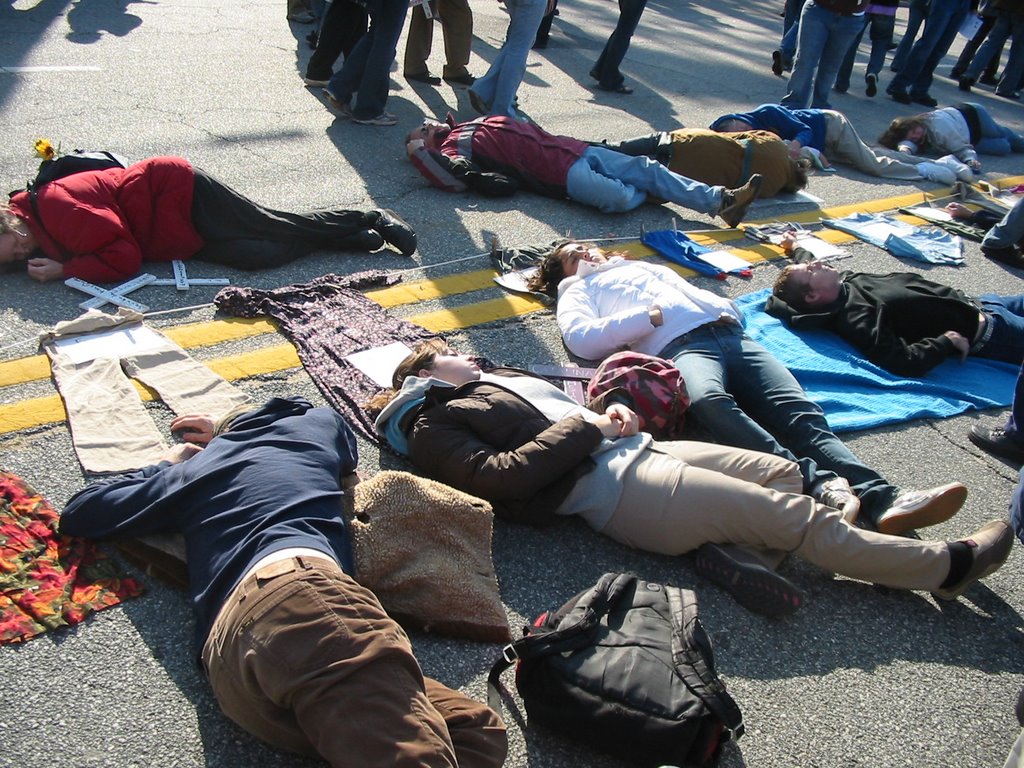
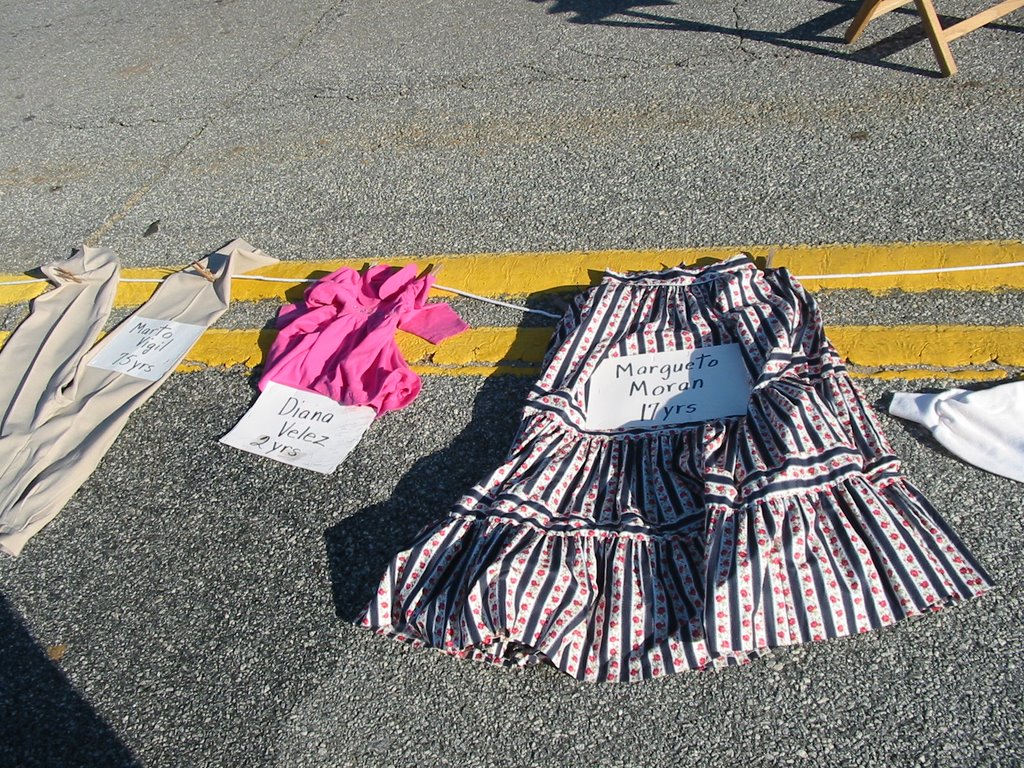
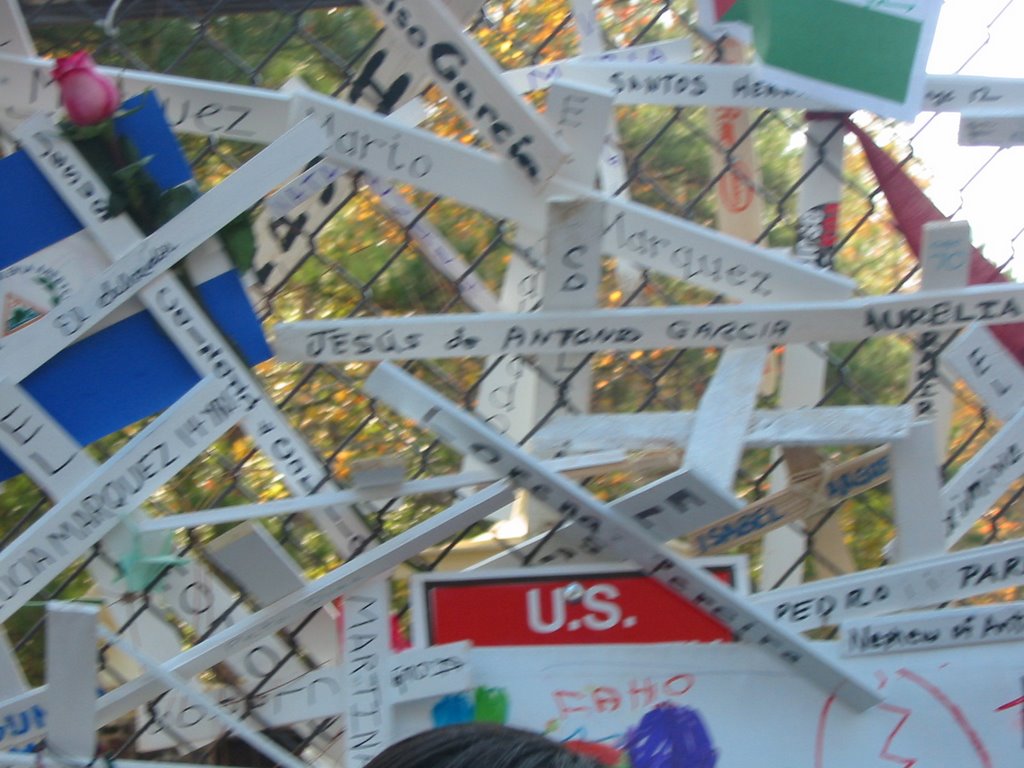 From the top: Grandmothers for Peace; a street theater performance of a massacre scene; the clothing of the dead; crosses in the Fort Benning fence. See full set of photos here.
11/20/2006
school of the americas march
Manuel Noriega is a notable graduate of the school. So are the fascists who ousted democratically elected Salvador Allende from power in Chile. The army claims the school primarily trains foot soldiers in the war on drugs, but most of the paramilitants who attend the school are involved in squashing democratic movements that the U.S. military perceives to be "communist threats"--anachronistic fears of democratic socialist governments that gain wide support (from farmers and peasants as well as missionaries working in these countries) by offering housing and health care reforms in developing nations. For their part, the powerful militias fear these movements because they control nearly all the capital in these nations and don't want to lose their control over even a small amount of that capital.
The march commemorates the anniversary of the 1989 massacre of six Jesuit priests, their housekeeper, and the housekeeper's child at a Jesuit University in El Salvador. The Jesuits had become vocal in their opposition to both the Salvadoran death squads and the U.S. military which was funding and training those squads. They were brutally martyred for speaking out. The U.N. concluded that nineteen of the twenty-seven soldiers who carried out the massacre were graduates of the SOA.
The protest consisted of a litany of the names of dead civilians (including many priests and nuns, who, not coincidentally, form one of the core constituents of the annual march), murdered in Latin America by SOA alums. We marchers carried white crosses with the names of "the disappeared" and responded with "presente" after each name was called, placing the crosses in the holes of the facility's fence. The litany is powerful, an aural commemoration of victims of fascism, victim of militarism run amock, victims of U.S. tax dollars. Seeing that barbed wire fence, drowning in tens of thousands of white crosses, is overwhelming. Many marchers became emotionally overcome at the fence.
Sixteen were arrested this year for acts of civil disobedience. Specifically, they crossed the fence onto "private property" (property owned and operated by our tax dollars). I saw the police leading the civil disobedients off to be processed while Fort Benning soldiers, watching the demonstration from inside the gate, laughed at them.
Our bus to the protest was an odd mixture of Detroiters--but a mixture that was reflective of the overall demographic make-up of the marchers. A group of us from Gesu church (the Jesuit-Catholic church I attend) joined a group of students from U of Detroit-Mercy, a group of Jesuit Volunteers Corps (a service corps made up of recent college graduates) stationed in Detroit, and groups from two local high schools. I have dozens and dozens of pictures. Stay tuned for photos on flickr.
11/17/2006
lists
Lists happen on blogs all the time, via memes, rants on what people did during the day, and tasks that folks plan to do. I do this sometimes. List of books I'm reading right now, for example. I do this in other realms, too. In 2004, I lost 100 pounds by writing down lists of everything I ate (and via other strategies too). At the end of the year, as I'm recuperating from finals week's usual grading frenzy, I like to read the ubiquitous end-of-year pop culture lists: 50 Best Records of the Year, etc.
At the campus rec. center yesterday, as I walked on the treadmill, I saw several people keeping lists of repetitions of exercises. I also listened to my i-pod. Here are the random songs that played, in list form:
- I Can't Help Myself, The Four Tops
- Heat Wave, Martha and the Vandellas
- Addiction, Kanye West
- When You Come, Crowded House
- We're Going to Be Friends, White Stripes
- When Ya Get Drafted, Dead Kennedys
- One Love, Bob Marley
- Endless Endless, Kraftwerk
- Cosmic Slop, Funkadelic
- European Son, Velvet Underground
- Let's Buy a Bridge, Swell Maps
- Watching the Clothes, The Pretenders
- Pet Sounds, Beach Boys
- White Tornado, REM
- For No One, The Beatles
- Blenheim Shots, Swell Maps
- Kiss the Children, Gram Parsons
- So Says I, The Shins
- Catfight, The Gossip
- Fame and Fortune, Mission of Burma
- Help Me Make It through the Night, Kris Kristofferson
11/15/2006
new york dolls
On a related note, Dolls lead guitarist Johnny Thunders overdosed in 1991. Like Johnny Marr of The Smiths, Thunders defined not only his band's sound but also defined a genre (for Marr, the genre of guitar-driven britpop; for Thunders, a little genre called punk rock). Thunders, sadly a lifelong addict who defied odds living as long as he did, went on to lead Sid Vicious's back-up band (speaking of short-lived), and his own Heartbreakers (sadly, they made only one record). He played with miscelaneous Ramones and Sex Pistols and ex-Dolls, mostly motley and trans-atlantic groups of heroin-addled musicians who could have been even greater were it not for drugs. Even with such limitations, Thunders was a distinct voice and created a paradoxical guitar aesthetic that was at once screechy and staccato, bluesy and brash. His solo masterpiece "You Can't Put Your Arms Around a Memory" is one of the great rock and roll singles of all time, often covered (Guns n Roses, not to mention the current Dolls incarnation) and often included in Martin Scorcese movies. So Thunders' specter will inevitably haunt any Dolls show in 2006.
On the other hand, this is the opportunity to see David Johansen, in person, doing his awesome cover of Bo Didley's "Pills," that three-chord ode to "rock-and-roll nurses," whatever that means. My favorite song to play on the guitar (not coincidentally, the easiest song in the world to play on the guitar, next to "Roadrunner"). Plus, "Personality Crisis" and "Trash." And the band's new record (only the third Dolls studio album) is quite good: bluesy, fast, strange, and featuring a song called "Dance Like a Monkey." And fifty-somethings up on a stage, still cross-dressing, still singing the same songs they sung in 1973, may not exactly be "punk," but it's certainly campy and subversive. And that's what the Dolls are all about.
See you tomorrow at St. Andrew's Hall.
geographies of writing: identity and detroit
The spatial makes us aware of difference, identity. So why leap from the spatial to the rejection of identity? Awareness of space is personal (mind mapping). External context shapes (as opposed to negating) identity-which is unstable, full of paradox and irony, socially and spacially situated. Much of the literature on spatial rhetoric uses "post identity" theories, which I think neglects the possibility of understanding identity markers as intersections. Class: intersection of power, geography, occupation, cultural practices-"spatial markers," all. What is more material than foregrounding identity? Place becomes abstraction when we neglect person-in-place.
I've been thinking on these things as I revise an article for JAC (fortuitously, the 'revise and resubmit' letter came days after sending revisions to the piece on my great-grandpa's poetry back to Rhet Review)-an essay that uses intersectional analysis to look at the rhetoric of persons-in-place. The reader reports were positive and helpful and challenged me to justify more clearly why identity markers still matter. Reynolds' book is helping.
The piece uses several Detroit texts where spatially situated persons (Detroit rock-and-rollers) construct identities as intersections. One of Reynolds' central claims is the idea that awareness of space fosters an understanding of difference, "how people respond differently to places depending on race, class, gender, sexuality, or ability." Detroit's somewhat unique in the fact that geographical situatedness is key to what it means to be a "Detroiter." Most cities have the city-suburb binary, but Detroit's version of that component of urban life is mythic (national guard keeping "Detroiters" out of white Dearborn, Coleman Young's defiant stance toward burbs, 8-Mile "border" as icon). Detroiters are acutely aware of space in a way that I think is unique (NYC bridges and tunnels, I suppose). Detroiters' understanding of difference (embodied by class-conscious and race-conscious garage bands, e.g.) is by extension acute and complex.
11/13/2006
current reading
- Nedra Reynolds, Geographies of Writing: Inhabiting Places and Encountering Difference. I'm late getting to this superb analysis of writing as a spatial process. Reynolds: "identities take root from particular sociogeographical intersections, reflecting where a person comes from and, to some extent, where she is allowed to go." I'm revising for jac an article on intersectionality and identity politics and Reynolds' book is helpful, to say the least, for moving from studies of 'place' to studying 'persons-in-a-place.' Rhetorics of place often critique (rightly) "identity" to the detriment, I believe, of the possibility of understanding intersections.
- Julie Lindquist, A Place to Stand: Politics and Persuasion in a Working-Class Bar. I'm re-reading this because I'm teaching Lindquist's ethnography in my honors course, the first time using her book in an undergraduate class. We start discussing Place to Stand this evening and I'm hoping for great things, as Lindquist pulls together threads we've been weaving: the heterogeneity of working-class politics, politics as identity marker/the use of politics as euphemism for (too illusive) working-class identity.
- Lesley Gill, The School of the Americas: Military Training and Political Violence in the Americas. In preparation for this coming weekend's trip down to the march on the SOA in Georgia, the Army's training facility for international military leaders and assassins. Sobering and disturbing reading.
- Paul Loeb, The Soul of a Citizen. This is also a kind of a pre-protest reading for me. I never heard of Loeb's book but a colleague lent it to me last week after reading my 'Writing as Civic Engagement' course proposal (hopefully on the books next fall). Sometimes Loeb's guilty of a kind-of liberal move where he attempts to naturalize all his own civic commitments as common-sensical. That rhetorical move always bugs me, but, still, Loeb offers an engaging 'rhetoric' of community-building to combat disengagement from the political process.
- Jeffrey Eugendies, Middlesex: A Novel. Cool Detroit novel that's taking me forever to read. (Not a reflection on the book but rather 1) my tendency to start a hundred things at once, and 2) my addiction to Ugly Betty, Lost, and Studio 60 on the Sunset Strip.)
11/10/2006
Following his cover of Nine Inch Nails' "Hurt," another compelling b&w video of a Johnny Cash track.
Cash allowed the secular and spiritual to mingle, while at the same time allowing so many musical vocabularies (blues, country, rock) to mingle.
A parade of artists populate "God's Gonna Cut You Down"--from Chris Rock to Kris Kristofferson, Brian Wilson to Kanye West--and none of them seems unlikely.
11/09/2006
so much happening
Closer to home...Tuesdays and Thursdays, earlier in the semester, meant entire days of rarely interuppted writing time. In November, not so much. Meetings I can't miss. Student papers waiting for my comments. Today, a reader report to complete for one of the journals where I do peer reviews. Then, one of the contributors to the book needed for his tenure committee documentation of the book's peer review process, so that meant some photocopying and collating and mailing. Little things. I love them all, but lots of little things become, well, you know. Okay, enough complaining. I wrote all morning and had lunch with a friend, so I've got no gripes. Next week, off to the School of the Americas protest in Georgia. The week after, off to Arizona for Thanksgiving with old pals. Lots to be excited about.
11/08/2006
the rhetoric of proposition 2
The groups opposing the ban represented an interesting cross-section. Not-surprising entities like labor unions, ACLU, anti-war groups. But also some surprises like chambers of commerce and CEOs. Many connected to higher ed in the state came out against the prop, including the state's college presidents and loads of student groups. Religious groups opposed to the prop also represented a diversity, encompassing Jewish, Christian, and Muslim groups in the state. This convergence was one of the instructive rhetorical components of the prop.
Another piece of the rhetoric: borrowing the language of the left. The framers called prop 2 a "civil rights initiative." "The Center for Equal Opportunity" became one of the key backers. The latter had been involved in opposing Title IX sports programs and is based in Virgnia. Despite creating an illusion of a grassroots movement, most of the backers were political groups and figures from outside the state, none more prominent than California's Ward Connerly, who funded the massive petition drive that got the prop on the ballot. One United Michigan alleges that some of these paid petitioners were trained to lie about the petition's contents.
Of course college admissions serves as one of the prime motivations for strong opinions regarding affirmative action and, here in Michigan, our flagship "public" institution (which admits fewer and fewer Michiganders and gets fewer and fewer state dollars) has competitive admissions policies for its law school and grad programs in particular, but also for undergrad admissions. Those in favor of affirmative action often reference legacy admissions (usually with a crack about George "Cs and Ds but I got into Yale" Bush) as a counter to the notion that colleges admit only on the basis of a single factor.
Rarely, however, do opposers reference "development admits," potential students flagged by elite schools as having potential to aid in "development" (i.e., fundraising). Duke and Brown both have gotten some attention (not much, though) for reserving spots for kids from wealthy families who have extremely low grades and test scores because of their potential to become generous alums after graduation. It's telling that the prospect of an African-American woman with a 3.7 instead of a 3.9 gpa going to law school in Ann Arbor raises outrage...but an industrialist's child who bombed the SATs and blew off eleventh and twelfth grades getting into an elite college is greeted with a big 'ho hum.'
Finally, I wonder how this outcome will affect discussions at department meetings regarding new faculty hires. At my previous institution, where I was involved in several searches, we routinely discussed strategies to increase recruitment of persons of color in the department. Such a conversation, if I understand the proposition, is now illegal at public colleges in Michigan.
11/06/2006
what we talk about when we talk about vocational education
Students in the class described familiar high school experiences: twelth graders on the vo-tech track leaving for the afternoon for job training courses, etc. We worked to unpack the language we use to talk about vocational training, especially regarding issues of agency ("students need useful skills," "the community needs a trained workforce," "kids who don't want to go to college need lucrative know-how," etc.). Who benfits from the language of need? Whose "needs" do the familiar tropes of vo-tech learning obscure (e.g., industry that benefits by having public moneys pay to train its workers)? Good discussion, good group of students.
11/03/2006
george bush as art

Steven Krause links to the video for Neil Young's song "Let's Impeach the President" and touts the clip's smart deconstruction of the cable news genre. Certainly the video also relies on culture jamming--a la Andy Warhol and Adbusters Magazine--the co-opting of icons from mass media to create an ironic piece of subversive art (spray-painting the words "eating meat" on a stop sign).
The other night I saw the faux documentary "Death of a President," in some ways a similar artistic artifact. Director Gabriel Range pieces together a "documentary" that looks at the 2007 assassination of George W. Bush. The audacious concept of the film overshadows the aesthetics, the affect, and the pathos, and the interesting-but-flat film chugs along on its one note. Still, the second and final act follows the investigation and that act's plot presents some surprises that I didn't see coming. Like Young's video, DoaP mashes up fiction and non-fiction, jamming icons. We see the real Bush delivering a real speech in Chicago. We see the real "President" Cheney (shudder) giving a real the eulogy--actually a clip of Ronald Reagan's funeral, according to all the reviews I've seen.
South Park offers an absurd and low-fi version of this brand of mash-up. So do Robert Smigel's "Saturday TV Funhouse" segments of Saturday Night Live, which use real audio soundbites dubbed over cartoon versions of politicians. Jimmy Kimmel's uproarious "Unnecessary Censorship" clips (Bush is a frequent target of the segments), where Kimmel pixelates celebs and politicians and beeps out their audio, make it seem like the famous are naked in public and/or saying wildly obscene things.
Culture jamming is thriving on the web, on television, in the world of music and film. George W. Bush may go down in history as one of the key figures in the mash-up revolution.
10/31/2006
building a culture of learning with undergrads
I wondered, as I read, the extent to which this was an outmoded image of higher education. Interaction that was meaningful, social, intellectual, outside the confines of the classroom. What a culture of learning Zinn constructed with his students. I remember my sophomore year of college going to a Christmas party at the home of Gloria Albrecht, my religious studies prof, eating cookies with Jesuits, talking with one of my English profs about Susan Faludi (Backlash had just come out and--thank goodness, I recall thinking--we had read excerpts in one of my classes that term, which meant I could talk about the book and sound halfway smart), being part of academic inquiry in a setting where you didn't have to raise your hand, where profs were relaxed, where there was good food.
Building this kind of culture is tough, but also worthwhile. In particular, it's a challenge on the commuter campus where I teach. I took my honors class to hear Barbara Ehrenreich speak in Detroit a few weeks ago, and I think we're going to attend the Rhetorics and Cultures conference at MSU this Spring (I'm hoping some of them get on the program!). I participate in community service events organized by the Student Activities office a few times a year. But, beyond that, locating feasible extra-curricular learning opportunities that are at once social, stimulating, and fun is hard.
Today a colleague mentioned to me that she used to invite students to her home at the end of the semester but that in recent years, students seem to have lost interest in such events. I don't want to dwell on the mythic and tired "instrumentalist students" mantra, but there *is* much truth in the perception that college is in large part a vocational pursuit. And evidence, anecdotal as well as substantial, abounds about the ever-increasing number of jobs that undergrads hold. And what of the *online* culture of learning that's thriving? I love the interactive opportunities of blogging et al, but wonder if such interaction is replacing something face-to-face that is valuable in and of itself. For now I'm looking for small-but-significant opportunities like that Ehrenreich lecture--which students enjoyed a great deal. Long-term, though, I'm looking for ways to build an ambitious culture of learning with meaningful and face-to-face faculty-student interaction. Hey, I figure I've got around thirty-five more years to spend kicking around on campus, tenure gods willing.
10/30/2006
driving before light
10/27/2006
teaching trauma
Sharing his 9/11 story, which consisted of "retreating" from what he saw as his duty to support his frightened students on the morning of September 11, Borrowman writes, "we teach through our own traumas, the individual traumas of our students, and the shared traumas of the nation." Among other things, writing is building a network of ideas and a network of multiple voices (voices of agreement, voices of dissent, etc.) and, in times of pain and war, in times of divisive public conversations, shouldn't the writing network that we teach provide means of responding to trauma?
After reading Borrowman, I went back and re-read Richard Miller's oft-cited CE article "The Nervous System." Miller articulates a version of trauma that negotiates the personal-academic divide in composition, concluding that "the lessons outlined above could be said to be basic to any composition classroom that conceives of revision not as the act of tidying up past transgressions, but as the ongoing process of entertaining alternatives." Engagement with trauma is more than engagement with the personal. More than engagement with critique. Writing through trauma is generative work, what Miller calls "entertainment," what Borrowman suggests is a discursive reflection on how national and personal traumas link.
10/26/2006
new look
10/24/2006
non sequitur
Unlike the region-specific/class-specific terms ("supper" for the meal you eat late in the day, "sweeper" for the machine you use to suck debris off the carpet, etc.) that got me odd looks when I went away to school, I think this is a family-specific term. But I could be wrong.
10/18/2006
Levine at Wayne
Best way to connect with the Muse: See Philip Levine at Wayne State University, 313-577-2450, We’re not giving you much notice, admittedly, but one of the grand poets of Detroit, Philip Levine, makes a rare hometown appearance Thursday, Oct. 19, and Friday, Oct. 20. On Thursday, the Pulitzer Prize and National Book Award winner talks about his writing and his Detroit roots (3 p.m. in the 10th floor conference room of the Maccabees Building at 5057 Woodward Ave., at Putnam). On Friday, as part of the Wayne State University Bernard Firestone Labor and Poets Arts Event at 7 p.m., he’s at Bernath Auditorium inside the David Adamany Undergraduate Library in the center of the WSU campus.
He’s a poet who’s imbibed his share of “isms” (anarchism, surrealism, etc.) yet exalts in the power of plain talk. The critic Harold Bloom asked whether any American poet since Whitman had written such “consistently magnificent” elegies. Levine once said it took him a long time to be able to write about Detroit because “I had to temper the violence I felt toward those who maimed and cheated me with a tenderness toward those who had touched and blessed me.”
10/17/2006
class trip
Ehrenreich distinguishes herself as both rhetor and rhetorician, equally skilled at employing and analyzing rhetoric. She offered last night her familiar critique of want-ads, job fairs, and personality inventories, picking apart ways that these genres construct job seekers as inherently flawed/failed individuals.
One useful (especially useful for the honors class--in which we're studying working-class culture and rhetoric) distinction she made between hiring practices in working-class vs. professional-class fields is that working-class jobs use personality tests whose purposes are easy to de-construct ("is it okay to use illegal drugs at work?") as disciplinary tools. Everybody knows you're supposed to answer such a question with a resounding NO, she argues in Nickle and Dimed; the point of the question is to remind employees that they better not do drugs. Professional-class jobs use personality tests that are more opaque ("do you get bored at parties or do you always have a good time in social settings?"), seeking to locate workers who are cheerful, obedient, and outgoing.
One interesting moment at the presentation: Somebody in the crowd asked Ehrenreich what she thought of immigration policy and its effect on the problematic workplace cultures she deconstructs in Nickle and Dimed and Bait and Switch. She reponded, first, by emphasizing that immigration and outsourcing are two separate issues and, second, by talking a bit about outsourcing. As Wafa pointed out after the reading, Ehrenreich sometimes talks like a politician.
from my lips...
Just yesterday, I post about the imperative for religious and secular Americans to locate a shared discourse, and then Studio 60 on the Sunset Strip, the increasingly great Sorkin-penned Monday-night drama, takes up that very theme. Vanity Fair is doing a feature on the fictional sketch comedy show and the savvy reporter gets Harriet (the most interesting character on Studio 60: a devout born-again Christian who happens to star in an irreverent comedy show that frequently satires the power of the Christian right with sketches like 'Science Schmience") to open up about the paradox that is Harriet's identity.
What makes this story line so intriguing is that paradoxes like Harriet are everywhere, defying the reductive labels and challenging observers to go beyond soundbites to encapsulate their identities.
10/16/2006
talking at cross purposes
Enter the film "Jesus Camp," an engrossing new documentary about children who attend a camp run by evangelical Christians where they learn to fight the culture wars and engage in a savvy and partisan version of civic life. This is must-viewing for anyone who has read Sharon Crowley's Toward a Civil Discourse: Rhetoric and Fundamentalism.
What fascinates me about this film is its reception. The, err, liberal media loves Jesus Camp, as evidenced by positive reviews in, err, elite publications like the New York Times. (See, you can't even analyze the trend without using the divisive buzz words.) The pentacostal pastors that run the camp--notably Becky Fischer, who becomes the film's central figure--ALSO love the film.
Klosterman and other cultural critics talk about the "Hey Ya!" moment a few years back when the ubiquitous Outkast song briefly appealed to soccer moms and critics and hip hop kids and rabbis and indie rock fans and the cranky guy in the apartment down the hall and your Aunt Sally and first graders and everybody else. The rare pop culture text consumed and enjoyed by diverse members of a fragmented culture.
Jesus Camp doesn't quite rise to the level of a "Hey Ya!" moment. For one thing, there were three people at the Maple Art Theatre's matinee yesterday and they were vocally anti-Becky Fischer. (To be fair, I joined the crowd of three in an audible gasp when the ministers rolled an actual-sized cardboard cutout of George W. Bush in front of the pulpit for what can only be described as a little old-fashioned idolatry.)
But here's a film about divisive and reductive red-state/blue-state mentalities that manages to appeal to a broad spectrum of the culture. One of the reasons for that appeal is the filmmakers' lack of intervention. I don't believe there's any such thing as objectivity, but directors Heidi Ewing and Rachel Grady do the impossible in the post-Michael Moore age: they largely retreat from the foreground and document something that's interesting and surreal.
The aforementioned Becky Fischer comes off as genuine in her beliefs--beliefs that include notions like the constitution ought to amend the separation of church and state, beliefs like the idea that democracy's fatal (literally DEADLY) flaw is giving people who are "wrong" an equal voice. Only during a scene that showcases Fischer applying liberal doses of hairspray do the filmmakers seem to be poking fun. We see the children at the camp speaking in tongues, flailing, and sobbing during a gruesome sermon about abortion. We hear a sermon that calls Harry Potter an evil warlock. We see a little girl who feels it's her vocation to approach strangers at bowling alleys and adults in public parks to evangelize them (her father praises her for "obeying" after one such brush with what the secular world would surely deem "stranger danger"). We hear Fischer try to convince the young children to take action from a young age since--and this is damn near a direct quotation--our enemies teach their children to fast during Ramadan from the age of five.
But, again, what is interesting is that Fischer loves how the film turned out. Ted Haggard, a preacher and political operative who, according to the film, meets with President Bush once a week, appears in the film to be cynical and manipulative. He mentors an earnest little boy who wants to be a preacher, urging him to exploit his cuteness until he's 30. He speaks with hostility about "liberals" and "secularists" with hostility.
Not surprisingly, he's called for a boycott of the film, which is a shame because his call decreases the likelihood of "Jesus Camp" becoming a shared cultural moment, maybe even a moment for dialogue that goes beyond divisive labels.
10/10/2006
lolita hernandez on peace and alliances
Hernandez suggested that the elite classes have no borders. The Saudi elite are essentially united with the U.S. elite, for example. No boundaries keep them from collaborating and consolidating their power. So why should workers abide borders and boundaries? Why shouldn't workers chip away at all that separates us, physically (fences and walls) and metaphorically and ideologically?
One point-of-view that Hernandez put forth was the notion that only the working class can combat war, torture, and the erosion of civil rights in the U.S. and abroad. The working class values collective action, for one thing, and also has the numbers (the "hidden majority") to band together. Further, Hernandez suggested, the working class is most invested in stopping these ills. Workers fight and die in the wars. Workers suffer when capitalists use war as a pretense for consolidating wealth. Workers can tell stories that counter both prevailing 'blame the worker' rhetoric (unions are to blame for high prices, etc.) and prevailing justifications for injustice (we must resort to extreme measures like torture to protect our own way of life).
I look forward to unpacking these ideas and linkages (especially the linkage between war and peace and the interests of the working class) in the coming weeks. The class seemed at once taken, intrigued, and discomforted by Hernandez's words. Much to discuss.
10/09/2006
monday miscelaneous
- Go Tigers!
- The van is no more and I'm now tooling around motown in a shiny black pick-up truck.
- Cranbrook Peace Foundation is bringing Howard Zinn to Detroit for a lecture at Cobo Hall. Info here.
- Looking forward to the march on the School of the Americas next month. I couldn't be more excited to join the contingent that Gesu Peace and Justice is sending down to the annual protest. Despite the name change, the school continues to train torturers, international terrorists, assassins, and fascists.
- Speaking of peace, please read Becky's compelling post here.
- Prediction #1: mounting evidence that GOP leadership covered up Foley's pedophilia won't hurt the republicans a lick.
- Prediction #2: no loud voices in the Foley conversation will challenge the media's subtle (and the GOP spin campaign's not-so-subtle) linking of 'preying on children' and 'being gay.' Say it loud everybody, regardless of how obvious: 1) most pedophiles prey on kids of the opposite sex; 2) pedophilia is not an expression of sexuality anyway, it's an expression of a criminal, violent pathology; and 3) the vast, vast, vast majority of gay people are not predators.
- Did I mention "Go Tigers!" already?
FYHC
FYHC, a new e-journal looking at composition's relationship to honors programming/curricula, looks interesting. I went to grad school with the journal's founder, a novelist who goes by the name McKenzie. We were new TAs together and were put in the same "small group," a collective of first-year TAs coming from the five or six separate grad programs sponsored by Arizona's English Department. As such, we got to know one another.
I was in the rhetoric program, but McKenzie was new to Arizona's MFA fiction program. He spoke in a provocative southern drawl but had spent the previous few years working on a novel in a Vermont cabin that had no electricity. He spoke frequently about 1) Jesus, 2) the years he spent working as a male model, and 3) his desire to teach students to avoid "purple prose."
The years in that Vermont cabin seemed to have affected McKenzie's attitude toward computer technologies--an attitude that leaned toward a Unabomber-esque loathing. He wished to handwrite his syllabus that first semester, but, if memory serves, eventually relented and paid some hungry grad student to type it for him. Due to a registrar screw-up, McKenzie's English 101 class was scheduled in a broom closet, so he took the class to the McDonald's that was adjacent to campus, ordered 25 Hi-C beverages, and held class in a booth there.
Standard MFA wackiness, I suppose, but I was surprised two year later, as I was prepping for comprehensive exams, when McKenzie finished the fiction degree and entered the rhetoric program. Though our program tended to draw on "retread" grad students from the University's masters programs (creative writing, ESL, etc.), McKenzie, a devotee of prose-as-craft, seemed like an odd fit for a program that emphasized theory and history.
I was even more surprised, even more years later, when (apparently) recovering luddite McKenzie started an electronic journal. Good going, McKenzie. The publication looks interesting, featuring articles by Victor Villanueva and Marvin Diogenes, another former Arizona MFA-turned-rhetorician. Check it out.