Not much time to blog lately...here's why.
House in OHio's been on the market for about a month now and a sale is pending. We're still moving ahead with much, much caution, as these things often collapse (sales and houses both). We're supposed to close this Friday, so cross those fingers. We re-did the dining room and I'll be happy if I never have to remove wallpaper again. The paint job made a difference and our potential buyers even commented on the dining room as a highlight of the house. Meantime, we've secured an apartment to hold our stuff and ourselves during our final months in the land of the buckeyes and the great swing state tragedy of '04. Meantime part deux: we've also started looking at some places in Detroit. More on that later, as time allows. Long story short: we're packing for two moves (and a garage sale this weekend).
Ohio Writing Project started today. Sadly, this will be my last summer co-teaching the four-week workshop. Teachers from K-12 come together for continuing ed. credit and an intensive writing experience. We're in the classroom from 8:30-3:00, Monday-Friday, so again: blogging's going to be tough. Happily, though, I tend to do lots of writing during the summer workshop. We devote one hour during the a.m. to writing each day, so my goal is to have my prep work done in the evenings and write along with the teachers every morning. Likewise, one hour of personal writing each evening is an OWP rule, and I hope to follow that guideline, even in the thick of packing for the move(s). Very rewarding four weeks--one of the things I'll miss about teaching at M.U.
6/13/2005
Non-Academic Stuff I Read During Summer Vacation #3
I've read many of Elmore Leonard's crime novels and tend to prefer those with a Detroit setting. E.L.'s got a cool detachment when it comes to representin' motown. Clearly he loves the music, the grit, the people who inhabit the city and yet--despite that love--he never moves into the "love affair" territory with the D. He understands that a strip club's still a strip club. Two-bit hustlers are still two-bit hustlers. But, in Leonard's Detroit, oh what fun all that goes down at those clubs...and oh the things that come out of the mouths of those hustlers.
Recently finished E.L.'s Pronto, which eschews the D for Miami and the Italian Riviera. Not his best work, but Harry Arno makes an odd Leonard protagonist (and a more interesting one than, say, Chili Palmer). Pronto revolves around Arno's feud with the mobsters he's been bilking and the feds who set him up. Arno's enough of a confident, smart alecky crook that you can't help but dig his style. Yet as you get to know some of the folks in Arno's world, you like Arno himself less and less. Notice how your attitude toward Arno's relationship with his girlfriend Joyce changes as the plot speeds along. I'll keep Rum Punch and Pagan Babies at the top of my Elmore Leonard list, but Pronto will do if you've read those two already. Nicole and I are working through some LEonard short stories, too, which are also interesting and also not his best work.
Recently finished E.L.'s Pronto, which eschews the D for Miami and the Italian Riviera. Not his best work, but Harry Arno makes an odd Leonard protagonist (and a more interesting one than, say, Chili Palmer). Pronto revolves around Arno's feud with the mobsters he's been bilking and the feds who set him up. Arno's enough of a confident, smart alecky crook that you can't help but dig his style. Yet as you get to know some of the folks in Arno's world, you like Arno himself less and less. Notice how your attitude toward Arno's relationship with his girlfriend Joyce changes as the plot speeds along. I'll keep Rum Punch and Pagan Babies at the top of my Elmore Leonard list, but Pronto will do if you've read those two already. Nicole and I are working through some LEonard short stories, too, which are also interesting and also not his best work.
5/31/2005
Non-Academic Stuff I Read During Summer Vacation #2
Ramones, by Nicholas Rombes, presents an interesting, well-documented reading of the Ramones and their New York social context. A slight 128 pages, the book reads like a punk song: brief and without needless flourish. So much has been written about NYC punk rock--and End of the Century narrates the story of the Ramones in some detail, and in a gritty, fanboy style that's lots of fun--that the question you've got to ask becomes: does this short book say anything new? Answer's yes. Rombes avoids dishing on the drugs and the fights and pursues some important issues like the inseparable nature of punk music and punk journalism and the irrelevance of the tired authentic-inauthentic binary in most analyses of punk. Quite engaging.
Rombes claims that the Ramones (both album and band) present a "unified vision," acknowledging punk's antecedents but downplaying their significance. Here's where I disagree. As Rombes himself points out, these guys were obsessed with pop culture and drew heavily on horror movies, comic books, 60s girl groups, glam rock, and Iggy and the Stooges. But they also drew on elements of French cinema and other avant garde art forms. The Ramones were the sum of these influences--and then some--to the point of pastiche. That's not to dis the importance of their music; I share Rombes' enthusiasm for those songs. But his "originality" argument doesn't quite ring true for me.
Sidenote: Rombes teaches at my alma mater, UDM. He got there midway through my undergrad years but unfortunately I never took a class with him and only knew him in passing. If Ramones is any indication, my loss.
Rombes claims that the Ramones (both album and band) present a "unified vision," acknowledging punk's antecedents but downplaying their significance. Here's where I disagree. As Rombes himself points out, these guys were obsessed with pop culture and drew heavily on horror movies, comic books, 60s girl groups, glam rock, and Iggy and the Stooges. But they also drew on elements of French cinema and other avant garde art forms. The Ramones were the sum of these influences--and then some--to the point of pastiche. That's not to dis the importance of their music; I share Rombes' enthusiasm for those songs. But his "originality" argument doesn't quite ring true for me.
Sidenote: Rombes teaches at my alma mater, UDM. He got there midway through my undergrad years but unfortunately I never took a class with him and only knew him in passing. If Ramones is any indication, my loss.
5/24/2005
music today
Made a great vinyl find over the weekend at a flea market before leaving Youngstown. The Supremes--A Bit of Liverpool (Motown, 1964, and in very good shape). To quote the liner notes, "A tribute to their brothers--their brothers in song. Who better to give this tribute than the gals who have received all of the tributes themselves? The Supremes, The Number One Sweethearts of America." Nice find since it's unavailable on CD except in an out-of-print (and cheesy) "two records on one cd" compilation, but this one's all about the music, mostly covers of British invasion bands. Fun, rockin' stuff. Among the three Beatles tunes, the best here is their faithful version of "I Want to Hold Your Hand," which rivals Al Green's take on the song on his similarly awesome "Green is Blues" covers record.
Today on Stylus, a nice analysis of R.E.M.'s Reckoning, a fixture in my top ten 80s records.
When I should have been working on research, made a mix CD for my nephew, home sick with mono. Here's the line-up:
Tony’s Theme (The Pixies)
Call the Doctor (Sleater-Kinney)
Repeater (Fugazi)
Summer Babe (Pavement)
December 4th (DJ Danger Mouse & Jaz-Z)
What do I get? (The Buzzcocks)
Lazy Line Painter Jane (Belle & Sebastian)
B.O.B. (Outkast)
Hellicopter (Bloc Party)
Granny’s Little Chicken (Dirtbombs)
Folsom Prison Blues (Boogie Man Smash)
Germ Free Adolescents (X-Ray Spex)
Arkansas Heat (Gossip)
Mono (Courtney Love)
Only a Lad (Oingo Boingo)
People Have The Power (Pearl Jam)
Comin’ Round the Mountain (Funkadelic)
I Wanna Be Your Joey Ramone (Sleater Kinney)
The District Sleeps Alone Tonight (Postal Service)
Today on Stylus, a nice analysis of R.E.M.'s Reckoning, a fixture in my top ten 80s records.
When I should have been working on research, made a mix CD for my nephew, home sick with mono. Here's the line-up:
Tony’s Theme (The Pixies)
Call the Doctor (Sleater-Kinney)
Repeater (Fugazi)
Summer Babe (Pavement)
December 4th (DJ Danger Mouse & Jaz-Z)
What do I get? (The Buzzcocks)
Lazy Line Painter Jane (Belle & Sebastian)
B.O.B. (Outkast)
Hellicopter (Bloc Party)
Granny’s Little Chicken (Dirtbombs)
Folsom Prison Blues (Boogie Man Smash)
Germ Free Adolescents (X-Ray Spex)
Arkansas Heat (Gossip)
Mono (Courtney Love)
Only a Lad (Oingo Boingo)
People Have The Power (Pearl Jam)
Comin’ Round the Mountain (Funkadelic)
I Wanna Be Your Joey Ramone (Sleater Kinney)
The District Sleeps Alone Tonight (Postal Service)
NYTimes on Class #2
One of the more interesting pieces to appear in "Class Matters" so far has been "On A Christian Mission to the Top," a look at how evangelical Christians are organizing to change the "class culture" in corporate boardrooms and at ivy league and other prestigious universities. The authors point out that statistically evangelicals became more affluent during the final decades of the twentieth century. But the article spends more time talking about how the culture of fundamenalist Christianity is gaining cultural capital in various high-prestige sites. They write:
The Times' analysis nicely allows mobility, affluence, and cultural markers to intersect in this piece. It presents the most inclusive definition of class of all the pieces so far in the series.
It should also be required reading for new faculty members at my soon-to-be-former-institution, Miami-Hamilton, where so many of our students are working-class (and sometimes working-poor) evangelicals. I've had numerous experiences and conversations with students and other community members in the Hamilton area that illustrate this tension. Resistance to readings and films with "questionable content" certainly, but also some interesting red state-blue state kinds of dialogue (I've been asked to defend One Flew Over the Cuckoo's Nest and Catch 22, for example, and the ensuing conversation revealed radically different, and fascinating perspectives about the purpose of reading a novel--learning about the best the culture has to offer vs. learning about ALL the culture has to offer). There's a prevailing sense among our students, and much of the Hamilton community, that the culture of higher education is suspect, and even antithetical to their own ideologies. And at times they're right. The humanities in particular value contingent knowledges and contested truths, for example. The trouble is, the discussion in the popular press of these different ideologies often is reduced to the "elitism" trope.
Humanities ideology (sorry to get all reductive and imply that there's only one version of "humanities ideology"--in reality there are of course many version of the "liberal arts" value system) *is* elite in the sense that it's a value system that's got high cultural capital. A bookshelf full of canonical texts of western civilization (connoting "education") still has a higher prestige factor than a shelf of denominational religious literature (connoting at best "belief" and at worst "rube"). That is indeed a class issue. But as the Times piece illustrates, fundamentalist culture is itself quite "elite" from the standpoint of mobility and the bottom line: "The growing power and influence of evangelical Christians is manifest everywhere these days, from the best-seller lists to the White House" and, of course, corporate boardrooms.
The article--which might have carried a subtitle saying something like "From Bob Jones University to Harvard"--focuses on the organized effort to affect change at high-prestige universities in particular. It's hard to imagine the ivy league losing its secular and socially liberal character, but as conservative Christians increase and consolidate their political and financial clout it's a trend worth watching. The article points out that raising funds to work toward this kind of change is quite easy in the red states:
Indeed the kind of "social change" that Havens et al wish to affect generally involves "moral issues," not broader issues of economic and social justice. Havens worries about promiscuity and homosexuality, not labor exploitation or racial inequality. Again, very consistent with my own experiences at MUH. I've talked to students about how this differs from my own experiences with Jesuit education--and I wish the Times had taken up the class dynamics of left-leaning campus activism on Catholic campuses like my own alma mater and other urban colleges and universities.
I hope to blog the series more--particularly the pieces that focus on education.
What has changed is the class status of evangelicals. In 1929, the theologian H. Richard Niebuhr described born-again Christianity as the "religion of the disinherited." But over the last 40 years, evangelicals have pulled steadily closer in income and education to mainline Protestants in the historically affluent establishment denominations. In the process they have overturned the old social pecking order in which "Episcopalian," for example, was a code word for upper class, and "fundamentalist" or "evangelical" shorthand for lower.
Evangelical Christians are now increasingly likely to be college graduates and in the top income brackets. Evangelical C.E.O.'s pray together on monthly conference calls, evangelical investment bankers study the Bible over lunch on Wall Street and deep-pocketed evangelical donors gather at golf courses for conferences restricted to those who give more than $200,000 annually to Christian causes.
The Times' analysis nicely allows mobility, affluence, and cultural markers to intersect in this piece. It presents the most inclusive definition of class of all the pieces so far in the series.
It should also be required reading for new faculty members at my soon-to-be-former-institution, Miami-Hamilton, where so many of our students are working-class (and sometimes working-poor) evangelicals. I've had numerous experiences and conversations with students and other community members in the Hamilton area that illustrate this tension. Resistance to readings and films with "questionable content" certainly, but also some interesting red state-blue state kinds of dialogue (I've been asked to defend One Flew Over the Cuckoo's Nest and Catch 22, for example, and the ensuing conversation revealed radically different, and fascinating perspectives about the purpose of reading a novel--learning about the best the culture has to offer vs. learning about ALL the culture has to offer). There's a prevailing sense among our students, and much of the Hamilton community, that the culture of higher education is suspect, and even antithetical to their own ideologies. And at times they're right. The humanities in particular value contingent knowledges and contested truths, for example. The trouble is, the discussion in the popular press of these different ideologies often is reduced to the "elitism" trope.
Humanities ideology (sorry to get all reductive and imply that there's only one version of "humanities ideology"--in reality there are of course many version of the "liberal arts" value system) *is* elite in the sense that it's a value system that's got high cultural capital. A bookshelf full of canonical texts of western civilization (connoting "education") still has a higher prestige factor than a shelf of denominational religious literature (connoting at best "belief" and at worst "rube"). That is indeed a class issue. But as the Times piece illustrates, fundamentalist culture is itself quite "elite" from the standpoint of mobility and the bottom line: "The growing power and influence of evangelical Christians is manifest everywhere these days, from the best-seller lists to the White House" and, of course, corporate boardrooms.
The article--which might have carried a subtitle saying something like "From Bob Jones University to Harvard"--focuses on the organized effort to affect change at high-prestige universities in particular. It's hard to imagine the ivy league losing its secular and socially liberal character, but as conservative Christians increase and consolidate their political and financial clout it's a trend worth watching. The article points out that raising funds to work toward this kind of change is quite easy in the red states:
Mr. Havens, the Brown missionary, is part of the upsurge of well-educated born-again Christians. He grew up in one of the few white households in a poor black neighborhood of St. Louis, where his parents had moved to start a church, which failed to take off. Mr. Havens's father never graduated from college. After being laid off from his job at a marketing company two years ago, he now works in an insurance company's software and systems department. Tim Havens's mother home-schooled the family's six children for at least a few years each.The myth of the benevolence of the rich is alive and well for Havens, who later in the article says "God has always used wealthy people to help the church." Indeed, there's an overwhelming trust of the rich among the evanegelicals interviewed in the article--and among my own evangelical students. Whereas the "educated" are suspected for being elites, the rich are not usually subjected to such scrutiny.
Mr. Havens got through Brown on scholarships and loans, and at graduation was $25,000 in debt. To return to campus for his missionary year and pay his expenses, he needed to raise an additional $36,000, and on the advice of Geoff Freeman, the head of the Brown branch of Campus Crusade, he did his fund-raising in St. Louis.
"It is easy to sell New England in the Midwest," as Mr. Freeman put it later. Midwesterners, he said, see New Englanders as "a bunch of heathens."
So Mr. Havens drove home each day from a summer job at a stone supply warehouse to work the phone from his cluttered childhood bedroom. He told potential donors that many of the American-born students at Brown had never even been to church, to say nothing of the students from Asia or the Middle East. "In a sense, it is pre-Christian," he explained.
Indeed the kind of "social change" that Havens et al wish to affect generally involves "moral issues," not broader issues of economic and social justice. Havens worries about promiscuity and homosexuality, not labor exploitation or racial inequality. Again, very consistent with my own experiences at MUH. I've talked to students about how this differs from my own experiences with Jesuit education--and I wish the Times had taken up the class dynamics of left-leaning campus activism on Catholic campuses like my own alma mater and other urban colleges and universities.
I hope to blog the series more--particularly the pieces that focus on education.
5/23/2005
NYTimes on Class #1
Donna wonders why few are blogging "Class Matters," the NYTimes series on social class in the U.S. I think she's right in suggesting the series' lack of revelations explains the lack of reaction in the blogosphere.
The entire series is probably a bit too self-congratulatory. We're the Times putting our imprimatur on a cutting edge issue. We acknowledge that class matters. As if acknowledgment is the end in and of itself. The series also eschews commentary on the political import of class, instead focusing on (indeed, fetishizing) the individual. Narrative takes precedence here, precisely because that's what makes for "good"--i.e., enjoyable--journalism. The introduction to the series reviews statistical data mostly centering on the extent to which economic mobility is in decline. In short, fewer families are moving to higher quintiles (as Donna pointed out, nothing new here). But the series merely uses this set-up as context for the narratives that follow, rarely returning to the statistics and trends or putting the case studies in dialectic with the broader themes. Class exists. There's less mobility than most folks believe. Now, here are some stories about rich and poor people.
If the individual is fetishized, so too is U.S. society. Little mention of globalization, free trade, outsourcing, worldwide union busting, corporate monopolizing, or resistance to any of the aforementioned. From the introductory essay: "The economic forces that caused jobs to migrate to low-wage countries are still active." That's it. Jeesh, talk about under-developed.
The notion of class-as-culture receives similar short shrift. The series, especially that introduction, implicitly define class as the convergence of the overlapping categories of income, education, occupation, and wealth. By focusing on mobility, the piece sets up a familiar trope of class-as-economics. The series becomes pro-con first-year composition/debate team scenario: There are limitations on our ability to get ahead...agree or disagree? Back up your argument with an interesting story or two. Where's a broader discussion of popular culture, food and drink, leisure-time pursuits, concepts like taste and subjectivity and cultural capital? How about a piece on how the texts and artifacts from everyday civic life (like the NYTimes forgoodnesssake) are classed?
One more missed opportunity from the introduction.
I'll say more about the series soon. In the meantime, for those interested in class, I'd suggest prining out copies of the articles before the Times moves the articles to its pay section.
The entire series is probably a bit too self-congratulatory. We're the Times putting our imprimatur on a cutting edge issue. We acknowledge that class matters. As if acknowledgment is the end in and of itself. The series also eschews commentary on the political import of class, instead focusing on (indeed, fetishizing) the individual. Narrative takes precedence here, precisely because that's what makes for "good"--i.e., enjoyable--journalism. The introduction to the series reviews statistical data mostly centering on the extent to which economic mobility is in decline. In short, fewer families are moving to higher quintiles (as Donna pointed out, nothing new here). But the series merely uses this set-up as context for the narratives that follow, rarely returning to the statistics and trends or putting the case studies in dialectic with the broader themes. Class exists. There's less mobility than most folks believe. Now, here are some stories about rich and poor people.
If the individual is fetishized, so too is U.S. society. Little mention of globalization, free trade, outsourcing, worldwide union busting, corporate monopolizing, or resistance to any of the aforementioned. From the introductory essay: "The economic forces that caused jobs to migrate to low-wage countries are still active." That's it. Jeesh, talk about under-developed.
The notion of class-as-culture receives similar short shrift. The series, especially that introduction, implicitly define class as the convergence of the overlapping categories of income, education, occupation, and wealth. By focusing on mobility, the piece sets up a familiar trope of class-as-economics. The series becomes pro-con first-year composition/debate team scenario: There are limitations on our ability to get ahead...agree or disagree? Back up your argument with an interesting story or two. Where's a broader discussion of popular culture, food and drink, leisure-time pursuits, concepts like taste and subjectivity and cultural capital? How about a piece on how the texts and artifacts from everyday civic life (like the NYTimes forgoodnesssake) are classed?
One more missed opportunity from the introduction.
[Amherst University President] Anthony W. Marx, explained: "If economic mobility continues to shut down, not only will we be losing the talent and leadership we need, but we will face a risk of a society of alienation and unhappiness. Even the most privileged among us will suffer the consequences of people not believing in the American dream."The article lets those words sit there unchallenged. My response to Marx's sentiment is that maybe we ought to think about broad responses to inequality instead of stopgap measures for preventing the unhappiness that stems from inequality. He sounds more concerned with creating the illusion of equality. Would have been nice to represent such a point-of-view and put those perspectives into some kind of critical dialogue.
I'll say more about the series soon. In the meantime, for those interested in class, I'd suggest prining out copies of the articles before the Times moves the articles to its pay section.
5/19/2005
CWCS Conference #2
Liberal-moderate pundit Ruy Texeira gave a talk, "Whither the White Working Class," (hereafter "wwc") this afternoon. Texeira spoke of the important role that the wwc plays in presidential electoral politics. Through much of the baby boom years democrats owned the wwc vote, but 1968 and 1972 saw the first backlash, when only 35% of the wwc vote went to the dems--that's a twenty point drop from the previous presidential election of '64. The second backlash came in '80 and '84 when, once again, only 35% of the wwc voted with the democrats. The democrats, Texeira says, never recovered from the two Reagan victories in terms of the wwc. Clinton won the wwc by a slight margin; Gore/Lieberman and Kerry/Edwards lost them by big margins.
Kind of interesting.
Texeira saw this as evidence of a need for the dems to move to the center--although I suspect he'd disagree with that characterization. At several points he conflated "good" and "moderate," making clear that he equates the two concepts (e.g., In terms of her voting record, Hillary Clinton is a good senator, very moderate.). He said the dems need to articulate their vision with niftier, shorter soundbites that appeal to the middle of the road. He urged the crowd to push the dems away from so-called polarizing liberals (again, a Hillary Clinton example: she "comes to bat with two strikes against her") so that they can re-capture the tens of thousands of votes that the GOP took from them, a demographic typified by the wwc.
I couldn't disagree more. Texeira wants the democrats to out-republican the republicans and that strategy DOESN'T WORK. Why should the left pander to regressives who can't handle a strong woman on the ballot? Why should the left imitate the values-laden rhetoric of the right? Why should we try to nickel and dime a victory by getting those pro-Bush wwc moderates? Why not tap the millions of white, black, and brown members of the working class and working poor who are disenfranchised from the entire process?
Texeira framed the issues in an interesting fashion but I suspect that many in the room, like myself, were lefties who gritted their teeth and fought for Kerry despite his less-than-progressive stances on Iraq and healthcare. And I get the sense that he knew he was losing the crowd, since his answers to critical queries grew shorter as the session progressed.
----
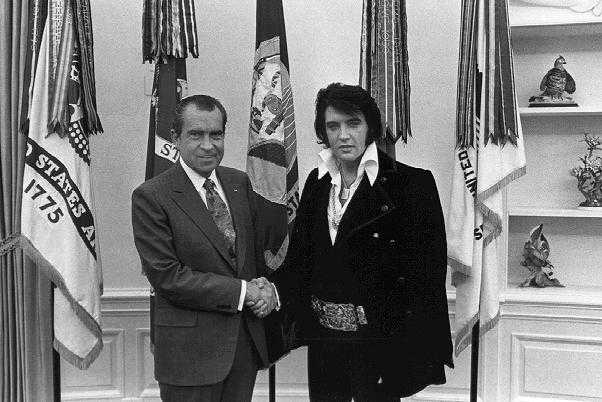
Later in the afternoon, Tony Esposito and Tony Peyronel did a session on Springsteen-as-icon. I walked away connecting in my head two great ironic-iconic images: Nixon and Elvis at the White house in the 70s and Springsteen and John Kerry on the campaign trail in '04.
Clearly it's the "Post Election Debacle of 2004" conference. Yee-ha!
Kind of interesting.
Texeira saw this as evidence of a need for the dems to move to the center--although I suspect he'd disagree with that characterization. At several points he conflated "good" and "moderate," making clear that he equates the two concepts (e.g., In terms of her voting record, Hillary Clinton is a good senator, very moderate.). He said the dems need to articulate their vision with niftier, shorter soundbites that appeal to the middle of the road. He urged the crowd to push the dems away from so-called polarizing liberals (again, a Hillary Clinton example: she "comes to bat with two strikes against her") so that they can re-capture the tens of thousands of votes that the GOP took from them, a demographic typified by the wwc.
I couldn't disagree more. Texeira wants the democrats to out-republican the republicans and that strategy DOESN'T WORK. Why should the left pander to regressives who can't handle a strong woman on the ballot? Why should the left imitate the values-laden rhetoric of the right? Why should we try to nickel and dime a victory by getting those pro-Bush wwc moderates? Why not tap the millions of white, black, and brown members of the working class and working poor who are disenfranchised from the entire process?
Texeira framed the issues in an interesting fashion but I suspect that many in the room, like myself, were lefties who gritted their teeth and fought for Kerry despite his less-than-progressive stances on Iraq and healthcare. And I get the sense that he knew he was losing the crowd, since his answers to critical queries grew shorter as the session progressed.
----
Later in the afternoon, Tony Esposito and Tony Peyronel did a session on Springsteen-as-icon. I walked away connecting in my head two great ironic-iconic images: Nixon and Elvis at the White house in the 70s and Springsteen and John Kerry on the campaign trail in '04.

Clearly it's the "Post Election Debacle of 2004" conference. Yee-ha!
CWCS Conference #1
Seventh Biennial Conference of the Center for Working-Class Studies (CWCS). This is my fourth time taking part in "the Youngstown conference," by far my favorite academic meeting. In addition to panels, CWCS always features poetry/prose readings, opportunities to take part in community/activist activities, and mini-trips (I toured one of Youngstown's horrific "supermax" prisons four years back). Plus, great group of people.
Last night Mike Rose gave the keynote address. Rose read from The Mind at Work, his exploration of blue-collar workplaces as sites of "neck up" work. I wrote a review of the book for Rhetoric Review and taught the book in my graduate class this past semester, so I've spent a lot of time thinking about Rose's research. One of the thing that fascinates me is thinking about the chapter on waitressing in contrast to other recent representations of waitressing. Rose's gaze is so different from, say, Barbara Ehrenreich in Nickel and Dimed. Rose looks at waitressing and sees complex and often abstract cognitive functioning (memorizing, ordering and prioritizing of tasks, negotiating complicated relationships with various agents, etc.) whereas Ehrenreich looks at waitressing and sees an often abusive labor arrangement. Alright, two different methods, two different sets of interest, and two different focuses. Obvious enough. But given all that we know about the complexity of texts (their ability to be "academic," "civic," "activist" all at once) the contrast between the two representations of the same line of work is interesting. The grad students were quite critical of what they saw as a glossing over of the injustices. Again, the waitressing chapter: Rose refers to how the waitresses (including his mother) respond to sexist comments from customers. For Rose, an opportunity to discuss cognition. But is there an ethical obligation to analyze the gendered nature of this real-world rhetorical situation? Texts like Ehrenreich's and Rose's are such rich teaching texts (little wonder both writers are often anthologized)--my prediction is that exerpts from both Nickel and Dimed and The Mind at Work will become staples of composition readers in the next few years.
There are so many generative opportunities for conceiving of the workplace-as-text and work-as-topoi. It's a shame that rhetoric and composition isn't better represented at the Youngstown conference.
Anyway, Rose's talk was more of a conversation. After a short reading from the introduction, audience members nudged Rose in different directions. Rose spent some time considering the question of whether "mind work" on the job translates into high cognition in other--namely civic--domains. In other words, do these blue-collar workplaces foster particular kinds of thinking when the worker is no longer at work? We sort of assume that, say, learning to think the way one must think in a geometry or foriegn language class has implications for becoming "educated"...Rose raises the question of whether learning to think like a line worker or waitress or hair dresser also gives individuals particular kinds of cognitive skills. Rose's thesis includes the idea that dismissing these blue-collar domains as sites of Fordist disciplining is too simple and fails to account for some interesting mind and body work going on there.
More on conference later.
Last night Mike Rose gave the keynote address. Rose read from The Mind at Work, his exploration of blue-collar workplaces as sites of "neck up" work. I wrote a review of the book for Rhetoric Review and taught the book in my graduate class this past semester, so I've spent a lot of time thinking about Rose's research. One of the thing that fascinates me is thinking about the chapter on waitressing in contrast to other recent representations of waitressing. Rose's gaze is so different from, say, Barbara Ehrenreich in Nickel and Dimed. Rose looks at waitressing and sees complex and often abstract cognitive functioning (memorizing, ordering and prioritizing of tasks, negotiating complicated relationships with various agents, etc.) whereas Ehrenreich looks at waitressing and sees an often abusive labor arrangement. Alright, two different methods, two different sets of interest, and two different focuses. Obvious enough. But given all that we know about the complexity of texts (their ability to be "academic," "civic," "activist" all at once) the contrast between the two representations of the same line of work is interesting. The grad students were quite critical of what they saw as a glossing over of the injustices. Again, the waitressing chapter: Rose refers to how the waitresses (including his mother) respond to sexist comments from customers. For Rose, an opportunity to discuss cognition. But is there an ethical obligation to analyze the gendered nature of this real-world rhetorical situation? Texts like Ehrenreich's and Rose's are such rich teaching texts (little wonder both writers are often anthologized)--my prediction is that exerpts from both Nickel and Dimed and The Mind at Work will become staples of composition readers in the next few years.
There are so many generative opportunities for conceiving of the workplace-as-text and work-as-topoi. It's a shame that rhetoric and composition isn't better represented at the Youngstown conference.
Anyway, Rose's talk was more of a conversation. After a short reading from the introduction, audience members nudged Rose in different directions. Rose spent some time considering the question of whether "mind work" on the job translates into high cognition in other--namely civic--domains. In other words, do these blue-collar workplaces foster particular kinds of thinking when the worker is no longer at work? We sort of assume that, say, learning to think the way one must think in a geometry or foriegn language class has implications for becoming "educated"...Rose raises the question of whether learning to think like a line worker or waitress or hair dresser also gives individuals particular kinds of cognitive skills. Rose's thesis includes the idea that dismissing these blue-collar domains as sites of Fordist disciplining is too simple and fails to account for some interesting mind and body work going on there.
More on conference later.
5/17/2005
Ohio towns
Blogging on location from Youngstown, Ohio, where I'm in town for the Center for Working-Class Studies conference at the end of this week. Driving across Ohio inspired my list of...
TOP TEN OHIO CITIES WHOSE PRONUNCIATION MIGHT SURPRISE YOU
10. Lima (pronounced like the bean, not the city in Peru)
9. Vienna (first syllable rhymes with "eye")
8. Bellefontaine ("bell fountain")
7. Lowellville ("low-ville")
6. Newark (often comes out in one syllable)
5. Toledo (okay, the pronunciation might surprise you if you're from Spain!)
4. Bucyrus (rhymes with "view virus")
3. East Palestine (pal-ah-STEEN)
2. Medina (ma-DYE-na)
1. Pataskala (surprising no matter how you say it)
TOP TEN OHIO CITIES WHOSE PRONUNCIATION MIGHT SURPRISE YOU
10. Lima (pronounced like the bean, not the city in Peru)
9. Vienna (first syllable rhymes with "eye")
8. Bellefontaine ("bell fountain")
7. Lowellville ("low-ville")
6. Newark (often comes out in one syllable)
5. Toledo (okay, the pronunciation might surprise you if you're from Spain!)
4. Bucyrus (rhymes with "view virus")
3. East Palestine (pal-ah-STEEN)
2. Medina (ma-DYE-na)
1. Pataskala (surprising no matter how you say it)
5/09/2005
Non-Academic Stuff I Read During Summer Vacation #1
Speak by Laurie Halse Anderson is an angsty piece of "young adult" (y.a.) fiction that I appreciate because Anderson refuses to sanitize the outcast-narrator. Anderson lets Malinda--a high school freshmen who exists on the margins of her school's social worlds--be miserable and awkward. [Consider this "nerd" representation in contrast to, say, Seth on the O.C., a show that feels compelled to portray its nerd as a hip, funny, ironic, guy who's tight with the best-looking kids at school.] Malinda's a great character who keeps readers wincing in scenes that (mostly) transcend y.a. cliches. It's hard to create a fresh image of a dejected teen, but Anderson does just that. Interesting character; interesting piece of work.
Thanks to Ohio Writing Project teachers for recommending Anderson's novel. They report that this is the book their junior high and high school students currently love. And I must confess a long-standing affinity for this genre of fiction that dates back to loving Robert Cormier, the master of "serious y.a. fiction," starting in sixth grade. Cormier's I Am the Cheese creeped me out more than anything I'd read or watched so far. I got to meet Cormier twice, in 1988 and 1998, the first time as a junior high student participating in English Festival (kind of like a science fair for kids who love reading) and the second time as a graduate student volunteering at English Festival, before his death a few years back. A generous writer, Cormier frequented the Festival and would sign autographs and listen to kids for hours on end.
Speak doesn't put Anderson in Cormier's league, but if you count the O.C. as a guilty pleasure, give it a look.
Thanks to Ohio Writing Project teachers for recommending Anderson's novel. They report that this is the book their junior high and high school students currently love. And I must confess a long-standing affinity for this genre of fiction that dates back to loving Robert Cormier, the master of "serious y.a. fiction," starting in sixth grade. Cormier's I Am the Cheese creeped me out more than anything I'd read or watched so far. I got to meet Cormier twice, in 1988 and 1998, the first time as a junior high student participating in English Festival (kind of like a science fair for kids who love reading) and the second time as a graduate student volunteering at English Festival, before his death a few years back. A generous writer, Cormier frequented the Festival and would sign autographs and listen to kids for hours on end.
Speak doesn't put Anderson in Cormier's league, but if you count the O.C. as a guilty pleasure, give it a look.
5/06/2005
obligatory post on reading student papers
Had final meeting with grad students last night. Dinner and informal presentations of seminar papers at my place...in that order. Dinner: stuffed grape leaves, hummus, salad with lots of basil and fresh mozzarella, spinach pizza. Presentations: identity construction & the blue collar comedy tour, confederate flag debate as embodiment of cultural capital, Canada's "fat" tax, belletrism at Appalachian settlement schools, and more. What great work. Over the next year or two these ought to morph into nine published articles. As I comment on the papers--asking questions, making suggestions, suggesting further connections--I envision the articles thrusting Aune, Lukacs, and Bourdieu (easily the three most cited theorists in the stack of papers) into the field's spotlight. A rhetoric revolution.
Sirc on Cobain
It's been a long time since I read something that made me want to re-assess classroom practice. Geoffrey Sirc's "Composition's Eye/Orpheus's Gaze/Cobain's Journals," in the new issue of Composition Studies, has got me thinking about what I want to do in writing courses next fall. Sirc starts with an image of Jim Corder asking "why in the hell" his students would want to write the tired essays he was assigning, and then posits Kurt Cobain's journals as a model of a different medium, a different "representational technology," a different "way of seeing."
Sirc reviews familiar critiques of textbook pedagogy--they emphasize consumption over production, they foster dispassionate and disengaged "essays"--and then gets us thinking about writing informed by Orpheus's gaze: something forbidden, something indulgent, and yet something everyday. Of students Sirc says "I can often get them to see the logic of memorializing their everyday, of capturing their unprogrammed interactions with other people and their environment" (15). He looks at Kurt Cobain's sad musings on fame, the state of music and culture, and spirituality, and wonders how journaling both constructed a world and helped (or not) Cobain think about the extant world..."self reflection as self definition" (18).
Thinking about Cobain, Sirc calls for a rethinking of journals in the classroom. If I'm getting the article (and I want to go back and read it again), though, he's calling for a particular use of those journals. Not as a place merely to reflect on the belletristic essay you just read, as a place to make banal lists: what did you see on the street today? what did you buy this week? what songs would you put on a mixtape today?
I've been thinking about these kinds of assignments (in anticipation of adding a significant blog component to writing classes next year) and how they could dovetail and sequence with other writing projects and the Cobtain connection has me thinking even more. I'm not sure what to make of Sirc positioning this mode, this way of seeing, as a response to the Jim Corder question "why in the hell would they want to write this?" If Cobain embodies this way of seeing (the indulgent, banal, everyday), then I gotta ask: why in the hell would they want to write this?
More on this later. What a great article. Makes me want to start putting together the fall syllabi (being that it's the last day of the spring term and all!).
Sirc reviews familiar critiques of textbook pedagogy--they emphasize consumption over production, they foster dispassionate and disengaged "essays"--and then gets us thinking about writing informed by Orpheus's gaze: something forbidden, something indulgent, and yet something everyday. Of students Sirc says "I can often get them to see the logic of memorializing their everyday, of capturing their unprogrammed interactions with other people and their environment" (15). He looks at Kurt Cobain's sad musings on fame, the state of music and culture, and spirituality, and wonders how journaling both constructed a world and helped (or not) Cobain think about the extant world..."self reflection as self definition" (18).
Thinking about Cobain, Sirc calls for a rethinking of journals in the classroom. If I'm getting the article (and I want to go back and read it again), though, he's calling for a particular use of those journals. Not as a place merely to reflect on the belletristic essay you just read, as a place to make banal lists: what did you see on the street today? what did you buy this week? what songs would you put on a mixtape today?
I've been thinking about these kinds of assignments (in anticipation of adding a significant blog component to writing classes next year) and how they could dovetail and sequence with other writing projects and the Cobtain connection has me thinking even more. I'm not sure what to make of Sirc positioning this mode, this way of seeing, as a response to the Jim Corder question "why in the hell would they want to write this?" If Cobain embodies this way of seeing (the indulgent, banal, everyday), then I gotta ask: why in the hell would they want to write this?
More on this later. What a great article. Makes me want to start putting together the fall syllabi (being that it's the last day of the spring term and all!).
4/28/2005
Pho
So I feel a cold coming on. Bad news because tomorrow I'm giving the final 'Faculty Seminar' (lecture open to campus-wide faculty) of the year. Luckily, a trip to the Saigon Dragon in beautiful Fairfield, Ohio, has perhaps saved the day. Pho is an absolute miracle cure: huge bowl (I've never seen a small serving of pho) of beef broth with a hint of fish sauce, tender strips of beef, and rice noodles, served with a heaping plate of fresh basil, cilantro, thai chilis, lime wedges, and sprouts to be added as desired. This will cure whatever ails you, guaranteed. Back in seminary--where about half the seminarians were Vietnamese--classmates introduced me to this staple, often eaten for breakfast in Vietnamese households. You can keep all the fancy thai soups, with the lemon grass, coconute milk, etc., and give me a heaping bowl of pho anytime. Here's an interesting blog about the pho scene in southern California.
A related cure that my Vietnamese chums swore by: stomachache relief from sucking the juice of half a lime (a lemon will do in a pinch), and then drinking a can of Coke (Pepsi will *not* do in a pinch) as quickly as you can. As memory recalls, results were less reliable than the old pho-for-the-common-cold.
A related cure that my Vietnamese chums swore by: stomachache relief from sucking the juice of half a lime (a lemon will do in a pinch), and then drinking a can of Coke (Pepsi will *not* do in a pinch) as quickly as you can. As memory recalls, results were less reliable than the old pho-for-the-common-cold.
those lefty judges...
What with all the talk about liberal-activist judges, here's an interesting statistic from the A.P./Detroit Free Press:
The number of secret court-authorized wiretaps across the country surged by 19 percent last year, according to court records which also showed that not a single application was denied.
4/26/2005
Sarah Vowell interview
Today's odd pairing: writer Sarah Vowell and Death Cab for Cutie guitarist Christopher Walla. Salon published today Walla's interview with the writer, who's promoting her new book "Assassination Vacation." Vowell voiced Violet (the angsty teen daughter) in The Incredibles, reads her essays on NRP, and also wrote the great essay collection "Take the Cannoli," which featured the titular story about studying abroad and being too embarassed to visit Corleone, Sicily, for fear of being outed as a Godfather-loving (actually, Godfather-addicted)American tourist. That essay also recounts Vowell's being abroad during the L.A. riots and feeling conflicted about violence, America, and family--all themes she implicitly connects to her Godfather obsession. Vowell's a wonderfully unfocused writer, meandering from experience to pop culture reference back to experience to op-ed mode.
Anyway, sit through the day pass thing and check out the interview. Vowell talks a lot about her new book, which I haven't read and which concerns itself with historical markers commemorating (?) presidential assassinations. But as is her style, Vowell does plenty of free associating. Here's a taste:
Also, Pitchfork today reports on Kraftwerk's soon-to-be-released double live album, which looks to be great. No summer dates in Ohio :( so I might need to figure out a way to be in Detroit for their June 2 show there. Sixty-year-old guys playing twenty-minute disco-synth songs sung in German...be there!
Anyway, sit through the day pass thing and check out the interview. Vowell talks a lot about her new book, which I haven't read and which concerns itself with historical markers commemorating (?) presidential assassinations. But as is her style, Vowell does plenty of free associating. Here's a taste:
There are certain public radio interviewers who are never going to ever ask me about the "O.C." section of the Garfield chapter [where Vowell links the utopian Oneida community, referred to in old letters as "the O.C.," to the Thursday-night teen drama] because they don't know what it is, or if they do, they're not going to admit to it. And then there are Morning Zoo guys who don't really want to get into the Spanish-American War. So it is kind of interesting going on all these different kinds of shows talking to all these different kinds of people.
And this book tour is different. Since I did "The Incredibles" I have these totally adorable 8- or 9-year-old girls coming to get their Violet stuff signed, and I get to talk to them about how their friends and them play and they always want to be Violet. It's so reassuring, especially because when I was known almost entirely for working on public radio, my audience was all from public radio, which meant that they were all kind of old. And it's kind of terrifying when you're, say, 35 and your audience is like 65. And then you wonder who is going to support your projects after your audience is dead.
Also, Pitchfork today reports on Kraftwerk's soon-to-be-released double live album, which looks to be great. No summer dates in Ohio :( so I might need to figure out a way to be in Detroit for their June 2 show there. Sixty-year-old guys playing twenty-minute disco-synth songs sung in German...be there!
4/22/2005
A Place to Stand
Thanks to Julie Lindquist for visiting my 'Rhetorics of Social Class' course on Wednesday. We discussed her important ethnography, A Place to Stand, and Julie generously spoke with grad students about the book's logistics, methods, and analyses as well as the emotional committment involved in doing the project. For those unfamiliar with her work, Lindquist studied the argumentative strategies of patrons of the working-class bar in suburban Chicago where she worked.
One of the things we talked about during her visit was her claim that 'argument' became the patrons' way to define rhetorically their own class identity. While patrons didn't utilize economic or "meta" jargon to talk about or identify their sociopolitical identity, they DID take part in political argument as a means to construct who they are and who they are not, using Lindquist (their bartender) as their "foil." Uniting around their shared (and usually friendly) opposition to her "liberal" positions on current events, the patrons used debate as their articulation of class position.
We connected this analysis to what Basil Bernstein and other sociolinguists say about working-class discourse--that working people often use qualified speech, hedging their statements with narrative ("this is just me, but...") and anecdote ("well, in my experience...") whereas middle-class and/or priveleged discourse is more willing to universalize and make blanket statements. Lindquist's ethnography, in my reading, disrupts Bernstein's schema in many ways. She finds that her working-class bar-goers are less rooted in storytelling and more rooted in deliberative rhetoric.
This and other connections grew from Wednesday's class. Thanks to Julie for making the drive to Oxford!
One of the things we talked about during her visit was her claim that 'argument' became the patrons' way to define rhetorically their own class identity. While patrons didn't utilize economic or "meta" jargon to talk about or identify their sociopolitical identity, they DID take part in political argument as a means to construct who they are and who they are not, using Lindquist (their bartender) as their "foil." Uniting around their shared (and usually friendly) opposition to her "liberal" positions on current events, the patrons used debate as their articulation of class position.
We connected this analysis to what Basil Bernstein and other sociolinguists say about working-class discourse--that working people often use qualified speech, hedging their statements with narrative ("this is just me, but...") and anecdote ("well, in my experience...") whereas middle-class and/or priveleged discourse is more willing to universalize and make blanket statements. Lindquist's ethnography, in my reading, disrupts Bernstein's schema in many ways. She finds that her working-class bar-goers are less rooted in storytelling and more rooted in deliberative rhetoric.
This and other connections grew from Wednesday's class. Thanks to Julie for making the drive to Oxford!
another reason for move
We'll likely make our move to Detroit in August. Wish they'd delay this weekend's Motor City Music Conference until then. Holy macaroni, check out the line-up at Cobo Joe's and the Majestic.
4/19/2005
what's the haps?
What's the haps, you ask?
*House went on the market yesterday. One family had a look this afternoon, and another is coming by tomorrow. One step closer to the new job; one step closer to Detroit rock city.
*Spent most of today working on presentation/article on faculty attitudes toward (il)literacy. More thinking on the rhetoric of "range of abilities." A majority of faculty reported (on surveys about student writing proficiency) frustration at classes made up of students of varying ability. Many reported not knowing what to do in the classroom when ability differs widely. This says much about teaching practices--the idea that there ought to be a homogeneity of proficiency. Certainly this stems in part from the culture of testing, right? The idea that a test can generate like-abled communities of learning. And I think this also has much to do with who (the teacher) defines ability, proficiency, etc. Still tentative...More later.
*No time to say much about news from Rome, except to say that the word "church" means people, not person.
*Tomorrow Julie Lindquist visits my grad. class to talk about her outstanding ethnography of working-class tavern.
*House went on the market yesterday. One family had a look this afternoon, and another is coming by tomorrow. One step closer to the new job; one step closer to Detroit rock city.

*Spent most of today working on presentation/article on faculty attitudes toward (il)literacy. More thinking on the rhetoric of "range of abilities." A majority of faculty reported (on surveys about student writing proficiency) frustration at classes made up of students of varying ability. Many reported not knowing what to do in the classroom when ability differs widely. This says much about teaching practices--the idea that there ought to be a homogeneity of proficiency. Certainly this stems in part from the culture of testing, right? The idea that a test can generate like-abled communities of learning. And I think this also has much to do with who (the teacher) defines ability, proficiency, etc. Still tentative...More later.
*No time to say much about news from Rome, except to say that the word "church" means people, not person.
*Tomorrow Julie Lindquist visits my grad. class to talk about her outstanding ethnography of working-class tavern.
4/18/2005
'range of skills' as a threat
The project that's this week's priority: a paper I'm working on about how faculty on my campus perceive writing proficiency. I did a pretty extensive survey last term asking faculty across-the-curriculum how much and what kinds of writing they assigned and also what they thought of student writing ability. I was wondering if there would be any interesting trends when I looked at their answers in conjunction with rank, department affiliation, and years employed at the university. A few such trends have emerged (I'll post about those later this week, as I crunch the data)...but what mainly interests me is the *language* that faculty used on the open-ended questions. Certainly a lot of panic in their assessments of student literacy (of lack thereof), but particularly when describing the RANGE of writing "skills." Range certainly represents a teaching *challenge*, but I'm interested in the implications of, well, freaking out about this kind of diversity. I wonder how I might try to understand this imperative in light of broader imperatives toward cultural homogenization. I'd like to look more at the literature on "universal design." More on this later (as I write the paper and think this through)...I'm giving a talk based on the research as part of our 'Faculty Seminar' series on the last of Friday of April--so I better get writing!
vinyl finds at brass armadillo
As my sojourn in SW Ohio begins to draw to a close, I realize my visits to the Brass Armadillo are numbered. The 'dillo, a sprawling antique mall, has been a great source of cool vinyl. This weekend's finds:
*T.Rex-"Tanx" (1973)
*Al Caiola-"Greasy Kid Stuff" (1963) Played guitar on a boatload of Johnny Mathis hits and recorded traditional Italian ballads...but he also put out a string of surf-guitar covers albums in the 60s, of which this is one. Fun stuff.
*Aretha Franklin-"Hey Now Hey: The Other Side of the Sky" (1973) Weird psychedelia. A concept album and collaboration with Quincy Jones.
*J.Geils Band-"Full House Live" (1972) Recorded at Detroit's Cinderella Ballroom.
*Kraftwerk-"Autobahn" (1974) Or, as Nicole calls them, the killer robots. I've always heard that Devo started out as a Kraftwerk parody.
I left behind the "Meatballs" soundtrack album because they wanted $4 (ridiculous!), but now I'm jonesing for the "Are You Ready for the Summer?" theme.
*T.Rex-"Tanx" (1973)
*Al Caiola-"Greasy Kid Stuff" (1963) Played guitar on a boatload of Johnny Mathis hits and recorded traditional Italian ballads...but he also put out a string of surf-guitar covers albums in the 60s, of which this is one. Fun stuff.
*Aretha Franklin-"Hey Now Hey: The Other Side of the Sky" (1973) Weird psychedelia. A concept album and collaboration with Quincy Jones.
*J.Geils Band-"Full House Live" (1972) Recorded at Detroit's Cinderella Ballroom.
*Kraftwerk-"Autobahn" (1974) Or, as Nicole calls them, the killer robots. I've always heard that Devo started out as a Kraftwerk parody.
I left behind the "Meatballs" soundtrack album because they wanted $4 (ridiculous!), but now I'm jonesing for the "Are You Ready for the Summer?" theme.
4/15/2005
Friday Morning Questions
When will Todd Solondz's Palindromes come to Cinci? Why isn't Solondz huge?
Why did anyone get behind Rosa Parks's lawsuit against Outkast? This morning CNN reports the thing's been settled...but how did it even go that far? Outkast can't rap about (or even use the name of) an historical figure without infringing on a trademark? Had they not settled, I'd have been curious to see who might have jumped on that gravy train. An enterprising church (or maybe Regis Philbin) sues Kayne West, maybe?
How can ya not be sad about the world we live in?
Why did anyone get behind Rosa Parks's lawsuit against Outkast? This morning CNN reports the thing's been settled...but how did it even go that far? Outkast can't rap about (or even use the name of) an historical figure without infringing on a trademark? Had they not settled, I'd have been curious to see who might have jumped on that gravy train. An enterprising church (or maybe Regis Philbin) sues Kayne West, maybe?
How can ya not be sad about the world we live in?
4/07/2005
Pope John Paul II on the Iraq war/occupation
Most media outlets seem to be ignoring Pope John Paul II's moral condemnation of the U.S.'s 2003 invasion of Iraq. The Pope spoke officially, from his moral seat, about the unjust nature of pre-emptive war. He offered an unequivocal assessment of pre-emptive strikes, citing both official doctrine of the Catholic Church as well as Thomistic thought (the writings of Thomas Aquinas that inform just-war theory) in order to morally condemn the invasion.
Media Matters does an excellent job refuting the right-wing distortions of the Pope's position on the war. My favorite of these distortions is Fox "News"'s assertion that the Pope's moral position on the war was a result of his bowing to pressure from his lieutenants. Come again? Pope JPII, no matter what you think of him, was NOT a leader who bowed to pressure. He faced enormous pressure to re-think his positions on the laity's role in church leadership, women and the church, birth control, and a slew of other issues about which his opinion was controversial. He faced enormous pressure from his inner circle not to apologize for the Vatican's historic anti-semitism--but made that apology anyway.
My second favorite of the distortions--one that Media Matters doesn't deal with--is the construction of the Pope as an ideological ally of Ronald Reagan. Yes, they both hated communism. But look more deeply at the record. Throughout the 80s, John Paul II consistently re-affirmed just-war theory and its abhorrence for the brands of fascism that Reagan was supporting (financially and militarily) in Latin America.
What a month we've had for cheap political co-opting of human life. Terry Shiavo--co-opted, her life turned into opportunities for political gain. Same with the Pope. His life and his life's work twisted and spun and reduced to partisan one-upsmanship. Look, the Pope took public positions consistent with conservative American politics: opposition to abortion and homosexuality. He took public positions consistent with progressive American politics: opposition to pre-emptive war and the death penalty. The Pope aligned himself with the battle to bring down communist regimes. He aligned himself with liberation movements for self-rule and the toppling of U.S.-backed fascism in central America. I agree with the Pope about some issues (the just war notion that military action by all nations, including the U.S., must meet ethical standards, for example) and disagree with him about others (the ordination of women, for example). Rush Limbaugh et al: stop using his life for your own narrow-ass agenda!
Good sources on just-war theory:
Just-War Theory (Internet Encyclopedia of Philosophy)
The American Catholic
Stanford Encyclopedia of Philosophy
**Thanks to Fr. Art McGovern, SJ, a professor mine from my undergrad. days, who introduced me to Catholic social justice teaching. I took Fr. McGovern's class in Ethics during freshman year and Peace and Social Justice during junior year. Both classes involved lots of reading, writing, debating, and attending various events in Detroit (before "service learning" was talked about much). Fr. McGovern embodied Jesuit education and liberal learning. His book "Marxism, an American Christian Perspective" is invaluable. Rest in peace.
Media Matters does an excellent job refuting the right-wing distortions of the Pope's position on the war. My favorite of these distortions is Fox "News"'s assertion that the Pope's moral position on the war was a result of his bowing to pressure from his lieutenants. Come again? Pope JPII, no matter what you think of him, was NOT a leader who bowed to pressure. He faced enormous pressure to re-think his positions on the laity's role in church leadership, women and the church, birth control, and a slew of other issues about which his opinion was controversial. He faced enormous pressure from his inner circle not to apologize for the Vatican's historic anti-semitism--but made that apology anyway.
My second favorite of the distortions--one that Media Matters doesn't deal with--is the construction of the Pope as an ideological ally of Ronald Reagan. Yes, they both hated communism. But look more deeply at the record. Throughout the 80s, John Paul II consistently re-affirmed just-war theory and its abhorrence for the brands of fascism that Reagan was supporting (financially and militarily) in Latin America.
What a month we've had for cheap political co-opting of human life. Terry Shiavo--co-opted, her life turned into opportunities for political gain. Same with the Pope. His life and his life's work twisted and spun and reduced to partisan one-upsmanship. Look, the Pope took public positions consistent with conservative American politics: opposition to abortion and homosexuality. He took public positions consistent with progressive American politics: opposition to pre-emptive war and the death penalty. The Pope aligned himself with the battle to bring down communist regimes. He aligned himself with liberation movements for self-rule and the toppling of U.S.-backed fascism in central America. I agree with the Pope about some issues (the just war notion that military action by all nations, including the U.S., must meet ethical standards, for example) and disagree with him about others (the ordination of women, for example). Rush Limbaugh et al: stop using his life for your own narrow-ass agenda!
Good sources on just-war theory:
Just-War Theory (Internet Encyclopedia of Philosophy)
The American Catholic
Stanford Encyclopedia of Philosophy
**Thanks to Fr. Art McGovern, SJ, a professor mine from my undergrad. days, who introduced me to Catholic social justice teaching. I took Fr. McGovern's class in Ethics during freshman year and Peace and Social Justice during junior year. Both classes involved lots of reading, writing, debating, and attending various events in Detroit (before "service learning" was talked about much). Fr. McGovern embodied Jesuit education and liberal learning. His book "Marxism, an American Christian Perspective" is invaluable. Rest in peace.
back on the road
I don't think I'd have the stamina for a job that involved constant traveling. Going through the airport is, frankly, humiliating: taking off the belt and shoes, getting patted down, having somebody paw through the briefcase. Breathing that canned, airplane air always makes me feel like I've been inhaling my oxygen through a dirty fiberglass filter. Squeezing into seats, designed apparently for super-models and eleven-year-olds, I usually feel hot, cramped, and not a little germ-phobic. And traveling, whether business or pleasure, brings out the worst eating habits (10:30...pizza and beer anyone?).
Today, dealing with airline travel will be worth it. Heading to the Bay Area for my good pal (since high school) Nate's wedding. Congrats! Talk about a guy who deserves all kinds of happiness and success. Old friends will be there, plus several of the priests who staffed our seminary high school (haven't seen them since the early 90s). Not sure whether I'm stepping into a time machine, a 'Christmas Carol'-style dream ("I am the rector of Christmas past"), or an all-male version of the "high school reunion" cliche. Looking back on the seminary, I see lots of connections with all that bugs me about airline travel--giving up control. That regimented life. The rules. The schedules. The lack of discretionary time. One of the last things I did before leaving the seminary was go through the battery of pscyhological testing that all seminarians must complete. My results revealed a distrust of institutions and authoritarian structures. A trait ("disorder"?) that's served me well in academe. Didn't serve me as well in the seminary. Nor at airports.
Today, dealing with airline travel will be worth it. Heading to the Bay Area for my good pal (since high school) Nate's wedding. Congrats! Talk about a guy who deserves all kinds of happiness and success. Old friends will be there, plus several of the priests who staffed our seminary high school (haven't seen them since the early 90s). Not sure whether I'm stepping into a time machine, a 'Christmas Carol'-style dream ("I am the rector of Christmas past"), or an all-male version of the "high school reunion" cliche. Looking back on the seminary, I see lots of connections with all that bugs me about airline travel--giving up control. That regimented life. The rules. The schedules. The lack of discretionary time. One of the last things I did before leaving the seminary was go through the battery of pscyhological testing that all seminarians must complete. My results revealed a distrust of institutions and authoritarian structures. A trait ("disorder"?) that's served me well in academe. Didn't serve me as well in the seminary. Nor at airports.
4/05/2005
pizza
Since my grandmother's death last year, Nicole and I have been trying on a pretty regular basis to recreate her cooking. Recent successes include "greens and beans" (or, "minestra," as the food network calls it) prepared in one of the dutch ovens that was hers. Easy stuff: onion, garlic, celery, carrot, and red pepper flakes in olive oil until everything's soft. Then add a couple cans of chicken stock and a can of great northern beans. Boil a bunch of chopped swiss chard separately, drain, and add to the soup. Let it all cook together for at least thirty minutes. Mmmmm.
Anyway, last night we made "pizza" a la Grandma D. Real simple dough: warm water, flour, yeast, pinch of salt. We let it rise, rolled it out, brushed the top with olive oil and then generous amount of black pepper, and baked. I guess it's more like "bread," but to her it was "pizza." (Of course, while we were at it, we also used the dough to make one with spinach, roasted garlic, fresh mozzarella, and no sauce.)
Anyway, last night we made "pizza" a la Grandma D. Real simple dough: warm water, flour, yeast, pinch of salt. We let it rise, rolled it out, brushed the top with olive oil and then generous amount of black pepper, and baked. I guess it's more like "bread," but to her it was "pizza." (Of course, while we were at it, we also used the dough to make one with spinach, roasted garlic, fresh mozzarella, and no sauce.)
4/04/2005
The Kills
Last night at Newport Kentucky's legendary Southgate House: The Kills. What a show. The band's made up of a transatlantic duo who exploit sexual tension to create really loud, agressive, bluesy punkrock. Both band members play guitar and sing and the cacophony's backed up by drum machines and (I think) backing tracks that are heavy on the bass and kinda hard on the ears of the over-thirty crowd (I'm just speculating of course). But American Idol this ain't. They ripped through virtually their entire, excellent, new album No Wow and broke out a few tunes from their debut (which isn't as strong a record) including "Cat Claw," one of woxy's last heavy-rotation songs before the station's demise and subsequent online rebirth. Mostly they stuck to the whole punkrock two-minute-tune aesthetic, but at times they let the distortion do a little extended eardrum-shredding. The frontwoman, who goes by "VV" for some reason, would either leer at the audience or pace, cat-like, during these solos. I really had the sense she was going to pull out a weapon at several points--especially when she climbed atop the amps. The highlight of the show was clearly the encore, during which the band covered Captain Beefheart's "Dropout Boogie"--a perfect ending to the show. They actually made the Captain's lyrics make sense: "ya told her you love her/so bring her the butter/ya love her adapt her." Great, great show.
3/31/2005
Stafford
In English 112 today, my students wrote about and discussed William Stafford's "Traveling through the Dark."
With all that's part of our national consciousness today, a poem about choices, dilemmas, existential moments. We deserve to agonize. We need to agonize. Our humanity resides in our agonizing over moments. All the consequences and implications, all the 'on the other hand's demand our reflection. Stafford's narrator *has* to push her over the edge but, just as sure, *has* to think of the fawn.
Traveling Through the Dark
by William Stafford
Traveling through the dark I found a deer
dead on the edge of the Wilson River road.
It is usually best to roll them into the canyon:
that road is narrow; to swerve might make more dead.
By glow of the tail-light I stumbled back of the car
and stood by the heap, a doe, a recent killing;
she had stiffened already, almost cold.
I dragged her off; she was large in the belly.
My fingers touching her side brought me the reason--
her side was warm; her fawn lay there waiting,
alive, still, never to be born.
Beside that mountain road I hesitated.
The car aimed ahead its lowered parking lights;
under the hood purred the steady engine.
I stood in the glare of the warm exhaust turning red;
around our group I could hear the wilderness listen.
I thought hard for us all--my only swerving--,
then pushed her over the edge into the river.
With all that's part of our national consciousness today, a poem about choices, dilemmas, existential moments. We deserve to agonize. We need to agonize. Our humanity resides in our agonizing over moments. All the consequences and implications, all the 'on the other hand's demand our reflection. Stafford's narrator *has* to push her over the edge but, just as sure, *has* to think of the fawn.
hypocrisy
I thought maybe after Terry Schiavo's death the exploitation-of-tragedy-for-political-gain game might end. I was wrong. Bush, today, said:
Maybe when, as governor, he joked with the Texas press ("please don't kill me" with his lips trembling and his voice in a high, feminine tone) about the woman whose plea for clemency he ignored? Maybe when he urged Iraqi troops to "bring it on," meaning, I guess, that they ought to step up their efforts. Maybe when he wrote that executive order expanding the ability to use "interrogation methods" on detainees.
Inspirational to hear him advocate for a "culture of life."
I urge all those who honor Terri Schiavo to continue to work to build a culture of life where all Americans are welcomed and valued and protected.What does Bush know about a culture of life? What policy decisions has he made that uphold standards of dignity or any semblance of the notion that life is sacred?
Maybe when, as governor, he joked with the Texas press ("please don't kill me" with his lips trembling and his voice in a high, feminine tone) about the woman whose plea for clemency he ignored? Maybe when he urged Iraqi troops to "bring it on," meaning, I guess, that they ought to step up their efforts. Maybe when he wrote that executive order expanding the ability to use "interrogation methods" on detainees.
Inspirational to hear him advocate for a "culture of life."
3/22/2005
couple o' quotes from the Times
From today's lunchbreak reading, two provocative quotations from NYTimes:
From Nicholas Kristof:
From Maureen Dowd:
At least he's more qualified than Bono.
From Nicholas Kristof:
Mrs. Clinton has helped turn the debate around by emerging as both pro-choice and anti-abortion.I've heard this factoid tossed around with some frequency. Not sure how accurate, but it's interesting and I'd like to hear the single-issue-voter contingent of the GOP (especially those who think Clinton made the country "less moral") contend with it.
That is potentially a winning position for Democrats. Abortions fell steadily under Bill Clinton, who espoused that position, and have increased significantly during President Bush's presidency.
From Maureen Dowd:
Wolfie's biggest qualification to run the World Bank? His prediction that Iraqi reconstruction would pay for itself with Iraqi oil revenues.
At least he's more qualified than Bono.
sandanista
From The Guardian:
Ward Churchill. Tariq Ramadan. Now, Dora Maria Tellez.
I remember my Aunt Minnie claiming in the early-80s that she was being watched by shadowy figures, presumably as a result of the money she was sending to the sandanistas (who W's hero Ronald Reagan, of course, despised for their leftism, even though they revolted against a tyrannical fascist and installed a democratically elected government--a democratically elected government that the U.S. paid the contras to overthrow). I also remember developing an affinity at the beginning and end of same decade for two of the finest pieces of radicalism ever recorded: The Clash's Sandanista, and Kris Kristofferson's Third World Warrior--both inspired by the movement that Tellez helped to lead.
Here's to Dora Tellez, Aunt Minnie, The Clash, and Kris Kristofferson!
So Bush appoints a former contra, John Negroponte, as his chief of intelligence overseeing terrorism, and the U.S. subsequently blocks a former sandanista from obtaining a visa? Tellez was a student who got involved in the ousting of a fascist dictator...that's a terrorist act? What's more threatening to Bush, that she *was* a sandanista or that she *is now* an academic?The woman who epitomised the 1979 Nicaraguan revolution that overthrew the dictator Anastasio Somoza has been denied entry to the US to take up her post as a Harvard professor on the grounds that she had been involved in "terrorism".
The decision to bar Dora Maria Tellez, one of the best-known figures in recent Latin American history, who has frequently visited the US in the past, has been attacked by academics and writers.
It comes at a time when President George Bush has appointed as his new intelligence chief a man associated with the "dirty war" against the Sandinistas in Nicaragua.
Ward Churchill. Tariq Ramadan. Now, Dora Maria Tellez.
I remember my Aunt Minnie claiming in the early-80s that she was being watched by shadowy figures, presumably as a result of the money she was sending to the sandanistas (who W's hero Ronald Reagan, of course, despised for their leftism, even though they revolted against a tyrannical fascist and installed a democratically elected government--a democratically elected government that the U.S. paid the contras to overthrow). I also remember developing an affinity at the beginning and end of same decade for two of the finest pieces of radicalism ever recorded: The Clash's Sandanista, and Kris Kristofferson's Third World Warrior--both inspired by the movement that Tellez helped to lead.
Here's to Dora Tellez, Aunt Minnie, The Clash, and Kris Kristofferson!
3/21/2005
Go 'Cats
Arizona's still alive and kicking, and the match with Oklahoma State Thursday night looks to be the most exciting of this year's Sweet 16 games. So far in the tourney, the Wildcats put forth two team efforts in a row. Not one of those "Salim S. scores 35 points" games. Not one of those "Frye dominates the inside all night" games. But team efforts with balanced scoring and unselfishness. That bodes well.
Three (Arizona, Louisville, and North Carolina) of my Final 4 picks are still alive, and I stand by those three choices. First off, 'Cats all the way. Plus, I think Louisville is going to beat up on Washington on Thursday, then do the same thing to Texas Tech two days later. And NC's as sure a thing as we've got left standing (although their cross-state challenges from NC State looked good last week). That other region is tough...I'd have to pick Kentucky at this point.
Three (Arizona, Louisville, and North Carolina) of my Final 4 picks are still alive, and I stand by those three choices. First off, 'Cats all the way. Plus, I think Louisville is going to beat up on Washington on Thursday, then do the same thing to Texas Tech two days later. And NC's as sure a thing as we've got left standing (although their cross-state challenges from NC State looked good last week). That other region is tough...I'd have to pick Kentucky at this point.
3/14/2005
mediocrity 101
Right-wing rag The Weekly Standard has a predictable Canada-bashing piece that rehashes lots of tired and under-substantiated claims about long waits for health care services and a couple FRESH, under-substantiated claims like how doggone greedy Canadians are. The accounts of Canadian health care continue to fascinate me. Here's an issue where the right and left in the U.S. find totally and utterly opposite findings. Not skewed a bit differently. Not spun in various directions. Opposite.
The Weekly Standard piece is unbelievably weak (it strives for a gonzo-renegade agit-prop style--"hey, I'll claim that Canadians are all greedy!"--and that's a style that conservatives don't know how to do). But I've read other conservative accounts that do garner both data and anecdote that suggests problems with health care services north of the border. And, of course, peruse any issue of The Progressive or Nation and you'll find loads of articles about just how accessible are prescription drugs and medical services. Issues like this make the teaching of rhetoric so interesting--helping students to see how opposing ideologues can come to radically different conclusions about the same question. Good reason to be in this business.
For my part, my wife's myriad relatives in Canada ALL give rave reviews to the Canadian health care system. Many of them are senior citizens and they all have access to various prescription drugs, timely procedures, etc. They react in horror to stories about uninsured Americans and think that we're pulling their legs about the situation here in the "land of the free."
Anyway, that was a big tangent for the interesting part of the Weekly Standard piece. Here's where they blow their credibility. The writer is analyzing the music industry and, without irony, makes reference to "Canadian rocker Bryan Adams." Err, "rocker"? Really friend? The quote from the man who wrote the lyric "Have you ever really, really, really, really, really, really loved a woman?" goes a little something like this: "[the regulatory policy] encourages mediocrity." I can picture the reporter running around the newsroom with his "Ditto Head" button and Matt Drudge fedora on yelling, "Somebody get me an expert on mediocrity," and the scrappy young employee, full of pluck, the ink still wet on his journalism degree from Bob Jones U, tapping him on the shoulder: "Boss, I got Bryan Adams on the line for you."
The Weekly Standard piece is unbelievably weak (it strives for a gonzo-renegade agit-prop style--"hey, I'll claim that Canadians are all greedy!"--and that's a style that conservatives don't know how to do). But I've read other conservative accounts that do garner both data and anecdote that suggests problems with health care services north of the border. And, of course, peruse any issue of The Progressive or Nation and you'll find loads of articles about just how accessible are prescription drugs and medical services. Issues like this make the teaching of rhetoric so interesting--helping students to see how opposing ideologues can come to radically different conclusions about the same question. Good reason to be in this business.
For my part, my wife's myriad relatives in Canada ALL give rave reviews to the Canadian health care system. Many of them are senior citizens and they all have access to various prescription drugs, timely procedures, etc. They react in horror to stories about uninsured Americans and think that we're pulling their legs about the situation here in the "land of the free."
Anyway, that was a big tangent for the interesting part of the Weekly Standard piece. Here's where they blow their credibility. The writer is analyzing the music industry and, without irony, makes reference to "Canadian rocker Bryan Adams." Err, "rocker"? Really friend? The quote from the man who wrote the lyric "Have you ever really, really, really, really, really, really loved a woman?" goes a little something like this: "[the regulatory policy] encourages mediocrity." I can picture the reporter running around the newsroom with his "Ditto Head" button and Matt Drudge fedora on yelling, "Somebody get me an expert on mediocrity," and the scrappy young employee, full of pluck, the ink still wet on his journalism degree from Bob Jones U, tapping him on the shoulder: "Boss, I got Bryan Adams on the line for you."
Arizona's year
Come on...this has got to be the year of the Arizona Wildcats. Salim Staudamire's the best shooter in the country. He tied his career-high 37 points over the weekend in Arizona's loss to Washington (more on them in a moment). When he and Channing Frye are both on, the Wildcats are the best team in the country. And, from the self-centered perspective, this is the last year where the Wildcats still have players (Frye and Staudamire, that is) from when I was at AZ. My last nostalgic/televised connection to grad school days, the last March Madness before I break out the geezer-talk ("wayyyy back when I was in Tucson, Gil Arenas was in my English 100 class and bla bla bla"..."I remember the championship game loss to Duke"). Go 'Cats. My prediction: Arizona's victory over Illinois in the elite eight match-up is the most talked-about game of the tourney.
Alright, the Washington Huskies. Let me join the choir and say that no way should they be seeded number one. Look for them to lose in the 3rd round to Louisville. Duke also was a prime contender for a number two or three seed...no surprise they were given a one-seed on a silver platter emblazoned with the words: "You may play your first two rounds in your home state, almighty Blue Devils" Look for Duke to also bow out in third round play (to Syracuse).
My picks for first-round upsets: UW-Milwaukee over Alabama (didya see UW-M beat up on the poor Detroit Titans? They're rough!). Creighton over West Virginia. Iowa State over Minnesota. NC-State over Charlotte. Miss State over Stanford (I'm down on non-Arizona Pac-10-ers this year). Iowa over Cinci (sorry my fellow southern Ohioans but Cinci is way inconsistent).
My final four: Arizona (3 seed), Louisville (4 seed), North Carolina (1 seed), Oklahoma (3 seed). The championship will see AZ triumph over Oklahoma in the battle of the seriously talented three seeds.
Alright, the Washington Huskies. Let me join the choir and say that no way should they be seeded number one. Look for them to lose in the 3rd round to Louisville. Duke also was a prime contender for a number two or three seed...no surprise they were given a one-seed on a silver platter emblazoned with the words: "You may play your first two rounds in your home state, almighty Blue Devils" Look for Duke to also bow out in third round play (to Syracuse).
My picks for first-round upsets: UW-Milwaukee over Alabama (didya see UW-M beat up on the poor Detroit Titans? They're rough!). Creighton over West Virginia. Iowa State over Minnesota. NC-State over Charlotte. Miss State over Stanford (I'm down on non-Arizona Pac-10-ers this year). Iowa over Cinci (sorry my fellow southern Ohioans but Cinci is way inconsistent).
My final four: Arizona (3 seed), Louisville (4 seed), North Carolina (1 seed), Oklahoma (3 seed). The championship will see AZ triumph over Oklahoma in the battle of the seriously talented three seeds.
3/08/2005
4C's session
Going to 4C's next week? Pencil in...
Session L.17: New Rhetorics of Working-Class Consciousness
Chair: Julie Lindquist
Participants: Bill DeGenaro ("Professing Class-Conscious Rhetorics"), Cathy
Chaput ("Reality TV and the Politics of Working-Class Identity"), Wendy
Ryden ("Bourgeois Realism, Working-Class Kitsch"), and Lew Caccia
("Workplace Risk Communication")
Four disparate critiques that argue for greater attention to issues of class in the study of the rhetorical tradition.
Session L.17: New Rhetorics of Working-Class Consciousness
Chair: Julie Lindquist
Participants: Bill DeGenaro ("Professing Class-Conscious Rhetorics"), Cathy
Chaput ("Reality TV and the Politics of Working-Class Identity"), Wendy
Ryden ("Bourgeois Realism, Working-Class Kitsch"), and Lew Caccia
("Workplace Risk Communication")
Four disparate critiques that argue for greater attention to issues of class in the study of the rhetorical tradition.
3/07/2005
Go Titans
Not too often the undergrad. alma mater ends up on national tv, so join me sports fans in watching the Detroit Titans battle for the Horizon League championship tomorrow night, Tuesday March 8 @ 9:00 EST, on ESPN.
clutter
Lots of clutter in the old brain these days. Much to do in the next five or six weeks, including two trips out west, one for 4Cs and one for my pal Nate's wedding. Going home for Easter weekend. In the midst of four or five writing projects, as usual. Revisions of my article for Community College Journal of Research and Practice. Second draft of a paper I'm co-writing about Million Dollar Baby (more on that project later). Final changes to next week's 4Cs presentation in San Fran. Productive weekend--read and marked set of term paper prospectuses from grad. students, got some reading done, cleaned basement and ended up listing a bunch of old stuff on ebay, raked leaves in backyard, broke away from work long enough to see "Be Cool," which was painfully mediocre (can't believe Elmore Leonard really had a hand in the adaptation).
Today, feeling jittery from a morning/early afternoon of paper grading (critical responses to Eve Ensler's "Necessary Targets") and from a lousy night's sleep. Last night woke up at 2 a.m. and couldn't sleep (rare for me), so I read most of Mark Haddon's novel "The Curious Indident of the Dog in the Night-Time," which I love even though at times the narrative becomes a parlor trick. It's a murder mystery of sorts, narrated by an autistic teenager in suburban London. Powerful characterization, but, again, the authorial trick becomes hokey at times. Good read though. Went to YMCA at 5:30 and actually felt wide awake by 7:00. But I'm gonna crash soon...Better get through rest of the papers while I can.
Today, feeling jittery from a morning/early afternoon of paper grading (critical responses to Eve Ensler's "Necessary Targets") and from a lousy night's sleep. Last night woke up at 2 a.m. and couldn't sleep (rare for me), so I read most of Mark Haddon's novel "The Curious Indident of the Dog in the Night-Time," which I love even though at times the narrative becomes a parlor trick. It's a murder mystery of sorts, narrated by an autistic teenager in suburban London. Powerful characterization, but, again, the authorial trick becomes hokey at times. Good read though. Went to YMCA at 5:30 and actually felt wide awake by 7:00. But I'm gonna crash soon...Better get through rest of the papers while I can.
3/01/2005
popstrology
(thanks to YellowDog for the link)
I've never been able to get into astrology. Nor have I ever gained much insight from knowing that I was born in the Chinese calendar's year of the ox. However, thanks to Popstrology, I've begun contemplating the significance of being born in the year of Roberta Flack, under the sign of Gladys Knight's "Midnight Train to Georgia."
I've never been able to get into astrology. Nor have I ever gained much insight from knowing that I was born in the Chinese calendar's year of the ox. However, thanks to Popstrology, I've begun contemplating the significance of being born in the year of Roberta Flack, under the sign of Gladys Knight's "Midnight Train to Georgia."
2/22/2005
civic duty
Folks, it finally happened. Last week, during my final two days of jury duty, I was seated for a real live criminal trial. I've always heard of juries comprised of senior citizens and miscelaneous folks with nothing else to do, but our jury had a nice mixture of young and old, male and female, rural and sub/urban. And I must admit, I never thought that a prosecutor in this neck of the woods would seat a lefty English prof for a criminal case...but I was wrong. The charge: aggravated robbery. The outcome: not guilty. Noteworthy was the absence of testimony. Various folks who clearly were eyewitnesses to the event and/or had knowledge about it were never called to the stand. The police detectives were asked few questions about their investigation. Of course we had to weigh the evidence that we had, but, afterward, I couldn't help but consider possible reasons why both sides seem to have left stuff out. Illegal search? The judge ruling some evidence inadmissable? Witnesses pleading the fifth or likely to plead the fifth?
Mmmm, the waffle truth
The Onion skewers Ben & Jerry's and Michael Moore this week. Here's the end of the piece (oftentimes the funniest parts of Onion satires):
Other Ben & Jerry's flavors slated for introduction in 2005 are Praline Kael, Noam ChompChompsky Crunch, Ché Guava, and Nelson Vanilla, an anti-apartheid flavor that consists of a dark-chocolate sorbet swirled in an equal amount of vanilla ice cream.
2/15/2005
proud to be from NE Ohio
Northeastern Ohio has produced some amazing art, much of it gritty and raw, a reflection of the region's industrialism and subsequent de-industrialism. I'm thinking of poets like Kenneth Patchen. Sherry Linkon and John Russo write in Steeltown USA: Work and Memory in Youngstown about how writers and thinkers and musicians reflected and responded to the changing face of class in the region, especially in the 70s and early 80s, as mills closed and unemployment lines lengthened.
No artistic movement thrived in the region with as much creative energy as first-wave punk rock. Rocket from the Tombs, the Dead Boys (with Stiv Bators, graduate of Youngstown's fine Catholic school system), Pere Ubu, Devo, The Waitresses, Chrissie Hynde, Rubber City Rebels. All from Cleveland, Youngstown, Akron, or Kent. Robert Christgau's website has in its archives a great piece Christgau wrote in 1978 about this burgeoning scene. Check it out!
No artistic movement thrived in the region with as much creative energy as first-wave punk rock. Rocket from the Tombs, the Dead Boys (with Stiv Bators, graduate of Youngstown's fine Catholic school system), Pere Ubu, Devo, The Waitresses, Chrissie Hynde, Rubber City Rebels. All from Cleveland, Youngstown, Akron, or Kent. Robert Christgau's website has in its archives a great piece Christgau wrote in 1978 about this burgeoning scene. Check it out!
2/07/2005
jury duty, or: so near and yet so far
This month I have jury duty, which entails calling the court every evening to find out if I need to report the next morning. Had to report this morning. Shuffled into sign-in area with about forty others for a quick video on civic duty featuring re-enactments of senior citizen (as the citizen) getting jury notice, vaguely ethnic-looking guy (as the accused) standing before a judge, and other assorted vignettes, interspersed with commentary cribbed from 'Schoolhouse Rock.' The video was narrated by a legal correspondent from one of the major networks because, hey, when you want to send a message about being "responsible," you want a member of the mainstream media in your corner.
Then we were led through the metal detectors, where numerous prospective jurors found out they couldn't bring pocket knives into the court room. Incidentally, when I was an altar boy, the priest--anticipating either that we should be gentlemanly or that we should always be prepared to commit and then cover up a crime--used to tell us to NEVER be without a pocket knife and a clean, white handkerchief. But I digress. Two prospective jurors had knitting supplies, too, and the needles also got a big ix-nay from the deputies.
Twelve of us (not including me) got to sit in the jury box. I call this group the "first string." After pledging allegiance and giving us some details about the case (a criminal case which involved a guy accused of gross sexual misconduct), the judge asked the first string some questions. Stuff like do you have a physical condition that could prevent you from showing up here each morning for the next few days. Then the prosecutor asked the first string a boatload of questions like have you or a friend or a family member ever had an unfavorable run-in with the law (that question will figure into the story in a moment). She also asked if they watch CSI or Law&Order. She asked those who said yes whether the show would cloud their ability to judge this case's merits. Then the defense attorney asked the first string a few real specific questions like do you know my client or any members of his family?
Sidebar time. The judge calls both attorneys to the bench. The bailiff puts on some classical music (kinda loud--almost in a "Clockwork Orange" way) so that the rest of us can't hear the sidebar. One juror is dismissed. The non-first-string person sitting closest to the jury box is called into the box. The judge asks her if any of the previously asked questions put up any red flags for her. Discussion ensues. Another sidebar, followed by the judge dismissing another juror. The person who is NOW sitting closest to the box is called up. Rinse, lather, and repeat. I was sitting tenth from the jury box...
And, yes, enough jurors were nixed that I was called into that box. The judge corrected the clerk's pronunciation of my name, cryptically adding that he knew it was a mis-pronunciation because he was familiar with lots of Italians from Youngstown (he was looking down at my juror questionaire and could see it was my hometown). Okay. So the judge asks me if any of the aforeasked questions was pertinent to me. Earlier, prosecutor had posed the question about run-ins with the law. Me? No. Family members? Err, kind of.
Questions ensued. Stories were told (during which the juror next to me picked up her purse ANTICIPATING that I would be the next to be dismissed). Sidebars were called. Juror DeGenaro was thanked and sent home. Boy, I came THIS CLOSE to being on that jury. Tonight I call again. Who knows? Maybe tomorrow I'll be back at the courthouse.
Then we were led through the metal detectors, where numerous prospective jurors found out they couldn't bring pocket knives into the court room. Incidentally, when I was an altar boy, the priest--anticipating either that we should be gentlemanly or that we should always be prepared to commit and then cover up a crime--used to tell us to NEVER be without a pocket knife and a clean, white handkerchief. But I digress. Two prospective jurors had knitting supplies, too, and the needles also got a big ix-nay from the deputies.
Twelve of us (not including me) got to sit in the jury box. I call this group the "first string." After pledging allegiance and giving us some details about the case (a criminal case which involved a guy accused of gross sexual misconduct), the judge asked the first string some questions. Stuff like do you have a physical condition that could prevent you from showing up here each morning for the next few days. Then the prosecutor asked the first string a boatload of questions like have you or a friend or a family member ever had an unfavorable run-in with the law (that question will figure into the story in a moment). She also asked if they watch CSI or Law&Order. She asked those who said yes whether the show would cloud their ability to judge this case's merits. Then the defense attorney asked the first string a few real specific questions like do you know my client or any members of his family?
Sidebar time. The judge calls both attorneys to the bench. The bailiff puts on some classical music (kinda loud--almost in a "Clockwork Orange" way) so that the rest of us can't hear the sidebar. One juror is dismissed. The non-first-string person sitting closest to the jury box is called into the box. The judge asks her if any of the previously asked questions put up any red flags for her. Discussion ensues. Another sidebar, followed by the judge dismissing another juror. The person who is NOW sitting closest to the box is called up. Rinse, lather, and repeat. I was sitting tenth from the jury box...
And, yes, enough jurors were nixed that I was called into that box. The judge corrected the clerk's pronunciation of my name, cryptically adding that he knew it was a mis-pronunciation because he was familiar with lots of Italians from Youngstown (he was looking down at my juror questionaire and could see it was my hometown). Okay. So the judge asks me if any of the aforeasked questions was pertinent to me. Earlier, prosecutor had posed the question about run-ins with the law. Me? No. Family members? Err, kind of.
Questions ensued. Stories were told (during which the juror next to me picked up her purse ANTICIPATING that I would be the next to be dismissed). Sidebars were called. Juror DeGenaro was thanked and sent home. Boy, I came THIS CLOSE to being on that jury. Tonight I call again. Who knows? Maybe tomorrow I'll be back at the courthouse.
2/04/2005
more campus politics
Four Ohio state senators--"small government" advocates all--have introduced a bill to establish an academic bill of rights for higher education in Ohio. Essentially, the bill provides for state-mandated neutrality on the part of college professors. The bill protects college students from indoctrination by their professors by legislating modes of instruction and evaluation. State senators are going to make decisions about how knowledge is constructed and disseminated! Please read the bill and think about the false sense of neutrality its language employs.
Students are to be graded without regard for ideological content. Okay, so as a teacher of writing, I must (by virtue of a state law?!) disregard ethical concerns. What ought I do with a grammatically correct essay that uses lively and active language to argue for the supremacy of the white race? That's a difficult question--one that is going to be decided by state senators instead of learned scholars who devote their lives to ethics and rhetoric?
What I like even more is the MANDATE that we teach "all human knowledge in these (subject) areas and provide students with dissenting sources and viewpoints." What does it mean to insist that a course cover "all knowledge," including "dissenting" views? Must a twentieth century history course cover the dissenting theory that the Holocaust never happened? Must a Shakespeare course (yeah, they still exist although the sponsors of the bill no doubt think the Shakespeare courses have been replaced with, God forbid, courses in lesbian literature) teach authorship conspiracies? Or, more likely, must a biology course teach creationism? What constitutes a legitimate academic theory can be tough. If a professor only has a ten-week quarter or a fifteen-week semester to cover a broad array of concepts, theories, and methods, some judicious cutting needs to take place. Once again, do we want state senators making those kinds of decisions about the legitimacy of a particular theory?
One interesting note on press coverage of the bill. The Columbus Dispatch ran a story that quoted an unnamed Miami University spokesperson as praising the bill. The story also quoted the president of the faculty union at Wright State as saying the bill was preposterous. The difference between a unionized and non-unionized faculty.
I'm fascinated (and, of course, frightened) by these crack-downs on so-called campus liberalism. The proponenets of the movement employ interesting rhetoric--often a discourse of "free speech" (protect the oppressed conservatives!) that borrows its tropes and logics from civil rights rhetoric. Two noted proponents, David Horowitz and Mike Adams, have gained attention in cable news and a.m. talk radio circles. Check them out.
The campus politics question is rearing its head in many venues. Marquette University shut down an "Adopt a Sniper" fundraiser (raising money for sharp shooters in the U.S. military) that the College Republicans group there was sponsoring. The Catholic University felt the rhetoric of the group (their motto: "1 Shot, 1 Kill, No Remorse, I Decide) was inconsistent with its respect for the sanctity of life. And, of course, Colorado Governor and the state's Regents are calling for the head of Ward Churchill, an ethnic studies professor who has contextualized 9/11 by writing about the role that U.S. imperialism played in prompting the attacks. Specifically, an article of his suggested that "little Eichmanns" died in the World Trade Center that day. Here's an interesting take on Churchill.
Students are to be graded without regard for ideological content. Okay, so as a teacher of writing, I must (by virtue of a state law?!) disregard ethical concerns. What ought I do with a grammatically correct essay that uses lively and active language to argue for the supremacy of the white race? That's a difficult question--one that is going to be decided by state senators instead of learned scholars who devote their lives to ethics and rhetoric?
What I like even more is the MANDATE that we teach "all human knowledge in these (subject) areas and provide students with dissenting sources and viewpoints." What does it mean to insist that a course cover "all knowledge," including "dissenting" views? Must a twentieth century history course cover the dissenting theory that the Holocaust never happened? Must a Shakespeare course (yeah, they still exist although the sponsors of the bill no doubt think the Shakespeare courses have been replaced with, God forbid, courses in lesbian literature) teach authorship conspiracies? Or, more likely, must a biology course teach creationism? What constitutes a legitimate academic theory can be tough. If a professor only has a ten-week quarter or a fifteen-week semester to cover a broad array of concepts, theories, and methods, some judicious cutting needs to take place. Once again, do we want state senators making those kinds of decisions about the legitimacy of a particular theory?
One interesting note on press coverage of the bill. The Columbus Dispatch ran a story that quoted an unnamed Miami University spokesperson as praising the bill. The story also quoted the president of the faculty union at Wright State as saying the bill was preposterous. The difference between a unionized and non-unionized faculty.
I'm fascinated (and, of course, frightened) by these crack-downs on so-called campus liberalism. The proponenets of the movement employ interesting rhetoric--often a discourse of "free speech" (protect the oppressed conservatives!) that borrows its tropes and logics from civil rights rhetoric. Two noted proponents, David Horowitz and Mike Adams, have gained attention in cable news and a.m. talk radio circles. Check them out.
The campus politics question is rearing its head in many venues. Marquette University shut down an "Adopt a Sniper" fundraiser (raising money for sharp shooters in the U.S. military) that the College Republicans group there was sponsoring. The Catholic University felt the rhetoric of the group (their motto: "1 Shot, 1 Kill, No Remorse, I Decide) was inconsistent with its respect for the sanctity of life. And, of course, Colorado Governor and the state's Regents are calling for the head of Ward Churchill, an ethnic studies professor who has contextualized 9/11 by writing about the role that U.S. imperialism played in prompting the attacks. Specifically, an article of his suggested that "little Eichmanns" died in the World Trade Center that day. Here's an interesting take on Churchill.
2/03/2005
the wrong words
Most reports will focus on the words themselves:
But the explanation of the words strikes me as much more interesting. His commandant explained that "he should have chosen his words more carefully." His word choice, apparently, was the problem. The military doesn't feel the content or the spirit of his words was wrong--only his diction.
"Actually it's quite fun to fight them, you know. It's a hell of a hoot," Mattis said, prompting laughter from some military members in the audience. "It's fun to shoot some people. I'll be right up there with you. I like brawling...it's a hell of a lot of fun to shoot them."So said General James Mattis, the three-star general who commanded Marines in Afghanistan and Iraq.
But the explanation of the words strikes me as much more interesting. His commandant explained that "he should have chosen his words more carefully." His word choice, apparently, was the problem. The military doesn't feel the content or the spirit of his words was wrong--only his diction.
1/29/2005
pixies
Don't know if anybody cares, but channel surfing just revealed that The Pixies are on Austin City Limits. And they're rockin' out in a big way. Dang, I think it's almost over. They're old but they still bust a mean version of "Caribou."
Million Dollar Baby
Just saw Clint Eastwood's "Million Dollar Baby." What an engaging piece of work; each frame is honest and simple, no extra flourishes. Just three characters who seem to really exist. The representation of the Hillary Swank character's family troubled me a bit though. In a film that mostly (and brilliantly) avoids easy answers and simple solutions, I was struck by how stereotypical was the portrayal of a "hillbilly" family. Lazy, shiftless, fat (Swank says at one point that in her family trouble comes by the pound), welfare cheats who deserve their lot. Caricatures. The only mis-step in an otherwise good film.
1/23/2005
Hannity insanity
I wish I had an exact quotation on this, because my paraphrase surely won't capture how precious was the hypocrisy. So I'm driving home from Michigan on Friday night and WJR is re-playing that afternoon's Sean Hannity radio show. Mostly Hannity is doing a roundup of pundits who praised W's inauguration speech (best presidential address since JFK, top 5 speeches given on U.S. soil in our nation's history, greatest oratory since the Encomium of Helen, Bush has crossed the RUBE-icon, etc, etc). Funny stuff, and I was getting kind of tired of the Life Aquatic soundtrack and Jay Z discs that were in the car's player.
So then Hannity starts rehearsing his regressive rhetoric about the protesters that were at the inauguration spend-fest. They're anti-American, out of touch, blah, blah, blah. Then Hannity turns to their elitism, which has got to be my favorite trope of American political discourse. White guys in tuxedos eating caviar and ballroom dancing and leaving the ball early because the next morning they've got to send more working-class kids to early deaths--they aren't elitists. But *protestors* signify elitism. Okay. But anyway, here comes my favorite zinger from Hannity (and, like I said, I'm paraphrasing here): These liberals dare to think they're smarter than us just because of their political opinions. Boy, are they stupid. I swear he wasn't being ironic. Good laugh, but I had switched back to the Jay-Z disc by the time I got to Toledo.
So then Hannity starts rehearsing his regressive rhetoric about the protesters that were at the inauguration spend-fest. They're anti-American, out of touch, blah, blah, blah. Then Hannity turns to their elitism, which has got to be my favorite trope of American political discourse. White guys in tuxedos eating caviar and ballroom dancing and leaving the ball early because the next morning they've got to send more working-class kids to early deaths--they aren't elitists. But *protestors* signify elitism. Okay. But anyway, here comes my favorite zinger from Hannity (and, like I said, I'm paraphrasing here): These liberals dare to think they're smarter than us just because of their political opinions. Boy, are they stupid. I swear he wasn't being ironic. Good laugh, but I had switched back to the Jay-Z disc by the time I got to Toledo.
Dearborn, Michigan
I found myself in Dearborn, Michigan, this weekend. Mostly business, not pleasure, but naturally made time to savor the Arabic cuisine of Warren Avenue. I wonder what the late Henry Ford and Orville Hubbard--arguably the architects of Dearborn's massive growth during the twentieth century--think of the city's distinct middle-eastern culture.
Mainly known as robber baron and popularizer of the "Fordist" model of efficiency in mass production, Henry made Dearborn synonymous with Ford Motor Company (or, "Ford's," as most Dearborn residents say). He also maintained a program in social programming for his employees (including high numbers of Catholics, Jews, and immigrants) that consisted of sending his minions to their households to make sure they and their families were speaking nothing but English in the homes and not practicing the rituals of non-protestant religions.
Orville Hubbard came a few years later. He was mayor of Dearborn for over thirty years (from WWII to the early 70s), an era that saw the population double and the tax base explode. Hubbard was also one of the most infamous defenders of segregation and Jim Crow legislation. Even during the housing crunch of the second world war, even after Open Housing laws in the 60s, Hubbard largely kept Detroit's African-American population out of Dearborn.
Somewhere, Henry and Orville must be sitting side by side, watching the streets of Dearborn team with the highest concentration of Arabs in the world outside of the middle east. What must they be thinking?
Anyway, before heading for Butler County (whose racial composition and political ideology would please Henry and Orville!), I enjoyed a delicious chicken shawarma with fatoush. Yum...
Mainly known as robber baron and popularizer of the "Fordist" model of efficiency in mass production, Henry made Dearborn synonymous with Ford Motor Company (or, "Ford's," as most Dearborn residents say). He also maintained a program in social programming for his employees (including high numbers of Catholics, Jews, and immigrants) that consisted of sending his minions to their households to make sure they and their families were speaking nothing but English in the homes and not practicing the rituals of non-protestant religions.
Orville Hubbard came a few years later. He was mayor of Dearborn for over thirty years (from WWII to the early 70s), an era that saw the population double and the tax base explode. Hubbard was also one of the most infamous defenders of segregation and Jim Crow legislation. Even during the housing crunch of the second world war, even after Open Housing laws in the 60s, Hubbard largely kept Detroit's African-American population out of Dearborn.
Somewhere, Henry and Orville must be sitting side by side, watching the streets of Dearborn team with the highest concentration of Arabs in the world outside of the middle east. What must they be thinking?
Anyway, before heading for Butler County (whose racial composition and political ideology would please Henry and Orville!), I enjoyed a delicious chicken shawarma with fatoush. Yum...
12/22/2004
Warhol at the Y
The long row of television monitors at the YMCA has always struck me as a Warhol-like spectacle. They emanate no sound, only de-contextualized visuals. Most frequently, the talking heads of ESNP or FoxNews. Silkscreen the series of Bill O'Reilly heads...pure Warhol.
Add the treadmills to the canvas and the spectacle becomes less Warhol and more Orwell. Remember the two-minutes hate from the opening sequence of 1984? Winston Smith's morning dose of anti-Emmanuel Goldstein propaganda? The line of bleary-eyed treadmill afficionados at the Y stare at the monitors and WALK, WALK FASTER, RUN.
Images from the soundless (my batteries went dead) morning news: Robert Blake's attorney wearing what looked like a tuxedo in the courtroom (Warhol again). A report about a painkiller's deadly side effects followed by a commercial for that same painkiller (Warhol again).
Add the treadmills to the canvas and the spectacle becomes less Warhol and more Orwell. Remember the two-minutes hate from the opening sequence of 1984? Winston Smith's morning dose of anti-Emmanuel Goldstein propaganda? The line of bleary-eyed treadmill afficionados at the Y stare at the monitors and WALK, WALK FASTER, RUN.
Images from the soundless (my batteries went dead) morning news: Robert Blake's attorney wearing what looked like a tuxedo in the courtroom (Warhol again). A report about a painkiller's deadly side effects followed by a commercial for that same painkiller (Warhol again).
12/21/2004
best of '04
Let me add to the year-end-music-geek-list-making cacophony...
BEST
1. "99 Problems" by Jay-Z. Jay-Z uses a tired hip hop trope: The Run-In With the Law. But he manages to make that trope fresh because, well, he understands narrative poetry. Not to mention dialogue: "My glove compartment's locked/so is the trunk and the back./And I know my rights so you gon' need a warrant for that."/"Aren't you sharp as a tack?/Are you some type of lawyer or something?/Somebody important or something?"/"Nah I ain't passed the bar but I know a little bit./Enough that you won't illegally search my shit." If you doubt Jay-Z's skills, try to sing along.
2. "Alive and Amplified" by The Mooney Suzuki. This is like Lenny Kravitz meets "Jesus Christ Superstar" meets the Sanford&Son theme.
3. "Monkey Man" by The Rolling Stones, off their latest cash cow, err, live album. Next to "Dead Flowers" this is my favorite RS song, and the new live version is brilliant. Creepy piano effect, slide guitar, and paranoid lyrics. If you don't mind making a contribution to the RS empire, give i-tunes your .99 for this one.
4. "An Open Letter to NYC" by Beastie Boys. Their new album was so-so but this was the stand-out track thanks to the sample of "Sonic Reducer" by the Dead Boys.
5. N*E*R*D--Fly or Die. My favorite album of the year. The most diverse thing I've heard in a while, alternating between funk, bubblegum pop, psychedelia, and hardcore punk.
6. "Take Me Out" by Franz Ferdinand. This is why music snobs need to stop bad-mouthing 80s new wave pop. Catchy, loud, and post-punk, this is a song that could have been on heavy rotation on MTV in 1981.
7. Northern State--All City. Why aren't Northern State huge? This is why I'd make a lousy record executive...because I'd have predicted this would be the biggest album of the summer. Stand-out tracks: "Girl for All Seasons," and "Last Night." Far-left politics mixed with hip hop party anthems...what more could anyone ask for?
8. Danger Mouse--The Grey Album. Absolutely worthy of the hype. DM mashes up the Beatles' White Album and Jay Z's Black Album..get it? Okay, the titular pun is cheesy, but the final product rocks, especially the "Glass Onion"-sampling "Encore" and the "December 4" remix fueled by "Blackbird." One of the (many) strokes of brilliance here is the thematic unity of the pairings. "Glass Onion" and "Encore" are both about fame. "December 4" and "Blackbird" both tackle coming-of-age. This is William Burroughs's cut-up method with a beat.
9. "Might as Well" by Something for Rockets. I think this is only available of SFR's website. This song reminds me of Joe Jackson. Just a really pretty keyboard-heavy tune. SFR's headed up by the son of Itzhak Perlman and the classical influence shows. I wish commercial radio played songs like this.
10. (tie) "Toxic" by Britney Spears and "Neighborhood #2" by Arcade Fire. The commercial juggernaut's best single. Britney must have heard Travis' cover of "Baby One More Time" and realized that guitars aren't completely incompatible with her bubbly confections. Can't believe she went and followed this up with that crappy cover. Yikes. The Arcade Fire song, like the SFR track above, is another pretty song that you won't hear on the radio. A huge critical success, though, and we're surely going to hear more from them. Bonus points for being Canadian.
BEST
1. "99 Problems" by Jay-Z. Jay-Z uses a tired hip hop trope: The Run-In With the Law. But he manages to make that trope fresh because, well, he understands narrative poetry. Not to mention dialogue: "My glove compartment's locked/so is the trunk and the back./And I know my rights so you gon' need a warrant for that."/"Aren't you sharp as a tack?/Are you some type of lawyer or something?/Somebody important or something?"/"Nah I ain't passed the bar but I know a little bit./Enough that you won't illegally search my shit." If you doubt Jay-Z's skills, try to sing along.
2. "Alive and Amplified" by The Mooney Suzuki. This is like Lenny Kravitz meets "Jesus Christ Superstar" meets the Sanford&Son theme.
3. "Monkey Man" by The Rolling Stones, off their latest cash cow, err, live album. Next to "Dead Flowers" this is my favorite RS song, and the new live version is brilliant. Creepy piano effect, slide guitar, and paranoid lyrics. If you don't mind making a contribution to the RS empire, give i-tunes your .99 for this one.
4. "An Open Letter to NYC" by Beastie Boys. Their new album was so-so but this was the stand-out track thanks to the sample of "Sonic Reducer" by the Dead Boys.
5. N*E*R*D--Fly or Die. My favorite album of the year. The most diverse thing I've heard in a while, alternating between funk, bubblegum pop, psychedelia, and hardcore punk.
6. "Take Me Out" by Franz Ferdinand. This is why music snobs need to stop bad-mouthing 80s new wave pop. Catchy, loud, and post-punk, this is a song that could have been on heavy rotation on MTV in 1981.
7. Northern State--All City. Why aren't Northern State huge? This is why I'd make a lousy record executive...because I'd have predicted this would be the biggest album of the summer. Stand-out tracks: "Girl for All Seasons," and "Last Night." Far-left politics mixed with hip hop party anthems...what more could anyone ask for?
8. Danger Mouse--The Grey Album. Absolutely worthy of the hype. DM mashes up the Beatles' White Album and Jay Z's Black Album..get it? Okay, the titular pun is cheesy, but the final product rocks, especially the "Glass Onion"-sampling "Encore" and the "December 4" remix fueled by "Blackbird." One of the (many) strokes of brilliance here is the thematic unity of the pairings. "Glass Onion" and "Encore" are both about fame. "December 4" and "Blackbird" both tackle coming-of-age. This is William Burroughs's cut-up method with a beat.
9. "Might as Well" by Something for Rockets. I think this is only available of SFR's website. This song reminds me of Joe Jackson. Just a really pretty keyboard-heavy tune. SFR's headed up by the son of Itzhak Perlman and the classical influence shows. I wish commercial radio played songs like this.
10. (tie) "Toxic" by Britney Spears and "Neighborhood #2" by Arcade Fire. The commercial juggernaut's best single. Britney must have heard Travis' cover of "Baby One More Time" and realized that guitars aren't completely incompatible with her bubbly confections. Can't believe she went and followed this up with that crappy cover. Yikes. The Arcade Fire song, like the SFR track above, is another pretty song that you won't hear on the radio. A huge critical success, though, and we're surely going to hear more from them. Bonus points for being Canadian.
12/03/2004
Democrats bashing Moore
Matt Taibbi at alternet has a great piece on how factions of the democratic party are blaming Michael Moore for Kerry's loss. The Democratic Leadership Council has decided that Moore and "Hollywood liberals" (and we should be very afraid when the left starts blindly adopting the epithets of the far-right) are dragging down the democrats. Taibbi, speaking about Moore's "Farenheit 911," points out that
This worries me a great deal. Michael Moore is *exactly* the kind of voice (a pro-labor, class-conscious, patriotic critic of the media, unchecked corporate power, and senseless war) we on the left should be embracing. Why do democrats think they can win by out-republicaning the republicans? At every turn, dems run to the right, thinking they can pull a Reagan and attract voters from the other side. What Michael Moore, Howard Dean, and Dennis Kucinich recognize is that there's a humongous segment of the population (lots of working people, lots of underemployed and disenfranchised individuals) that doesn't vote--tap them, not the knuckleheads who think that critical thinking and social commentary are marks of anti-Americanism.
Some democrats and progressives are making a similar mis-step in terms of looking at Bush's popularity with "religious" voters, concluding, for example, that the left needs to prove its own viability as a choice for voters who've "got religion." Leave organized religion and religious beliefs out of the political sphere. You want a society whose public policy is based on religious beliefs? So does the Taliban.
...it was, according to exit polls, a much better demographic success than the actual Democratic party. A Harris poll conducted in July found that 89 percent of Democrats agreed with "Fahrenheit 9/11," along with 70 percent of independents. That means Moore outperformed John Kerry among independents by about 19 points, if we are to go just by the data presented by bum-licking power-worshipper Ron Brownstein of the Los Angeles Times at the DLC roundtable.
This worries me a great deal. Michael Moore is *exactly* the kind of voice (a pro-labor, class-conscious, patriotic critic of the media, unchecked corporate power, and senseless war) we on the left should be embracing. Why do democrats think they can win by out-republicaning the republicans? At every turn, dems run to the right, thinking they can pull a Reagan and attract voters from the other side. What Michael Moore, Howard Dean, and Dennis Kucinich recognize is that there's a humongous segment of the population (lots of working people, lots of underemployed and disenfranchised individuals) that doesn't vote--tap them, not the knuckleheads who think that critical thinking and social commentary are marks of anti-Americanism.
Some democrats and progressives are making a similar mis-step in terms of looking at Bush's popularity with "religious" voters, concluding, for example, that the left needs to prove its own viability as a choice for voters who've "got religion." Leave organized religion and religious beliefs out of the political sphere. You want a society whose public policy is based on religious beliefs? So does the Taliban.
12/01/2004
buried under paper but tapping my toes
I find myself in the midst of the second-to-last week of the semester. With the term's end comes the inevitable rush of papers. First drafts of multi-genre essays. IRB proposals from the master's students. Student evaluation forms. Dossiers from applicants for our job opening. To-do lists composed on legal pads during five-minute bursts while students freewrite. I wade into my office instead of walking into it during the final weeks of any given semester.
Good background music for these weeks:
1. The Swell Maps. Great punk rock music. At times as snotty and simple as the Dils or Dead Boys...but at other points they show an appreciation for keyboards, melodies, and various odd sound f/x. Highpoint: "HS Art" from their '79 debut A Trip to Marineville. Inspring lyric: "Do you believe in art?"
2. U2's new album. Not their best work (didya expect it to be?), but I love the "Vertigo" single (i-pod shilling and annoying ubiquity nonwithstanding), as well as "Love and Peace Or Else." Early reviews suggested the album might be a return to their early-80s guitar band mode. It's not. More like a continuation down the earnest path of All That You Can't Leave Behind. Only complaint (and it's the same complaint I had about the new REM disc): how about some more fast tunes? After all, I'm wading through a stack of rough drafts here!
Good background music for these weeks:
1. The Swell Maps. Great punk rock music. At times as snotty and simple as the Dils or Dead Boys...but at other points they show an appreciation for keyboards, melodies, and various odd sound f/x. Highpoint: "HS Art" from their '79 debut A Trip to Marineville. Inspring lyric: "Do you believe in art?"
2. U2's new album. Not their best work (didya expect it to be?), but I love the "Vertigo" single (i-pod shilling and annoying ubiquity nonwithstanding), as well as "Love and Peace Or Else." Early reviews suggested the album might be a return to their early-80s guitar band mode. It's not. More like a continuation down the earnest path of All That You Can't Leave Behind. Only complaint (and it's the same complaint I had about the new REM disc): how about some more fast tunes? After all, I'm wading through a stack of rough drafts here!
11/22/2004
notes
1. Read Elmore Leonard's newest novel, Mr. Paradise, over the weekend. Definitely not his best work, but was I ever left with a serious case of Detroit nostalgia afterward.
2. Speaking of motown...this a.m. I had my English 112 students look at a few analyses of Friday's Pistons-Pacers brawl and compare them in light of Matthew Arnold's "Culture and Anarchy," which they read (and seemed to enjoy!) over the weekend. Good discussion of what Arnold means by "the pursuit of sweetness and light."
3. Finishing up revisions of my article, "Two-Year Colleges, the Media, and the Rhetoric of Inevitability," to submit to Community College Journal of Research and Practice. Almost ready to send. If it's not in the mail by Wednesday at this time, the tenure gods will surely be frowning in my general direction.
2. Speaking of motown...this a.m. I had my English 112 students look at a few analyses of Friday's Pistons-Pacers brawl and compare them in light of Matthew Arnold's "Culture and Anarchy," which they read (and seemed to enjoy!) over the weekend. Good discussion of what Arnold means by "the pursuit of sweetness and light."
3. Finishing up revisions of my article, "Two-Year Colleges, the Media, and the Rhetoric of Inevitability," to submit to Community College Journal of Research and Practice. Almost ready to send. If it's not in the mail by Wednesday at this time, the tenure gods will surely be frowning in my general direction.
11/20/2004
Santo Domingo
Good eats right here in Hamilton, Ohio. A Caribbean restaurant, Santo Domingo, opened a few months back at Third and Pershing and we finally checked it out this afternoon. The kind of lunch that makes me guilty I didn't hit the Y this morning. But my was it tasty! I got the peppered steak, which came with mounds of onions and a bigger mound of dirty rice with black beans. The woman who runs the place, sensing we had never been there, brought us a few samples of their other items, including some ox tail. We'll definitely be back.
Last night saw Miami's production of "Hair." Definitely dated, but I've always liked the music, particularly the "Frank Mills" ballad that the Lemonheads covered in the early 90s. I doubt the irony of staging the show at this cultural moment was lost on anyone in attendance. Smack dab in the middle of Butler County, where well over 2/3 of voters supported Issue 1 two weeks ago, and we're celebrating love and acceptance. So it was a bittersweet performance.
Last night saw Miami's production of "Hair." Definitely dated, but I've always liked the music, particularly the "Frank Mills" ballad that the Lemonheads covered in the early 90s. I doubt the irony of staging the show at this cultural moment was lost on anyone in attendance. Smack dab in the middle of Butler County, where well over 2/3 of voters supported Issue 1 two weeks ago, and we're celebrating love and acceptance. So it was a bittersweet performance.
11/16/2004
11/12/2004
anti-Catholic activist endorses Bush win
http://www.salon.com/news/wire/2004/11/12/bob_jones
Bob Jones: Bush win was God's 'reprieve'
- - - - - - - - - - - -
ASSOCIATED PRESS
Nov. 12, 2004 | GREENVILLE, S.C. (AP) -- Bob Jones III, president of the fundamentalist college that bears his name, has told President Bush he should use his electoral mandate to appoint conservative judges and approve legislation "defined by biblical norm.''
"In your re-election, God has graciously granted America -- though she doesn't deserve it -- a reprieve from the agenda of paganism,'' Jones wrote Bush in a congratulatory letter posted on the university's Web site.
"You have been given a mandate. ... Put your agenda on the front burner and let it boil. You owe the liberals nothing. They despise you because they despise your Christ,'' said the letter, dated Nov. 3.
A White House spokesman said he didn't know whether the president had seen the letter.
Jonathan Pait, a spokesman for the university, said the letter was placed on the school's Web site because Jones had read it to students in chapel and many told their parents about it. He said Thursday that Jones had not received a response from the White House.
Pait said it would be a misreading of the letter to think that ``everyone who voted for the Democrats is a pagan'' or that "if you voted for John Kerry you are a despiser of Christ.''
"For example, there are those who voted for John Kerry because they opposed the war in Iraq,'' Pait said. ``Dr. Jones did not intend to paint everyone with that broad a brush.''
Jones wrote that Bush will "have the opportunity to appoint many conservative judges and exercise forceful leadership with the Congress in passing legislation that is defined by biblical norm regarding the family, sexuality, sanctity of life, religious freedom, freedom of speech and limited government.''
In February 2000, Bush spoke at Bob Jones University when he was running for his first term in the White House. At the time, the school banned interracial dating and included anti-Roman Catholic material on its Web site.
The private Christian college has since dropped the dating ban but still maintains on its Internet site material questioning Catholicism.
Bush came under fire for the visit but defended it. He later wrote Cardinal John O'Connor of New York to apologize.
11/10/2004
Iraqi civilian death toll
The U.S. military doesn't track the number of Iraqi civilians who die, but a team from Johns Hopkins does. Since the U.S. invaded Iraq, 100,000 *civilians* have been killed. Iraq was a volatile place before the invasion, but the report also found that the risk of violent death for civilians is now 58 times greater than it was pre-invasion. Story here: http://www.progressive.org/webex04/wx110104.html
11/09/2004
the acceptance of prejudice
Why do we reject some forms of racism and prejudice and accept others? Hating gay people and Arab/Muslim people is not only widespread, it's condoned, it's righteous and it's all-American.
Seven days ago, eleven states passed ballot initiatives banning gay marriage. If I hear a million pundits (mis)use the word "morality" or claim these initiatives have a thing to do with "protecting marriage," I won't believe it. This was about hate and nothing more. These are modern day miscegenation laws, heirs of the prohibitions of inter-racial marriage, laws which were justified in the American south using the very same arguments: "we need to protect the institution of marriage," "God wants it this way," "this is how we want to do things in our state." Words spoken only two generations ago about black people marrying white people. Words spoken today about gay people marrying each other.
Gay people are still allowed to enter into relationships with one another; these referendums do nothing to stop homosexuality in general. They just discourage monogamy and commitment. Think about that. Defenders of morality in this country are now fighting *against* monogamy and commitment.
How is this protecting marriage? Marriage in this country is a state-sanctioned institution that brings with it material benefits. If an individual religious denomination wants to refuse to marry gay people, that's one thing (I'm sorry that those who run these churches choose to do this, but individual churches may opt to do just that). But straight people who just met are allowed to get married in Elvis chapels. Is that "moral"? And when the state bans certain groups from marrying, those groups are cut out of various tax breaks, incentives, and health care benefits. Yet these states expect gay people to continue to pay taxes and otherwise contribute to society, all the while being denied a right based on a fundamental identity marker.
The majority has spoken. The people in these states should set their own courses. Right? Well we are also a country that protects against the tyrrany of the majority. The American South thought that if a majority of their citizens supported their "peculiar institution of slavery," then they should be able to maintain slavery. How is this different?
It all comes back to "morals" and references to de-contextualized quotations from Hebrew scriptures. Personally, I and my own faith tradition (Catholicism), question from a theological standpoint the notion of literal interpretation of scriptures, which in addition to condemning homosexuality, dictate how one should go about selling daughters into slavery, forbid eating pork, and issue loads of other mandates. So I think any Christian who claims they interpret scriptures literally inevitably doesn't interpet ALL of scripture literally. But those are theological debates and it's up to individuals to decide what theology makes sense to them.
However, does anybody in this country *really* want to make LAWS based on what these scriptures say? Then eating pork should be illegal, too.
Seems like a ridiculous notion, right? A silly example, right? We also last week elected new legislators who don't think gay people should be teachers. Two of them also don't think single women should be allowed to be teachers. So I'm not sure that my own examples are necessarily too far beyond the realm of what's unfolding before our eyes.
The other acceptable form of hatred is anti-Arab and anti-Muslim sentiment. First of all the vast majority of Muslims in the world are not Arabic, so it's ridiculous that we link these two groups so closely. Ann Coulter recently spoke here at Miami University and she argued with much passion in favor of racial profiling, especially when the race being profiled is Arab. So much for the idea that only liberals are permitted on college campuses, eh? Examples of anti-Arab and anti-Muslim sentiment are legion. Often the hatred is guided by so much confused and misguided anger and hostility and ignorance, it makes the head spin (the Sikh man who was killed days after 9/11 in Arizona--who was neither Muslim nor Arabic, but because of his turban, he was assumed to be both).
Recently, there's been an e-mail campaign to boycott the U.S. Post Office's new Eid stamp, which celebrates the holiday ending Ramadan, the Muslim month of fasting. The e-mail circulating about this boycott questions why we'd celebrate the religion that bombed us. Think about that. What if there was a boycott against a Christmas stamp because it celebrates the religion that lynched black people in the American south and led the Crusades (the ones in the Middle Ages where Christians slaughtered Muslims). What is interesting about this e-mail campaign is that it urges "patriotic" folks to forward the message and take part in the boycott. You know, it's one thing when a form of hatred becomes accepted. It's another thing when NOT taking part in the hatred is *un*acceptable. Prove you're a real American, this e-mail campaign implicitly says, and help us fight the enemy.
We're living in an historically significant era, without a doubt. I want to look back on this dark period and know that I did something to fight against these forms of prejudice that are accepted and condoned by both our public discourse as well as by our public policy. And make no mistake, the way we talk and the way we legislate ARE linked. Marlon Riggs' excellent documentary "Ethnic Notions" (go get this at your local library right now!!) makes the case that the U.S. has historically witnessed a convergence of discourse and policy. Riggs' film looks at images of African-Americans in popular culture (jokes and comic books and films and advertisements and minstreal shows) and dissects familiar stereotypes like the mammy, arguing that these discursive and pop cultural expressions at once mirrored, influenced, justified horrific legislation.
Seven days ago, eleven states passed ballot initiatives banning gay marriage. If I hear a million pundits (mis)use the word "morality" or claim these initiatives have a thing to do with "protecting marriage," I won't believe it. This was about hate and nothing more. These are modern day miscegenation laws, heirs of the prohibitions of inter-racial marriage, laws which were justified in the American south using the very same arguments: "we need to protect the institution of marriage," "God wants it this way," "this is how we want to do things in our state." Words spoken only two generations ago about black people marrying white people. Words spoken today about gay people marrying each other.
Gay people are still allowed to enter into relationships with one another; these referendums do nothing to stop homosexuality in general. They just discourage monogamy and commitment. Think about that. Defenders of morality in this country are now fighting *against* monogamy and commitment.
How is this protecting marriage? Marriage in this country is a state-sanctioned institution that brings with it material benefits. If an individual religious denomination wants to refuse to marry gay people, that's one thing (I'm sorry that those who run these churches choose to do this, but individual churches may opt to do just that). But straight people who just met are allowed to get married in Elvis chapels. Is that "moral"? And when the state bans certain groups from marrying, those groups are cut out of various tax breaks, incentives, and health care benefits. Yet these states expect gay people to continue to pay taxes and otherwise contribute to society, all the while being denied a right based on a fundamental identity marker.
The majority has spoken. The people in these states should set their own courses. Right? Well we are also a country that protects against the tyrrany of the majority. The American South thought that if a majority of their citizens supported their "peculiar institution of slavery," then they should be able to maintain slavery. How is this different?
It all comes back to "morals" and references to de-contextualized quotations from Hebrew scriptures. Personally, I and my own faith tradition (Catholicism), question from a theological standpoint the notion of literal interpretation of scriptures, which in addition to condemning homosexuality, dictate how one should go about selling daughters into slavery, forbid eating pork, and issue loads of other mandates. So I think any Christian who claims they interpret scriptures literally inevitably doesn't interpet ALL of scripture literally. But those are theological debates and it's up to individuals to decide what theology makes sense to them.
However, does anybody in this country *really* want to make LAWS based on what these scriptures say? Then eating pork should be illegal, too.
Seems like a ridiculous notion, right? A silly example, right? We also last week elected new legislators who don't think gay people should be teachers. Two of them also don't think single women should be allowed to be teachers. So I'm not sure that my own examples are necessarily too far beyond the realm of what's unfolding before our eyes.
The other acceptable form of hatred is anti-Arab and anti-Muslim sentiment. First of all the vast majority of Muslims in the world are not Arabic, so it's ridiculous that we link these two groups so closely. Ann Coulter recently spoke here at Miami University and she argued with much passion in favor of racial profiling, especially when the race being profiled is Arab. So much for the idea that only liberals are permitted on college campuses, eh? Examples of anti-Arab and anti-Muslim sentiment are legion. Often the hatred is guided by so much confused and misguided anger and hostility and ignorance, it makes the head spin (the Sikh man who was killed days after 9/11 in Arizona--who was neither Muslim nor Arabic, but because of his turban, he was assumed to be both).
Recently, there's been an e-mail campaign to boycott the U.S. Post Office's new Eid stamp, which celebrates the holiday ending Ramadan, the Muslim month of fasting. The e-mail circulating about this boycott questions why we'd celebrate the religion that bombed us. Think about that. What if there was a boycott against a Christmas stamp because it celebrates the religion that lynched black people in the American south and led the Crusades (the ones in the Middle Ages where Christians slaughtered Muslims). What is interesting about this e-mail campaign is that it urges "patriotic" folks to forward the message and take part in the boycott. You know, it's one thing when a form of hatred becomes accepted. It's another thing when NOT taking part in the hatred is *un*acceptable. Prove you're a real American, this e-mail campaign implicitly says, and help us fight the enemy.
We're living in an historically significant era, without a doubt. I want to look back on this dark period and know that I did something to fight against these forms of prejudice that are accepted and condoned by both our public discourse as well as by our public policy. And make no mistake, the way we talk and the way we legislate ARE linked. Marlon Riggs' excellent documentary "Ethnic Notions" (go get this at your local library right now!!) makes the case that the U.S. has historically witnessed a convergence of discourse and policy. Riggs' film looks at images of African-Americans in popular culture (jokes and comic books and films and advertisements and minstreal shows) and dissects familiar stereotypes like the mammy, arguing that these discursive and pop cultural expressions at once mirrored, influenced, justified horrific legislation.
11/03/2004
wake up
"Our lives begin to end the day we become silent about things that matter" --Martin Luther King Jr.
"Dawn does not come twice to awaken a man" --Arab proverb
"Dawn does not come twice to awaken a man" --Arab proverb

Subscribe to:
Posts (Atom)